
How heise reported at the end of March, the smooth shopping experience ends with the invoice. In a test purchase carried out by heise.de, the buyer ended up with a list of the price in euros on the Amazon website, a Fiscally invalid invoice in US dollars and a customs invoice in British pounds.
It is not only in the trade of physical goods that the Processes relating to billing confronted with increasing demandsThis also applies to digital services - here even in an intensified form.
The reason for this is the different business models. The predominant model for physical goods is a one-off purchase with a one-off payment of the purchase price. In the case of digital services, users expect tariff offers tailored to their individual usage behavior, such as pay per use. In order to be able to effectively map these business models in IT, a powerful Subscription Management System necessary. Subscription management solutions provide the functionality for Micropayment, subscription or pay per use "out of the box" with. In the vast majority of cases, the use of such special systems is more economical than the cost-intensive Customization the existing IT systems in the companieswhich were originally only intended for billing simple business models.
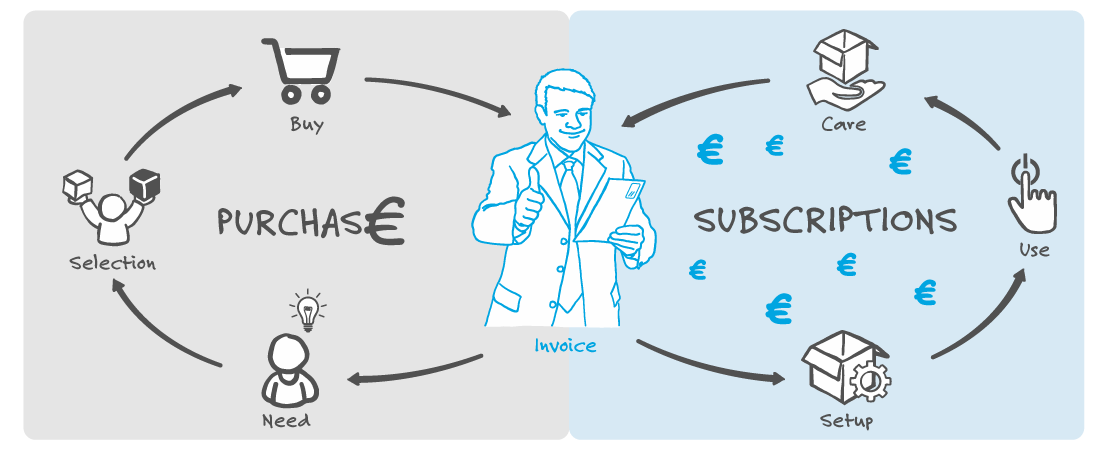
How does a subscription management solution work?
The subscription management solutions of the providers on the market differ in various respects. Nevertheless, they all offer the following central functions:
Collect usage data for correct invoicing
For digital services, the data relevant to billing, centrally, because they are the basis for the Invoicing. To do this, it is important to know the interfaces to the systems that provide this data.
Price calculation and rating
Prices are calculated depending on the customer's contract. In order to offer customers the best possible service, it makes sense to Tariffs as simple and individual as possible and store them accordingly in the billing system.
Billing and invoicing
The invoice run and the creation of the Invoice document are depending on the contractsuch as tariff, payment method and payment period. This is where market-specific requirements arise, such as currency conversion (multicurrency). There is also additional information on the invoice, such as the term or quantities.
Market-specific customs and tax calculation
Depending on the product, customer and market Different tax rates and tax rules apply. Customs duties must also be taken into account for cross-border sales - as in the case of the Amazon example.
Dunning and receivables management
There are different Make dunning levels flexibly configurable and provide reports to be able to.
Payment with common and modern payment methods
Customers today want Various payment methods use - from Credit card, Paypal and mobile payment. Here, too, it is important to identify the interfaces to various Payment providers to be able to connect.
The example of Amazon shows that even experienced companies can be successful when it comes to digital services. Pitfalls in invoicing experience. Modern and powerful subscription management solutions bring "out of the box" Functions for the invoicing of digital services and thus make efficient billing possible. Your customers will thank you for it, because for them this means more flexibility and a Intuitive payment and invoicing process.
Learn more about Subscription Management
You might also be interested in these blog posts:
Subscription management: six steps to simple billing of flexible tariff models
What impact does subscription management have on the customer experience?
Sources:
[1] https://www.heise.de/ct/artikel/Rechnungs-Chaos-bei-Amazon-4333756.html