At the heart of the subscription economy is the idea that customers prefer Take out subscriptionsto use a product or service whenever they want instead of buying it. The customer concludes a contract for a specific or indefinite period and can use a service from the provider in return. The subscription economy differs fundamentally from conventional subscription business models, such as those used by fitness studios and mobile phone providers1. At the heart of the subscription economy is the customer benefit, which in this model consists not only of the actual product, but also of the mostly context-related and individual valuethat a user actually experiences2. In the subscription economy, business models are viewed far more comprehensively than in a pure purchase transaction.
The subscription economy is leading to a change in the rules of the game and therefore also to new success factors. Five aspects that favor the successful introduction of a subscription model are described below.
Subscription Economy - customers take center stage
The Subscription Economy is driving the fundamental shift towards a result-oriented and customer-centered perspective. A customer-centric approach means that both during the purchasing process and afterwards during use, the customer is specifically addressed and learned from their behavior. This goes far beyond the mere development and sale of a product. Customers do not purchase a product once, but pay for its use on a regular basis. This means that the provider is in constant contact with the customer and can thus Constantly optimizing customer benefits. This enables them to put together a step-by-step offer that optimally reflects the needs of their customers. Consequently, a key to growth for such companies lies in the successful Development and provision of multi-channel experiences and serviceswhich are continuously improved over time and tailored to customer needs.
Subscription Economy contributes to customer loyalty
The customer's flexibility to cancel the subscription at any time means that companies are required to provide customers with a consistently high level of service. Under these conditions, the service offered must be continuously and sustainably expanded3. After customer acquisition and the initial conclusion of the contract, this ensures the Successful customer retention. It is important to provide a wide range of products and services and to continuously identify customer needs. Based on this, the products or services are continuously developed further4. A wrong decision can quickly lead to far-reaching consequences, possibly to Cancellation of the subscriptionlead. Netflix was harshly criticized in the USA for its own production "Cuties". Before the film was released, a petition was called for, which was ultimately signed over a million times. Even US senators called for the film not to be released. After its release, the hashtag #CancelNetflix was at times the most discussed topic on Twitter5.
Innovation as a service in the subscription economy
As a result, it is important that Innovation continuously promoted and driven forward. Innovation "as a service" can be used for this purpose. This describes innovation as a continuous process whereby a product or service is continuously improved in short cycles through new findings and an innovation is incorporated into the end product as quickly as possible in order to increase its benefits. Large, extensive product releases and contracts with long terms, which the customer cannot terminate early, therefore do not meet the requirements of a subscription economy. Customer loyalty should be ensured by Continuous further development of the product and the Direct implementation of new functions be promoted. The Close linking of research and development with go-to-market teams is an important prerequisite for analyzing customer needs and ensuring the delivery of new value-generating functions. The go-to-market team identifies and represents the interests of customers and the sales team to the product manager in order to directly drive the further development of the product6. Accordingly, a dynamic, closely collaborating internal organization with rapid information flows and consequently a fast "time-to-market" to create a Competitive advantage contribute to a competitive edge.
Subscription Economy relies on sustainable pricing
In contrast to opportunistic pricing, the subscription economy is based on sustainable pricing. Opportunistic pricing is competition-oriented. A company raises or lowers its prices depending on the competitor's price. The aim of these price changes is to wrest a market share from the competition. The opportunistic pricing strategy is primarily used in markets with high competition, price-sensitive customers and few opportunities for product differentiation. Subscription providers, on the other hand, aim to prevent price wars and downward price spirals through a Personalization of the offer to circumvent this. Subscription prices are not set according to a competitive approach, but according to the Level of customer benefit must be measured. The price must not be set too high so that customers would cancel their contract as a result or the acquisition of new customers would be made more difficult. To achieve this, a Mature product or service catalog and the customer should be made aware of the specific benefits. The price should be set in such a way that the company does not make a loss and is affordable for the customer at the same time. When using the subscription economy, companies are expected to achieve an actual increase in value without increasing the price7. Market research shows that the majority of customers prefer a Choice between different variants and that three gradations are best suited for this. The majority of customers choose the middle one.
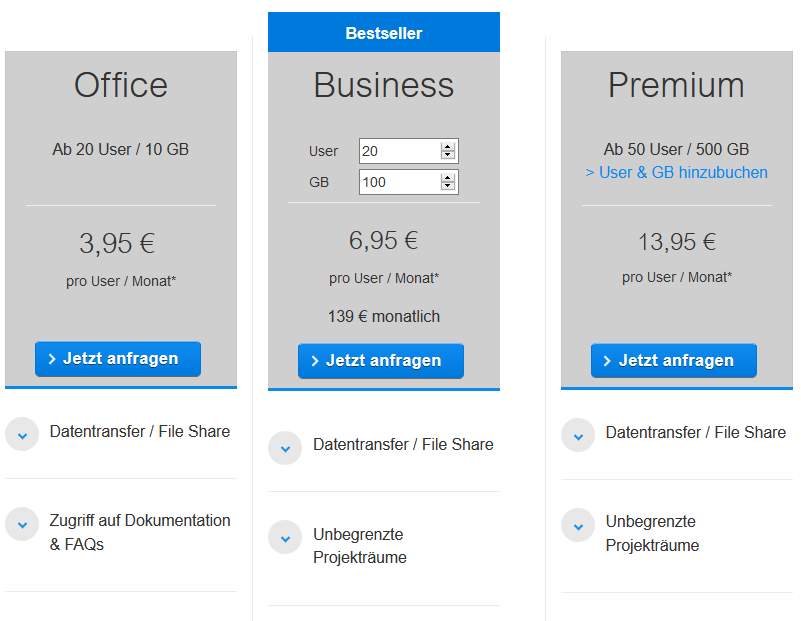
When creating the tiered price offer, it is essential to create the incentives for customers to switch to a to switch to a higher-quality offer. As digital subscription models have low variable costs, the price depends on the customer benefit. Annual payment intervals are suitable for many companies because they have a regular income. However, this changes the customer's purchasing decision from a spontaneous, small service to a well-considered purchase, which reduces the likelihood of concluding a contract8. A study by Zuora has shown that companies achieve an average growth of 8 percent in the first year after introducing usage-based billing. Currently, the greatest growth is achieved when between one and 50 percent of revenue is usage-based. The Subscription Economy provides for the greatest growth to be achieved through a Achievement of 100 percent usage-based sales is achieved. To achieve this, it is necessary to focus on the customer lifetime value, i.e. the value that a customer has for a company and will have in the future, when calculating revenue9, instead of the contribution margin10.
Changing requirements for the IT landscape due to ongoing subscription adjustments
One of the fundamental changes in the market is the desire of customers to have more flexibility. With the introduction of a subscription economy, customers can independently adapt their subscription to their individual needs. This trend is becoming increasingly apparent. The number of changes per subscription has doubled from 0.3 to 0.6 since 2016. For this reason, the processes, systems and the entire IT landscape must be designed in such a way that they can be easily adapted to the needs of the customer. New tariff or price models can be adapted. The aim must be for the customer to be able to make changes without bureaucratic obstacles11.
Better customer service thanks to Subscription Economy
The subscription economy is based on the fact that customers want added value. Using the service should be as easy and convenient as possible. The subscription economy therefore expects more than just standard customer service, which currently consists largely of contact forms and telephone hotlines. It is also about offering a Customer Success Team which implements an explicit customer success strategy operationally through targeted measures. Some of these measures are described below12.
- Transparent, friendly communication is elementary. This requires the company to be aware of all the functions and limitations of the product or service. Criticism and Requests for improvement should be seen as an opportunity to grow. Praise and positive reviews can be used for customer acquisition.
- The User Experience and usability should be implemented at a high level throughout. At certain points, tool tips or other information such as achievements or benefits should be highlighted. However, the customer should not be overwhelmed with too much information, as this can appear dubious and intrusive.
- Through the Automation of processes the customer experience can be sustainably shaped. To this end, emails can be generated and sent to customer groups via distribution lists. In addition, pop-ups can be displayed automatically, offering the customer valuable information during the course of a process. The customer's reaction to this, for example, unsubscribing from the email newsletter or clicking on a pop-up window, can Usage behavior analyzed to be Suitable answers and assistance to generate.
- Basically, it makes sense, Analyze usage data or evaluate customer reviews. The results provide important insights that help to improve the customer experience. For example, a mobile view can be offered for the website if the data analyses show that many customers access the website using their smartphones.
- One of the most important measures of the customer success strategy is the Customer survey. To this end, telephone surveys can be conducted to better understand customer needs, ask contextual questions, improve existing processes and identify new functions13.
Conclusion
Subscription-based business models offer a win-win situationfor both consumers and providers. The advantages for customers are, for example, that they have more control over their subscription, a easier access to innovations and at the same time a Lower investment risk have. A Subscription offers a high degree of flexibility and requires no initial investment to use. Different services can be added quickly and easily depending on the circumstances. The use of the product can be efficiently adapted to user behavior, thus avoiding wastage.
One of the main advantages for a company with a subscription model is the Predictability of demandwhat the Production planning both simplified and more cost-effective. If a company operates a stable subscription business model, revenue can be forecast up to a year in advance. predicted based on the number of subscribers. Especially as it is often already known exactly how much has been sold. Furthermore, the constant customer contact a great advantage, because it offers many opportunities to Extend the customer lifecycle. Once a customer has become enthusiastic about a product, flexible upgrade/downgrade paths and optional add-on products can be used to retain them for a long time and maximize their sales. Through constant interaction with the customer, a subscription provider receives active feedback as well as Data-based insights into user behavior and can thus further optimize the products. Shareholders and investors also appear to be very pleased with the trend towards the subscription economy. This is reflected in their tendency to invest in subscription providers, as they have comparatively high profit margins, robust cash flows and enormous potential for scaling.
Switching to or starting with a subscription model is always worthwhile and with the factors mentioned above, one or two mistakes can be avoided and success can be better planned.