This opens up a huge playground and a huge learning field for car manufacturers, suppliers and software developers. They need to learn how personalized features work in the market, which existing business models are reinventing themselves and how this opens up new customer segments.
The parallels with the smartphone are obvious: The vehicle is becoming the hardware basis for software providers. The specific range of functions and added value are shifting more and more towards software-driven applications and services.
There are essentially three areas in which software will determine what happens in cars in the future:
- Advanced Driver Assistance Systems (ADAS), which mostly serve to improve safety and pave the way towards autonomous driving.
- Infotainment applications or those that turn the vehicle into a mobile office.
- Apps that offer further added value, such as the digital key, bookable services and functions or applications in the extended area of e-commerce.
For example, it is possible to buy and pay for more powerful engines, seat heating, brake assistance systems and digital services on demand or by subscription - regardless of the initial vehicle configuration. And all of this directly in the "vehicle app store", as we know it from our smartphones.
Experts assume that other software-supported services will boom as soon as highly automated driving (level 3) and fully automated driving (level 4) become suitable for mass use. This is because when control is transferred to the vehicle, it is not only advanced assistance systems that are required. The driver will be able to use various systems in the car, for example for entertainment purposes or to make life easier in other ways. For example, automatic billing systems for tolls, parking fees or e-filling stations. Or individualized navigation services that are based on personal preferences - independent of the vehicle.
Central element in the vehicle of the future: personal services
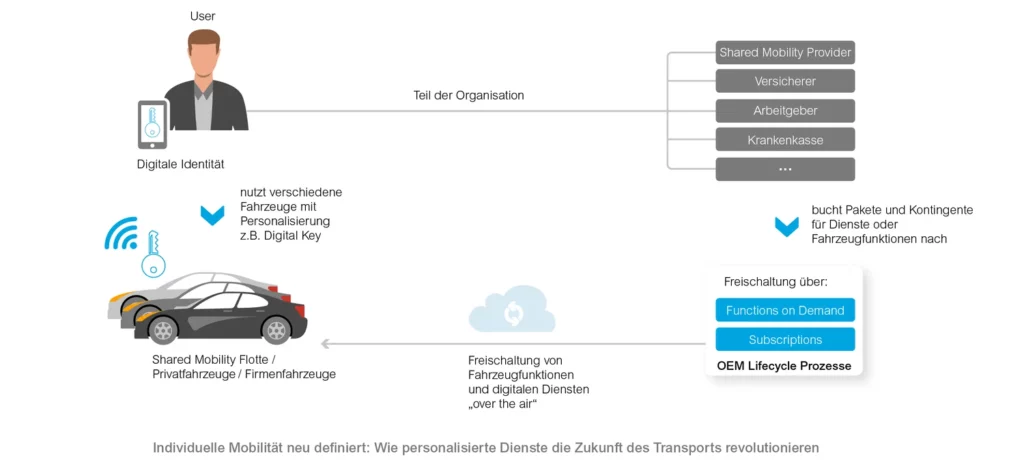
It is already becoming apparent that many digital services will no longer be linked to the vehicle in future, but to the person using it. In concrete terms, this means that personalized services will be available to the user in any vehicle from the same manufacturer. This has the advantage that all services and settings booked for a private vehicle can also be used in shared mobility or fleet vehicles.
But how can this flexibility be realized in practice? The prerequisite for this is a unique digital identity. One possible example is the digital vehicle key, which not only serves as a door opener for your own vehicle, but also enables new personalized mobility concepts through the secure and fast creation and sharing of a key.
Behind what at first glance appears to be the "simple service" of the digital vehicle key, several business models can arise for customers. The possibility of parameterizing the digital vehicle key, e.g. a time limit on its validity, means that the duration of a booked service can be defined in addition to the security aspect. The digital vehicle key is therefore a potential enabler for personalized business models - but just one example of many:
A car insurance company finds that an activated emergency brake assistant or parking assistant reduces the number of rear-end collisions or parking accidents. This is why there is great interest in offering their policyholders this feature free of charge. The reduced risk of accidents increases the safety of policyholders and saves the insurance company money. A classic win-win situation.
An employer has a booked contingent of temporary Level 3 or Level 4 packages (see above) in its fleet, which it makes available to its employees for business trips. This increases productivity, safety and comfort.
Personalized services will also enhance the used car market. When buying a used car in the future, the digital identity of the buyer will determine what their next vehicle can do, as this will be determined by the individually compiled service portfolio. All of this, of course, within the framework of the vehicle's hardware equipment.
The speed of learning and adaptation determines competitiveness
Services and entire service areas such as the personalization of mobility services or the creation of digital identities are the basis for both existing and future business models. It is now important for OEMs to learn quickly and precisely from today's usage cycles in order to remain competitive in the future. This is done, among other things, through data-driven analyses of user behavior in order to better identify the customer wishes of the future - e.g. with the help of product analytics.
Those who focus on digital services and drive personalization as well as being flexible, adaptive and open to new business models will play a strong role in the automotive market in the future.
Authors: Manuel Teufel & Markus Beller
Find out more about Connected Mobility