The future of mobility will be significantly shaped by software, and renowned companies such as the ZF Group, Continental, Microsoft, Karakun and Toyota have joined forces to shape the future of mobility. Open Technology Platform for Software Defined Vehicles (SDV) of the future. Their goal: to develop software that will power the vehicles of tomorrow.
Their focus goes far beyond the mere end product of software - they are also heavily involved in the development of software that supports the development process and prototyping. How does the Software Defined Vehicle Group go about this and which projects have already been implemented? Find out in this blog post!
Vision, goals and measures of the Software Defined Vehicle Group
The Software Defined Vehicle Group has the vision of providing open source software as efficient components and frameworks for different hardware. It relies on open standards and a strong community spirit to bring together experts from different areas. The aim is to unite these fragments and use them to build the ecosystem of the Software Defined Vehicle in a "code-first" approach.
Special attention is paid to:
- Microcontroller frameworks
- Operating systems
- Middleware
- Cloud-based solutions to manage vehicles and their software
Together, they have defined various measures to achieve their goals, including providing open source solutions, supporting the "code-first" approach and defining compatibility rules and branding processes. Promoting integration into various developer toolchains and community support, creating a user-friendly platform, strengthening the brand and communicating with other open source communities also play a central role.
The Software Defined Vehicle Group has already Projects have been launched, all of which are still in an alpha phase or have not yet had an official release. But what are the goals of the projects and what exactly do they look like? We present five of these projects below:
ADAAA - ZF
With this project, ZF would like to gain experience in the integration of a Adaptive Cruise Control about AUTOSAR interface share. From their point of view, the integration of an application via AUTOSAR is very tedious and strenuous, which is why they would like to publish several example applications in the future.
Using the ADAAA, they have created a demo of how they can manipulate the speed of a vehicle via the interface and then record these results.
Chariott - Microsoft
Eclipse Chariott is a Microsoft project that aims to increase the efficiency of software developers in the automotive industry. It provides a metadata-driven middleware and abstraction layer that enables access to vehicle hardware and sensors via modern application programming models.
This innovative approach enables automakers, partners and software providers to continuously develop and deliver new software functions, features and services for vehicles without the need for extensive re-architecture. The metadata-driven middleware/abstraction model creates a common way to access vehicle resources and is being adopted across the industry to streamline development work. It provides a user-friendly service interface for third-party software developers to access vehicle services and functions.
eCAL - Continental
eCAL is a high-performance publish-subscribe middleware that supports inter-procedural and cross-host data exchange. It has a clear GUI as well as a CLI.
The principle behind it is very simple. There is the eCAL Process (or eCAL node) that receives or consumes messages, which is either an executable or a script. The messages are not sent directly from the eCAL Process to the recipients, but are instead published as an eCAL Topic. As is usual in messaging, an eCAL topic is defined by a unique name and is then issued to all subscriber processes. The publishers and subscribers know nothing about each other.
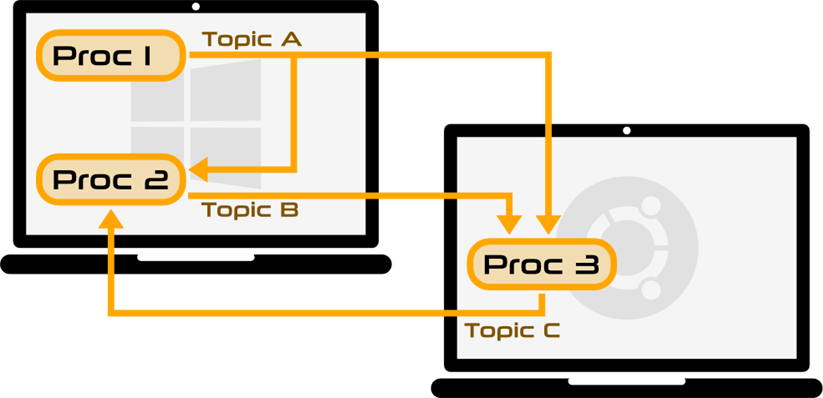
You can see the behavior very clearly in the picture: Proc 1 sends a Topic A, which is subscribed to by Proc 2 on the same machine and by Proc 3 on a different machine. Proc 2 publishes a Topic B that Proc 3 has subscribed to and Proc 3 publishes a Topic C that Proc 2 has subscribed to.
Unlike MQTT brokers, eCAL is decentralized and does not require a central component for messaging.
eCAL also has a recorder and player. The recorder can record all topics that are generated during recording and saves them in a file. The player can then replay the recorded topics so that each message can be run through again during debugging. The messages can be viewed via the monitor. The player also allows you to pause and continue step by step. For example, published images from the camera in the vehicle can be viewed step by step.
However, the developers state that this tool is only installed in prototype vehicles and is not used in the end product.
KUKSA
One of the main features of KUKSA is the abstraction of vehicle data and interfaces to a common format that is based, for example, on the vehicle signal specification.
In this way, all functions based on KUKSA can be executed on all approved vehicles. KUKSA focuses on adapting different vehicle interfaces into a basic base interface using simple APIs. This makes it easier to add an independent onboard or offboard tech stack to new vehicle architectures.
SommR
Eclipse SommR provides an automotive-grade implementation of the someIP specification for embedded Linux systems along with the necessary tools to support developers.
Eclipse SommR promotes interoperability between EUCs (Electronic Control Units) and helps developers to focus on application development in less time. In contrast to existing solutions, Eclipse SommR is language-independent.
Conclusion
The Software Defined Vehicle Group is in the process of setting good standards and developing very helpful tools for the community. Well-known names as well as car manufacturers are represented in the group and are in the process of creating something big.
The group offers interesting fields and is also of interest to doubleSlash - we will continue to keep an eye on it. There may also be opportunities for collaboration in the future if we want to operate in similar areas or even provide our own software.