
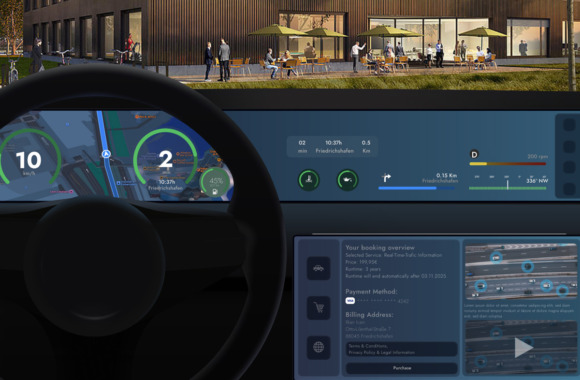
Over the last 10 years, the automotive industry has undergone a significant technological transformation. Car manufacturers and their vehicles are no longer differentiated by the classic fuel drive or by their engine performance, but by their level of connectivity, new innovations, modern designs and comfort for the occupants. The Software Defined Vehicle and its services have become a benchmark by which today's innovation and progress are measured. Car manufacturers are focusing on making the in-vehicle experience as seamless as possible for drivers and passengers. The COVID-19 pandemic has proven to be a catalyst for the growth of software-based technological advances such as in-vehicle payment solutions. Payment methods and options, which became a key issue especially during COVID times, have changed significantly in recent years. Conventional cash has been replaced by cashless EC and/or credit card solutions. Nowadays, we use the credit or debit card in our smartphone or in smart devices via Apple and Google Pay. Paying quickly with a smartphone or smartwatch is not only convenient for the user, but also efficient and connected. No more bulky wallets, searching for small change or searching through large pockets for the right amount in the queue. The vehicle as a software-defined vehicle should be no exception. The central point is to create a digital experience for the customer not only in the vehicle, but also in the environment around the vehicle.
New sources of income through IVP
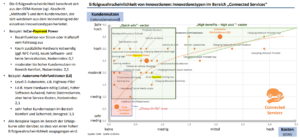
From a business perspective, in-vehicle payment (IVP) opens up new sources of revenue for OEMs, dealers and payment intermediaries. In addition, new innovative and smart connected features offer added value that improves the customer experience in the vehicle and makes the vehicle even more intelligent as an everyday companion. The added value is that payment for a service becomes faster, more convenient and more efficient. The Juniper Research study estimates the business value of in-vehicle payment use cases at up to 86 billion euros, making it a lucrative innovation from a business perspective. The aforementioned business value represents the value that can be created not only by this business area, but is also made up of commercial value, market position, increased efficiency, customer benefits and future value. These are underlined by the collected results from this year's Connected Car Innovation (CCI) study. The CCI study classifies the innovation as a "quick win".
What is the advantage of payment in the software-defined vehicle?
Central Pains without payment in the vehicle
- The process of manually paying for charging, parking and refueling is cumbersome.
- Manual payment takes time (queues or slow staff).
- Manual payment requires cash, debit or credit card or a payment-enabled smartphone.
- The potential in the vehicle as a software-defined vehicle is not being exploited.
- The environment in the vehicle and its use cases are inefficient and do not correspond to the digital experience of the software-defined vehicle.
Central Gains with payment in the vehicle
- The user does not waste time in the queue.
- The user no longer has to leave the vehicle to pay.
- The user has a digital and convenient experience.
- Paying directly in the vehicle makes the transaction quick and efficient.
- The user only needs the vehicle, no smartphone, no EC card, no other smart devices.
- The user does not need to carry cash.
- Charging and billing take place automatically via the Internet.
- Invoice can be retrieved directly by email/in the app (no loss of invoice).
- B2B cooperation opportunities.
In-Vehicle Payment Use Cases
We have looked at a few key use cases for in-vehicle payment:
The fuel payment:
Paying for fuel via the infotainment system in the dashboard will become the most common use case for in-vehicle payment. In-Vehicle Payment users can select any fuel pump directly in the vehicle, fill up with fuel and pay for the amount of fuel filled up via the platform provided by their payment provider. Fuel payment is one of the most popular use cases and is already being promoted by Mercedes-Benz.

Intelligent parking:
Intelligent parking combines the existing technology of finding a parking space using a digital service and paying for it after parking via the head unit in the vehicle. The idea is to bundle several providers generically so that the same process can always be used regardless of the provider. This offers the advantage of a single registration process in the vehicle and the user saves having to manage multiple accounts for different providers (ParkNow, etc.).
The function-on-demand service booking:
Function-on-Demand (FoD) services are features and functions that are activated in the vehicle via over-the-air updates (using mobile data from the mobile network). The required hardware is available in the standard vehicle. A so-called store app in the vehicle gives the user the flexibility to book an FoD service at any time via the head unit in the vehicle.

New standard: in-vehicle payment
In-vehicle payment is an innovation that generates positive customer benefits. The use cases of refueling, charging, parking and digital services offer a new digital experience inside and outside the vehicle. We assume that in-vehicle payment will become a new standard in the field of connected mobility and are excited to see what other future cases await us.
In the next part of the series, we will take a closer look at the framework conditions and the enablement of payment in the vehicle.
________________________________________________________________________
Are you interested in the topic of connected mobility and looking for an exciting and challenging thesis?
Apply here now: Bachelor's/Master's thesis
Sources:
CCAF, World Bank and World Economic Forum (2020): The Global Covid-19 FinTech Market Rapid Assessment Report. Available online at https://www3.weforum.org/docs/WEF_The_Global_Covid19_FinTech_Market_Rapid_Assessment_Study_2020.pdf, last checked on 29.11.2022.
Fueling the Connected Car Economy (2022). Available online at https://www.jpmorgan.com/solutions/treasury-payments/insights/fueling-the-connected-car-economy?source=wp_di_jp_Mobility0522, last updated on 28.11.2022, last checked on 29.11.2022.
Harshada Thok (2021): In-Vehicle Payments Resolving Fragmentation. Available online at https://www.juniperresearch.com/document-library/white-papers/in-vehicle-payments-resolving-fragmentation, last checked on 29.11.2022.
Mercedes-Benz Mobility AG (2022): In-car payment by using your fingerprint | Mercedes-Benz Mobility AG. Available online at https://www.mercedes-benz-mobility.com/en/what-we-do/payment-services/in-car-payment/, last updated on 29.11.2022, last checked on 29.11.2022.
Stefan Bratzel, Ralf Tellermann (2022): Connected Car Innovation Study 2022, with the collaboration of Jonathan Bar-Hod. Edited by Felix Böbber. Center of Automotive Management (CAM.