The Gaia-X project was launched to resolve these dependencies and create a secure, open and sovereign alternative for European companies. [1]
What is Gaia-X and how does it help us?
The aim of Gaia-X is to create a platform for the exchange of data that is independent of China and the USA. To this end, secure and open interfaces and standards for the aggregation of data are being developed. The central focus here is on safeguarding the privacy and human rights of all EU citizens and ensuring the independence of nations within the EU [1].
Or as the Federal Ministry for Economic Affairs and Energy (BMWi) puts it: "The goal is a secure and networked data infrastructure that meets the highest standards of digital sovereignty and promotes innovation" [2].
Such a platform should strengthen trust in European data infrastructures and consolidate the transparency and attractiveness of digital services.
Who is involved in Gaia-X?
In principle, Gaia-X distinguishes between two main players: the users and the providers. Providers could, for example, be one or more banks that offer interfaces for account information. These interfaces could then be accessed by an app developer (in this case the user), who bundles and displays account data from various banks for the end user in their smartphone app.
The first important goal for users is to identify and define relevant use cases. It has been established that use cases from different domains pose the same challenges and that cross-domain solutions can therefore be created [1]. Additional requirements should be developed based on the relevant domain and the associated use cases. For example, there are working groups for the domains of mobility, finance & insurance or the healthcare system to define the requirements there.
With projects that are implemented and provided by one or a few companies, there is always a strong link to the operation and stability of the respective companies. In contrast, this is no longer the case with Gaia-X. Here, the most important feature of the providers is that they are an orchestration of different providers. In other words, the providers all jointly provide the infrastructural ecosystem for the users. This means that all providers are responsible for the operation of their infrastructure components and the stability of the infrastructure is no longer dependent on the operation of one or a few individual companies.
The providers for this infrastructure can consist of regional providers, hyperscalers or network and internet providers. This creates an infrastructure with many operational managers.
Federation Services
The Federation Services are the core elements from which Gaia-X is to be assembled. They contain the minimum technical requirements and services for the operation of Gaia-X. All services that are developed in the course of the first iteration are to be made available as open source.
One of these services, for example, will be Gaia-X's identity management, which is to be implemented as a decentralized solution. This includes mechanisms such as "Trust Over IP" or "Self-Sovereign Identity (SSI)" based authentication and authorization mechanisms. SSI can be thought of as an infrastructure consisting of a group of organizations, institutions or governments. Together, these form a decentralized network in which data is replicated at many locations in order to keep errors and failures to a minimum [3, p.9]. This makes a decentralized authentication solution possible. A popular example of such a decentralized infrastructure is the cryptocurrency Bitcoin.
Organizational structure of Gaia-X
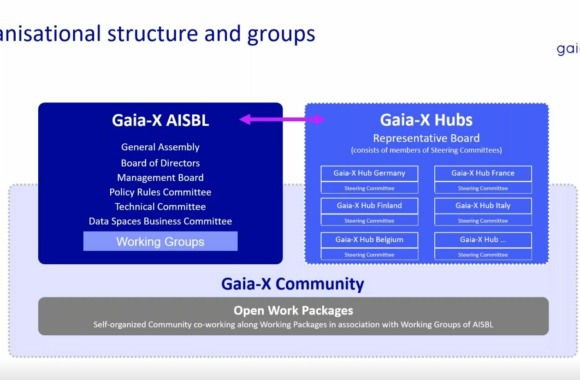
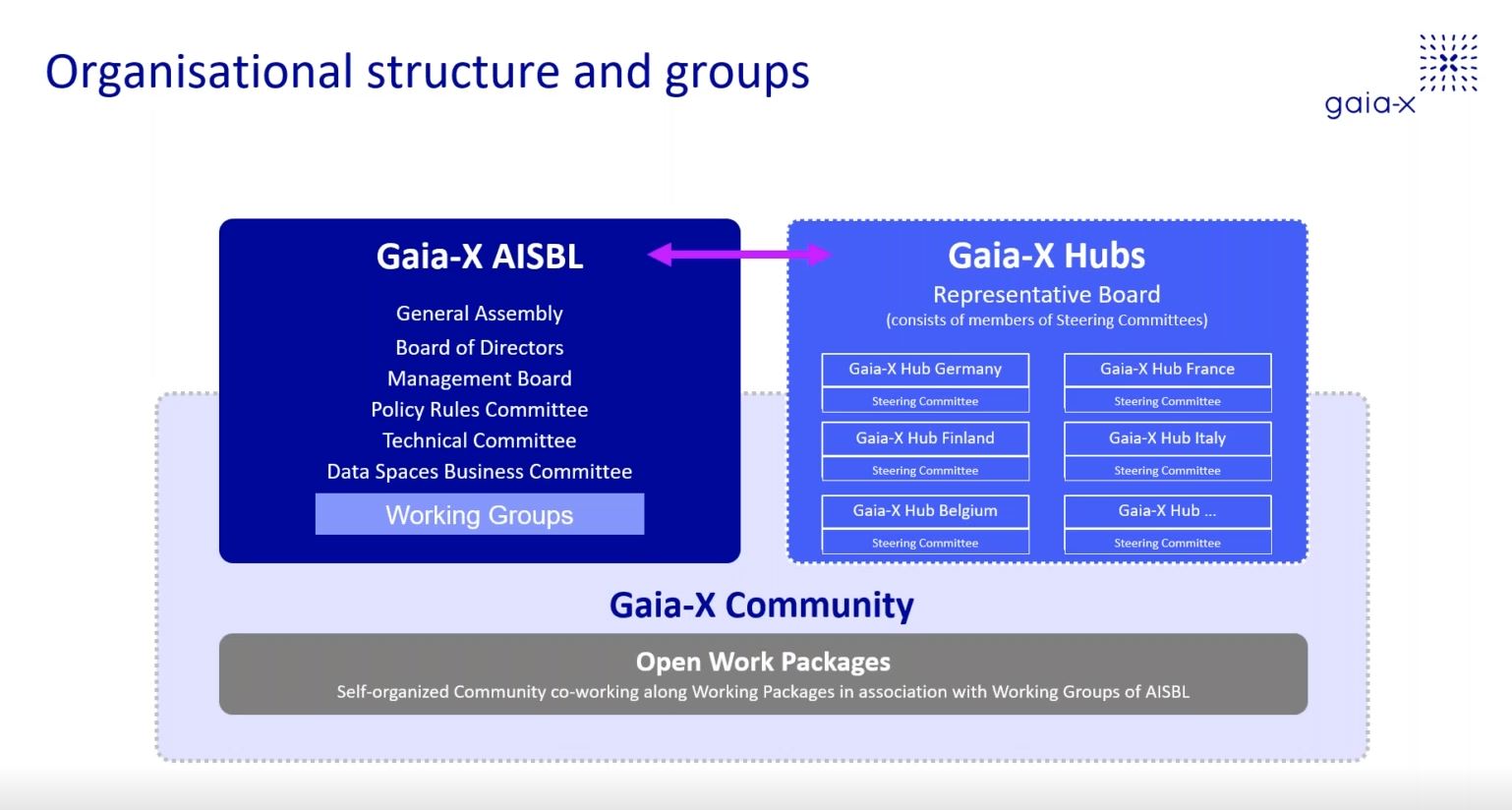
The organizational structure of Gaia-X is divided into three groups: Gaia-X AISBL, Gaia-X Hubs and Gaia-X Community.
Gaia-X AISBL
The Gaia-X AISBL (Association internationale sans but lucratif, under Belgian law [4]) is the organizational layer of Gaia-X. This group consists of various committees and the management (see Figure 1). No code is developed there, only the organizational work is done. This includes, among other things, the definition and delivery of basic principles and standards for development.
Gaia-X Hubs
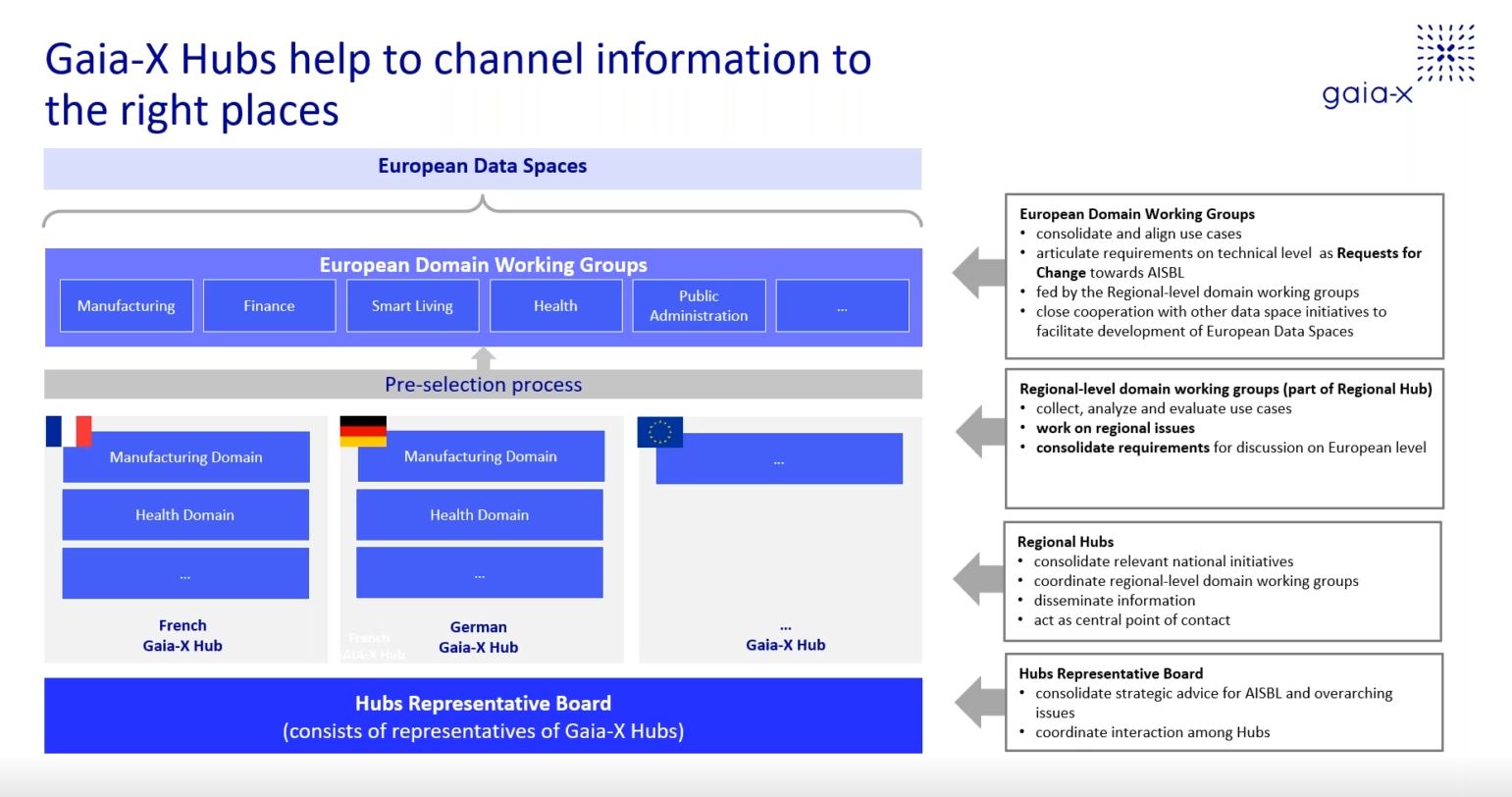
The hubs are divided among the participating countries. There is therefore one hub each for Germany, France, Austria and all other countries participating in the project. National interests are collected there and these are processed in cooperation with the other hubs as so-called "Domain Working Groups" in order to define the required data spaces.
Gaia-X Community
The last group is summarized as the Gaia-X community. This is where the actual development work is done and code is written that is necessary to get the Gaia-X project running. The work packages are coordinated in close communication with the Gaia-X AISBL.
Gaia-X Roadmap
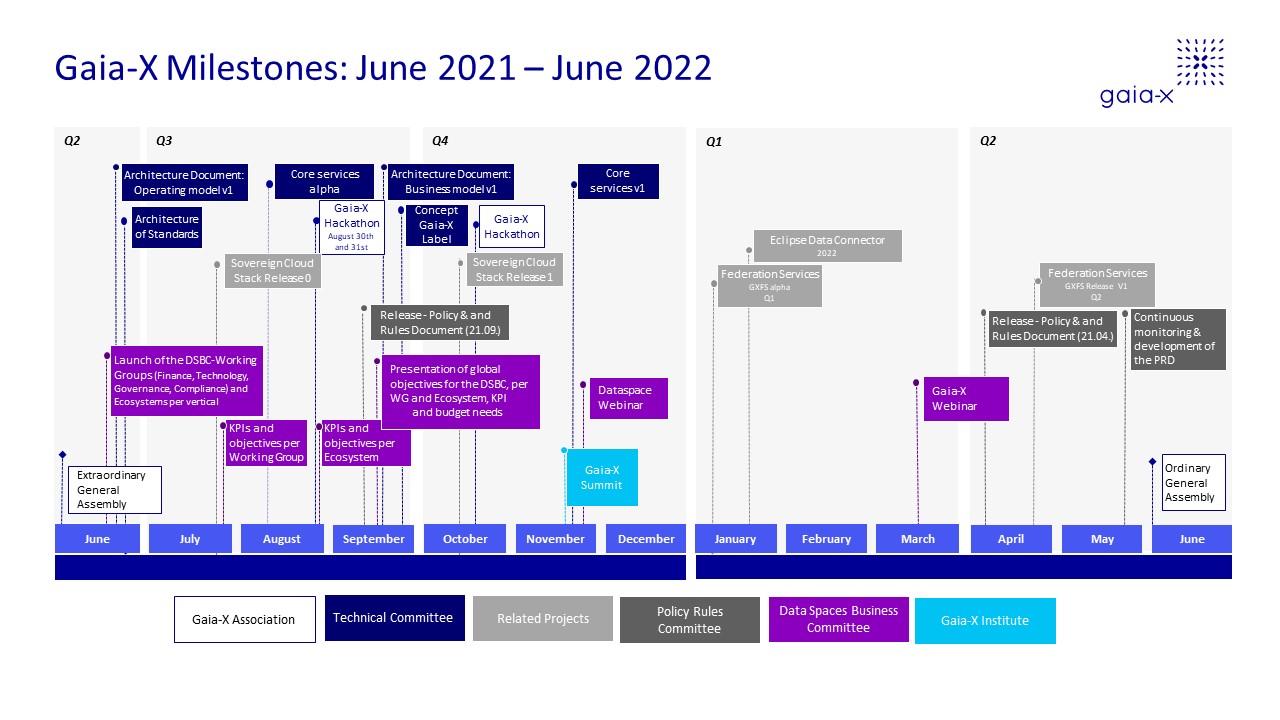
Last but not least, there is an outlook based on the roadmap for 2021.
Conclusion
So far, much of the planned infrastructure is still theoretical. The next major goal is to implement the alpha version of Federation Services as an open source solution by the end of 2021 and to start operating it. It should then be possible to use this as a data exchange platform. This will show the extent to which a solution for sovereign, secure and open data exchange can work in a European community and whether it has the potential to compete with large hyperscalers such as Amazon and Google.
Sources
[1] Gaia-X Information Web Seminar, Accessed on 06.09.2021 https://register.gotowebinar.com/register/3435279358674077197
[2] Federal Ministry for Economic Affairs and Energy, accessed on 06.09.2021 https://www.bmwi.de/Redaktion/DE/Dossier/gaia-x.html
[3] Tobin, A., & Reed, D. (2016). The inevitable rise of self-sovereign identity. The Sovrin Foundation, 29(2016).
[4] Non-profit association, accessed on 06.09.2021 https://de.wikipedia.org/wiki/Vereinigung_ohne_Gewinnerzielungsabsicht
[5] Gaia-X Update July 2021, accessed on 21.10.2021
https://gaia-x.eu/news/gaia-x-update-july-2021