

Why is the topic Blockchain and cryptocurrency are currently hotly debated in many IT projects and on websites - but at the same time neither traditional payment providers nor banks offer a service based on cryptocurrencies?
One of the largest payment providers in the world, Stripe, provides an answer to this question: Stripe is an online payment service that was founded in the USA in 2009 by brothers Patrick and John Collison. In 2014, Stripe was the first major payment company to support Bitcoin payments. However, after four years, the processing of Bitcoin transactions was discontinued in April 2018.
Blockchain practical knowledge this way
The reason for this decision? Stripe hoped that paying with cryptocurrency would help customers to enable payments in geographical areas where credit card and bank payment settlements are generally impossible or very difficult.
The demise of Bitcoin payments
However, Bitcoin has not developed into a medium of exchange, but has mutated into an asset or speculative object and is therefore rather unsuitable as a means of payment.
On top of this came a number of other functions that finalized the decision to abolish Bitcoin payments, such as the confirmation time of a transaction. As the transaction time increased, so did the error rate of transactions. By the time a transaction was finally confirmed, the price of the currency had often already changed. The result was the booking of "incorrect amounts". This led to large losses, especially in high-speed trading.
Transaction costs have also risen sharply in recent years, putting them on a par with regular bank transfers.
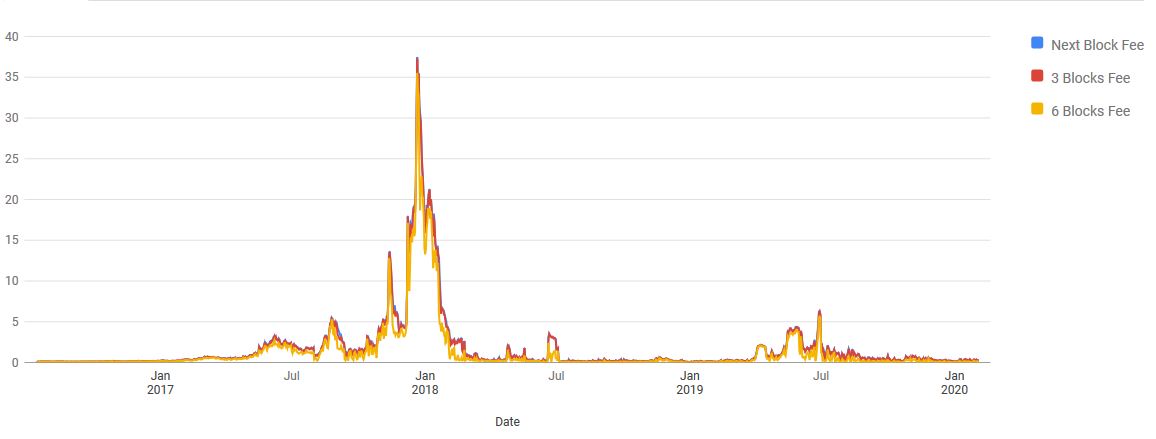
Stripe not only observed a decline in transaction volumes, but also a reduction in the number of companies accepting Bitcoin payments. Bitcoin payments were then completely discontinued on April 23, 2018.1
The alternative: stable coins
But what do other global players and experts think about Bitcoin and cryptocurrencies? IBM sees potential in blockchain technology and points to its success in the areas of supply chain, cross-border transactions and identity verification. In particular, the immutability of the blockchain without regulation of the mechanism makes business processes faster and less complicated.2 The use of blockchain technology also promises users a high level of security.3 This is extremely important when processing sensitive data, such as money transactions.
IBM is also working on the development of a "stable coin", which will avoid high volatility and serve as a practical transaction mechanism.4 In contrast to Bitcoin, stable coins are linked to a different asset. In the case of Facebook's cryptocurrency "Libra", these currencies are the US dollar, euro, yen, British pound and the Singapore dollar.
The German government's attitude towards cryptocurrencies is generally positive, but it rejects a stable coin. One reason for this is the assumption that stable coins from larger companies could compete with the euro. A notorious fear, if you look at Facebook, for example, with its own stable coin and its more than 2 billion users. Politicians and central banks also see a loss of value in handing over their tasks to corporations.5 A third argument is that even if the technology leaves little room for security gaps in theory, hacking attacks still occur frequently in practice. These are often phishing attacks or password theft in which humans are exploited as a weak point6 or DDoS attacks on such platforms, which result in high economic and reputational damage for the operators due to overloading of the hosting systems.7
In summary, it can be said that the financial world and its established players do not want to return to a time without cryptocurrency and blockchain technology. The search for possible lucrative areas of application for cryptocurrency will continue among payment service providers and investments will be made where there is the prospect of high profit potential. Despite the enormous potential of these technologies, they are still far from a perfect mechanism that will completely change the course of the global currency process.
You might also be interested in this blog post: The world in a Bitcoin frenzy
1 Cf.https://stripe.com/de/blog/ending-bitcoin-support (12.12.2019)
2 See https://fortune.com/2018/07/17/stripe-blockchain/ (12.12.2019)
3 See https://www.computerwoche.de/a/blockchain-was-ist-das,3227284 (12.12.2019)
4 See https://fortune.com/2018/11/19/blockchain-ripple-transferwise/ (12.12.2019)
5 Cf.https://www.biallo.de/geldanlage/news/stablecoin-kryptowaehrungen-reif-fuer-den-massenmarkt/ (13.12.2019)
6 Cf.https://www.it-finanzmagazin.de/sicherheitsrisiko-kryptowaehrungen-gefahr-cyberangriffe-66768/ (13.12.2019)
7 Cf.https://www.security-insider.de/was-ist-ein-ddos-angriff-a-672826/ (13.12.2019)