The DORA metrics were developed by DevOps Research and Assessment (DORA) team developed 1to make the performance of software development teams measurable. They are based on extensive research and data analysis and help to make decisions on a sound, empirical basis.
One of the four central DORA metrics is the Change Lead Time. In this article you will learn what it means, how to measure it and how you can improve it.
What are DORA metrics?
The DORA metrics originate from the research of the DevOps Research and Assessment team, which has analyzed data from thousands of software projects over the years. The aim was to identify measurable metrics that can predict the success of software development teams.
The four DORA metrics are:
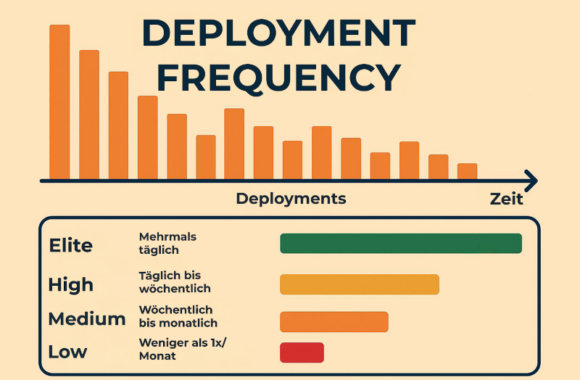
- Deployment FrequencyHow often are changes brought into production?
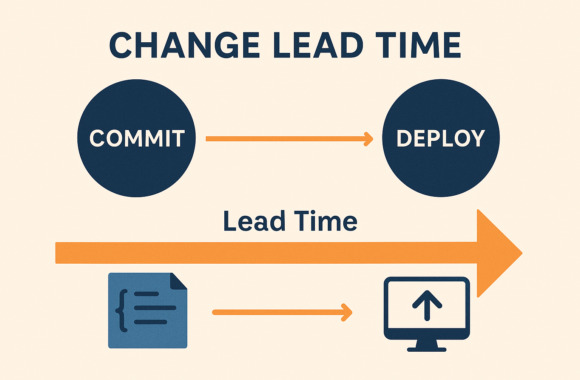
- Change Lead TimeHow long does it take from the code change to productive use?
- Change Failure RateHow often do changes lead to errors in production?
- Time to Restore ServiceHow quickly is a faulty condition rectified?
These metrics help teams to objectively evaluate and improve their development and operational processes.
Definition: Change Lead Time
The Change Lead Time measures the time span from the commit of a change in the source code to its successful deployment in production. This metric provides information on how quickly a team can react to requirements - be it through new features, bug fixes or other changes.
Meaning of the metric
A short change lead time is an indicator of efficient development processes and fast delivery. It is directly related to a team's ability to react promptly to market requirements or customer feedback.
Long lead times can indicate the following problems:
- Manual processes
- Bottlenecks in the CI/CD pipeline
- Complex review and approval processes
- Lack of automation
DORA benchmarks
DORA research distinguishes between four performance levels:
| Power level | Change Lead Time |
|---|---|
| Elite | < 1 day |
| High | 1-7 days |
| Medium | 1-4 weeks |
| Low | > 1 month |
These values serve as a guide for classifying your own processes. For self-assessment, the DORA metrics can also be compared with the DORA Quick Check and compare them with different sectors.
Measurement of change lead time
The following points in time are typically recorded to measure the change lead time:
- Commit timeWhen was the change saved in the repository?
- Deployment timeWhen was the change successfully put into production?
The difference between these points in time is the lead time. Tools such as GitHub, GitLab can be used as sources of information and with tools such as Apache DevLake 2 or Keptn 3directly in DORA Metrics.
Optimization options
The following measures can help to improve the change lead time:
- Small, frequent commitsReduces complexity and accelerates reviews.
- Automated tests and deploymentsMinimizes manual steps and sources of error.
- Trunk-Based DevelopmentPromotes continuous integration.
- Feature TogglesEnable the safe roll-out of unfinished features.
- Shortening feedback cyclesFaster review and testing.
Conclusion and outlook
Change lead time is a key performance indicator for evaluating the speed and efficiency of software development teams. It offers clear starting points for process improvement and should be measured and analyzed regularly.
In the next article, we will look at deployment frequency - how often should you actually deploy?
Stay tuned - and take your DevOps performance to the next level!