
How often does your team release new features? The answer could determine the success of your software projects. The Deployment Frequency shows how regularly new features, bug fixes, or improvements are delivered.
What are DORA metrics?
The DORA metrics were developed by the DevOps Research and Assessment (DORA) team,1 to make the performance of software development teams measurable. They are based on extensive research and data analysis and help to make decisions on a sound, empirical basis.
One of the four central DORA metrics is the Deployment Frequency. In this article, you will learn what it means, how to measure it, and how you can improve it in a targeted manner.
Definition: Deployment Frequency
The Deployment Frequency Measures how often a team successfully implements changes in production. It is an indicator of the ability to continuously deliver added value and respond quickly to new requirements.
Meaning of the metric
A high Deployment Frequency stands for short release cycles and a culture of continuous improvement. It reduces the risk of large, error-prone releases and enables faster feedback loops.
A low Deployment Frequency may indicate the following problems:
- Large, rare releases with high risk
- Lack of automation in the CI/CD pipeline
- Complex approval processes
- Dependencies between teams or systems
DORA benchmarks
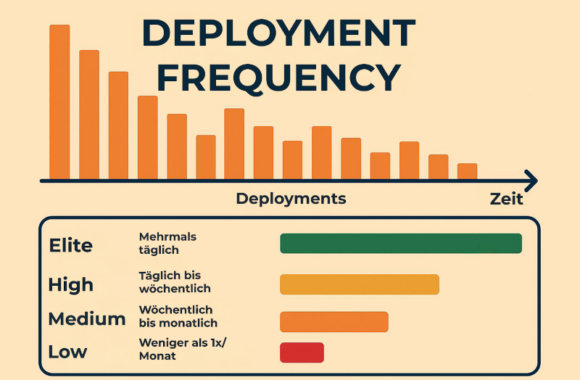
DORA research distinguishes between four performance levels:
| Power level | Deployment Frequency |
|---|---|
| Elite | Several times a day |
| High | Once a day to once a week |
| Medium | Once a week to once a month |
| Low | Less than once a month |
These values serve as a guide for classifying your own processes. For self-assessment, the DORA metrics can also be compared with the DORA Quick Check and compare them with different sectors.
Measuring deployment frequency
Deployment frequency is determined based on the number of successful deployments to production within a defined period (e.g., per day, week, or month).
The most important data sources are the CI/CD pipelines,because they automatically execute and log all deployments.
The evaluation can be carried out using the following sources:
- pipeline logs
- Deployment histories
- Metrics of the Git platform
Optimization options
The following measures can help improve deployment frequency:
- Automation of deploymentsReduces manual steps and sources of error.
- Continuous delivery or continuous deploymentIncreases frequency through automated approvals.
- Small, incremental changesMinimizes risk and simplifies testing.
- Trunk-Based Development: Promotes continuous integration and rapid delivery.
- Feature Toggles: Allow the safe rollout of unfinished features.
Conclusion and outlook
Deployment frequency is a key metric for the speed and stability of software deliveries. It helps teams reduce risks and respond more quickly to market demands. First, record your team's deployment frequency and ask yourself: What is preventing us from deploying more often and in smaller steps?
From my everyday experience, I can say that switching to trunk-based development has made our release process significantly easier and faster. This allows us to deploy more often and respond to changes more quickly.
In the next post, we will focus on Change Failure Rate – How often do changes cause problems in production?
Stay tuned - and take your DevOps performance to the next level!