
With the accompanying popularity, the term has become increasingly blurred due to its widespread use. In this article, I would like to Term "AI" in its original meaning and, on the other hand, show that "AI" is also based on well-known principles and extends them.
Strong and weak AI
Artificial intelligence can be roughly divided into two different sub-areas: strong and weak AI. The Strong AI is the dream of AI research: a program that can mental abilities in all facets such as consciousness, emotionality or creativity, for example. We are still a long way from this and we will probably have to leave the exploration of these exciting possibilities to science fiction writers.
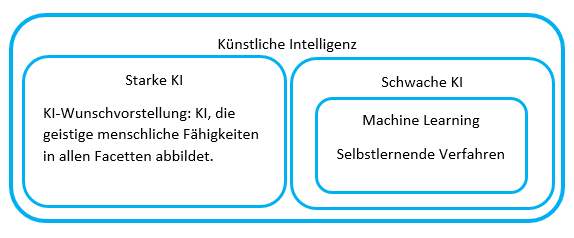
Instead, there has been impressive progress in recent years in the area of weak AI. This includes programs that clearly defined mental human abilities and today often even surpass humans in many aspects. Today, this includes practically all applications of artificial intelligence. This includes for example, the recognition of objects and faces in images, or game programs such as "AlphaGo", the AI developed by Google for the highly complex board game "Go".
AI - old wine in new bottles?
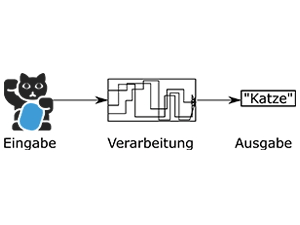
However, these revolutionary advances are based on well-known principles. For example, the EVA (input, processing, output) principle (see illustration). Image recognition, for example, uses an image as input, processes it and outputs a keyword.

Progress consists of the Type of processing, or how the processing rule is found. A processing rule here simply means a mathematical rule with which, for example, the name "cat" is generated from the image.
All problems that are solved using AI processes have one thing in common: they are too complex for a human to solve. Processing instructions can be found by hand. Therefore one uses "intelligent" algorithms, that try to automatically find the best possible rule to solve a specific problem.
Let's take another look at the example of image recognition of a cat. An image data set serves as the starting point. The existing images are additionally with keywords (e.g. "cat", "no cat"). A Machine Learning Algorithm is now trying to find a processing rule that recognizes images of cats as well as possible. The machine learning Algorithm tests iterativelywhether the Quality of the results has become better or worse. The quality of the results is measured mathematically using a so-called Target value function is expressed. To do this, the processing rule is changed slightly and the value of the target value function is calculated. If this value is smaller, the result has improved. The algorithm then performs further Targeted adjustments to achieve even better target values.
However, there is a Large number of machine learning algorithms. Depending on the application, these are differently suited to efficiently solving a specific problem.
Which machine learning algorithm fits which problem?
In the search for the best possible processing instructions, a Structured approach important:

- Problem classification
The first step is to abstract and classify the problem. Most problems can be broken down into three main categories subdivide: the prediction of numerical values (Regression), the recognition of labels (Classification) and finding similarities in data (Clustering). - Selection of the algorithm
In the next step, a suitable approach is selected from the very large number of possible machine learning algorithms. Selecting the correct algorithm is the key to success. You often work your way through from simpler approaches to more complex approaches before. This also ensures that a Comparative value exists: if a complex AI approach is not able to beat a simple model in terms of output quality, the simple model should be preferred. - Application and iteration
Finally, the algorithm is applied and the processing rule is adapted in many small steps. To do this, the existing data is simplified and divided into Training and test data set. The algorithm uses the training data set to find the best processing rule. The Quality of the resulting processing instructions with the test data set to ensure that it is generally valid.
AI - Think before you act
What you should not forget when using the respective procedures: AI is not an end in itself. You don't have to use the most complex machine learning algorithms for every application. Often, well-known, simpler methods such as Simple statistical analysis methods continue to be justified. The use of AI methods should always bring added value.
AI is often used as a very vague term. Today's use cases are clearly Delimited human mental abilities such as facial recognition. Concepts such as "consciousness" are beyond the scope of today's possibilities. The foundations of artificial intelligence are based on well-known principles such as EVA (input, processing, output). The art in the application of AI lies in the Correct processing method to choose and Only use AI when traditional methods fail.
Learn more about AI technologies
You may also be interested in these articles:
The five ultimate AI trends for the next decade
Artificial intelligence (AI) buzzword jungle - the most important terms at a glance
Sources:
[1] https://www.faz.net/aktuell/wirtschaft/diginomics/merkel-deutschland-muss-bei-kuenstlicher-intelligenz-fuehren-15920734.html