
Artificial intelligence (AI) is on everyone's lips. Some see new, previously unimagined opportunities in AI to adapt products even faster and more precisely to the needs of the people who use them. In short, artificial intelligence helps to create added value and make our lives better.
AI as a threat to human sovereignty?
The opposing view sees AI as a threat to human sovereignty and decision-making authority. If algorithms are already controlling large swathes of global financial and economic activity today, if they are being used to assess applicants for their suitability for the job to be filled, then - so the fear goes - we will soon be the assistants of computer programs. And some gloomydystopian Vision culminates in scenarios like this: A super-intelligent AI comes to the conclusion that humans, when given free rein, make too many wrong decisions. So it puts us in a kind of reservation with limited freedoms. There we may live happily, contentedly and in well-structured ways, but we are not free.
I am convinced that both points of view are justified and should be included when it comes to this, explore the possibilities associated with artificial intelligence and consciously shape its development.
Which brings us to the core of our topic: the need to control the technology so that it does not take on a life of its own. Because it will be if there are no control mechanisms. Just as all software today must comply with the law, otherwise the person who develops it is liable to prosecution, AI must also comply with legal requirements. This is precisely what was circumvented in the diesel scandal, for example. So the question is not how intelligent AI becomes through learning or programming, but how much power we give it.
Assessing the consequences of technology
Artificial intelligence is probably the Man's most important "invention" to date, because it has the most far-reaching consequences. Even the technologies of the 20th century and their effects show that much of what is technologically feasible or profitable does not necessarily make our world a better place and the earth a better place to live. It is no coincidence that the research field of technology assessment has existed since the 1960s.
Inventions and new technologies have always changed people's living conditions and therefore also their behavior. This is all the more true the more the innovations intervene in existing structures, the greater their reach and the faster they spread. Take, for example, the mobility of modern man, mass tourism, industrial food production or the internet, which is available anytime and anywhere. They have not only led to massive changes in human behavior, they are currently shaking the planet to its very foundations.
Artificial intelligence has the potential to change the way we live together and our economic and social reality far more than any technology we have seen to date. This alone is reason enough for us not to leave its development to chance, the mechanisms of the markets or the few who can create facts with immense financial resources. Rather, AI needs to be controlled by the human community, by all of us.
So what is to be done?
First of all: I am convinced that even high expectations of the The potential of AI is justified - Whether it's autonomous driving, diagnostics in medicine or achieving more efficient, better-selling products, a higher degree of automation and more efficient decision-making processes, whatever the field. All of this will come. And it is suitable for solving some of today's seemingly unsolvable problems and actually move us forward in a positive sense. Overdrawn seem to me, however, the Expectations regarding the time horizon. Even if the pace of development is rapid, we tend to underestimate the mental and cognitive performance of humans and overestimate that of machines.
In other words: In my view, it is unlikely that "the machine" will have more practical intelligence and therefore make better decisions than humans in every situation in the next 50 years. There are too many unknown situations in our everyday lives for this, in which people are better able to find their way around thanks to their general knowledge of the world. Nevertheless, what will happen in the coming years and decades in terms of artificial intelligence has long since begun. It is developing rapidly - and so far relatively uncontrolled. So it's high time, to look closely and consciously steer in which direction we want to go.
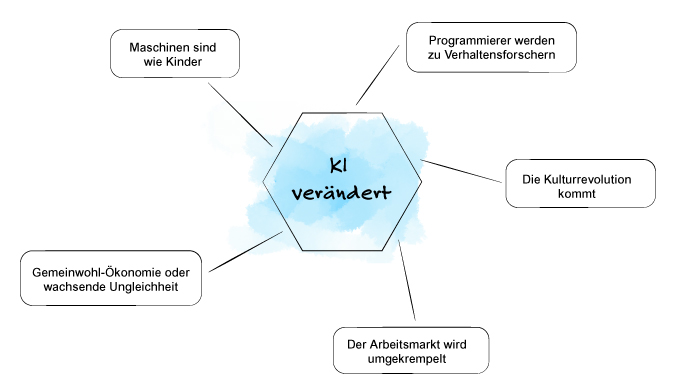
Act consciously - five Trends
In my view, the overriding AI trend of the coming decade is: Develop public awareness. For the possible developments of artificial intelligence, for its technological, economic and social opportunities and its realistic assessment. And for the Risks. Particular attention must be paid to the following areas.
1.machines are like children. Computers that are equipped with self-learning algorithms, i.e. artificial intelligence, basically behave like children. Their learning is based on what they are "fed". Just as children imitate the behaviour of their parents, the machine recognizes and interprets patterns based on their input and logically develops the manifestations that follow these patterns. It learns new things, but always against the background of what it originally experienced. We will therefore have to ask ourselves the question: Do we want to leave the results of this learning to chance? Or would it be better to develop binding guidelines for learning objectives and the assessment of learning outcomes? And then ensure that adherence to these guidelines can be monitored and tracked? We should keep this in mind: If machines learn uncontrolled in the future, there is a high probability that they will develop primarily along the lines of maximizing their owner's profits. This cannot be in the public interest.
2 Programmers become behavioral researchers. If artificially intelligent machines behave like children, the logical conclusion is that the developers who work with these machines should know and implement the guidelines that have yet to be developed. They should be able to assess what the machine will do with its "food" in the long term. This results in new requirements for IT training: pure programming know-how alone is no longer enough. Instead, a good AI specialist will need a kind of basic ethical training in future. They must learn to consciously align their work with the common good and the fundamental ethical values of humanity. In addition, they will need comprehensive technical knowledge of the five large schools of machine learning, as defined by the renowned computer scientist Pedro Domingos:
Connectivity. This school is based on the functional principle of the human brain. The result is neuronal networks whose neurons form or change synapses.
Symbolism. It has its roots in logic and infers unknown premises from known facts. Example: "I am a human being. I am mortal. It follows from this: People can die."
Evolution. The most powerful learning principle known to us. This school relies on programs that simulate the natural selection of evolution.
Bayes' school. Learning here means postulating hypotheses and adapting them to new observations.
Analogy. Each new observation is assigned to the category that contains the most similar or most similar cases.
3 The Cultural Revolution is coming. No technology created by humans to date has even come close to opening up such a range of new possibilities as AI - both positive and negative. What's more, everything is spreading at the speed of light thanks to the Internet. This is one of the reasons why AI development will be difficult to control and will make progress in many areas that is tantamount to evolutionary leaps. The decisive factor here is: For the AI-based system dawning on the horizon to function at all in the long term, it must ultimately serve humans. Since the beginning of industrialization, the machine has set the pace and direction.
With AI, it is possible to realign this system with people. To do this, however, we have to reorganize our Overcome practiced thinking in hierarchical structures and separate subsystems. Only then will we be able to master the digitalization and artificial intelligence technologies we have created. If not, the technologies will master us. What we therefore need is an open culture based on values that are actually practiced, a culture of error, which is geared solely towards the search for the truth or the best possible result for the general public. And we need transparency, because this is the best way to prevent the spread of applications that cause harm. With transparency, the diesel scandal would simply not have been possible. But for this we need New organizational structuresthat support a development towards a culture of error and transparency. They need to be developed.
4 The labor market is being turned upside down. If more and more machines are used to create value, this will have an impact on the labor market. One of the first effects will be that traditional job profiles will become extinct or offer significantly fewer job opportunities - for example, for cashiers in the retail sector or advisors in the financial sector. As far as job losses are concerned, the Federal Ministry of Labor paints a rather optimistic picture,[1] according to which 1.3 million jobs will be lost in Germany over the next five years as a result of the structural change in AI, while 2.1 million new jobs will be created. By 2035, experts expect around four million jobs to be lost and around 3.3 million new jobs to be created. However, this will only happen if many employees acquire new qualifications. This requires retraining and further training. Whether this assessment is realistic remains to be seen. It is also quite conceivable that many millions of jobs will be lost without replacement. We will also have to develop plans for such scenarios in the coming years. Will an unconditional basic income then be necessary to secure people's livelihoods - and their consumption as the mainstay of our economy?
5 Economy for the common good or growing inequality. One thing is certain: artificial intelligence will continue to create new opportunities to maximize profits. And machines will have an ever greater share in general value creation. This added value must make an appropriate contribution to the community. Otherwise, the mechanisms by which our market economy has functioned to date will ensure that the money they generate will primarily benefit those who own or operate these machines. If we leave development unchecked to these mechanisms, in a few decades there may be tens of thousands of super-rich people on the planet and an army of billions of poor people whose consumption is maintained by subsidies. No one can say what psychosocial consequences this will have. The alternative: We create a Economy for the common good, a system in which value creation benefits the general public more than it does now. Because one thing is clear: our economic system thrives on consumption. Cooperation is therefore in everyone's interest, whether they own a lot or a little. It would be ideal if the rich or the owners of AI super machines recognized that they need other people to maintain the system. And act accordingly, according to the motto: live and let live.
Conclusion
If we succeed in finding good answers to the questions outlined above, if we are able to give the ethical dimension of AI and steer its development accordingly, then - I am firmly convinced - artificial intelligence can become a blessing for mankind. The decisive factor will be: We need to think now, start the public debate and act quickly. Otherwise, Pandora's box may be open before we know how to deal with its contents.
Have you already found good answers to the above questions? Will we be able to steer the development of AI? Share your ideas with us in the comments section.
By the way: The The first companies are now publishing algorithms that they are developing for their AI projects. For example, car manufacturer BMW recently published some of its algorithms created for machine learning as open source on Github [2], making them available and transparent to the public. Such decisions are definitely a step in the right direction.
You can find out more about artificial intelligence and data-driven here
Would you like to work on exciting AI projects? Then apply to us now as a consultant or software developer.
These other blog posts may also be of interest:
The most important AI terms at a glance
Can AI do everything? The current limits of AI and deep learning
[1] https://www.sueddeutsche.de/wirtschaft/ki-observatorium-tuev-arbeitsministerium-1.4676937
[2] https://www.golem.de/news/deep-learning-bmw-legt-eigene-ki-algorithmen-offen-1912-145576.html