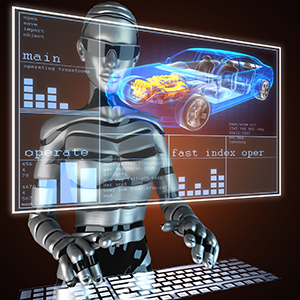
Here, the main character flees from his pursuers in an automatically controlled cab. The vehicles described in these films primarily correspond to levels 4 and 5 of automated driving. This means that the driver can completely hand over control of the vehicle to the vehicle or even that there is no longer a driver, only passengers.
While automated and even self-driving cars are already standard in science fiction films, the reality is quite different. Even today, we are still a long way from levels 4 and 5 of automated driving - for technical and legal reasons.
But what exactly are the different levels of automated driving and what are the biggest challenges?
The five stages of automated driving
Assisted, semi-automated, highly automated, fully automated, autonomous: these terms describe the various stages leading up to the autonomous vehicle, in which the driver gradually hands over more and more responsibility to the car.
The various automated driving technologies are divided into five levels.
The higher the level, the higher the degree of automation of the vehicle. The respective level indicates the extent to which the car can take over the driver's tasks.
Level 0 - "Driver-only"
Level 0 - "Driver-only" describes a non-automated vehicle. At this level, the driver is fully responsible for Cross guide (steer) and longitudinal guide (maintaining speed, accelerating and braking). Vehicles that correspond completely to level 0, there are fewer and fewer in Germany. Because at least an anti-lock braking system (ABS) is now standard in new vehicles. And these systems can already intervene in the longitudinal guidance.[1]
Level 1 - assisted driving
Assisted driving support individual assistance systems for certain driving tasks. This can relate to the lateral or longitudinal control of a vehicle. Even in level 1, however, the driver is in constant control of his vehicle and must keep an eye on the traffic. They are also liable for damage and traffic violations.
Assisted driving is already a reality in many cars today. One example of an assistance system available in many vehicles is the Cruise control. This ensures that the selected speed is maintained. The safety distance to the vehicle in front can be adjusted by the automatic adaptive cruise control (ACC, Adaptive Cruise Control): This brakes or accelerates the car depending on the distance to the vehicle in front. The Automatic lane departure warning system (LKAS, Lane Keeping Assistant System) is often installed in vehicles.
Level 2 - semi-automated driving
Level 2 is referred to as partially automated driving. In this level, the vehicle driver can, in a specific application, control both the transfer both lateral and longitudinal guidance to the vehicle. This means that the car can temporarily carry out some tasks independently - without human intervention. For example, a level 2 vehicle is able to drive on the highway to brake, accelerate and stay in lane at the same time.[2]
To achieve this, car manufacturers combine various assistants - in this case the brake and lane departure warning system with adaptive cruise control. Another level 2 function is the Automatic parking systemwhere the driver no longer has to reach for the steering wheel.
In contrast to assisted driving, with semi-automated driving the driver can Take your hands off the wheel for a momentwhen the car is driving in semi-automated mode.
As in level 1, however, the driver must continue to keep a constant eye on the vehicle and the traffic while driving. The driver is responsible for using the assistance systems stets and to recognize and correct malfunctions. This means that he must also be able to take over control of the vehicle at any time - without prior notice - and is also responsible in the event of an accident.
Level 3 - highly automated driving
In contrast to level 2, the system independently recognizes its limits during highly automated driving. If such a case occurs, the car prompts the driver to take over.
Highly automated vehicles are capable of master certain driving tasks independently and without human intervention. For example, they overtake, brake or accelerate - depending on the traffic situation. However, this is only possible for a limited period and under suitable conditions, as specified by the specified conditionspossible.
In such a highly automated application, the driver of a level 3 vehicle may temporarily turn their attention away from driving and road traffic. This means, for example, that they can read the newspaper or turn their attention to passengers in the rear seats. However, they must pay attention to Request by the system to take over the vehicle at short noticei.e. he must be ready at all times.
Highways offer the best conditions for using level 3 vehicles: The lane markings are generally in order, there is no oncoming traffic and the roads are digitally mapped throughout.
Some Legal issues are still possible with level 3 vehicles unexplained - e.g. who the Pay a fine if the assistance system disregards a speed limit in semi-automated mode. [3]
Level 4 - fully automated driving
From the fully automated driving level upwards, the driver can Transfer complete vehicle management to the system. The driver thus becomes a passenger. The car then manages Travels completely independently on certain routes. For example, the vehicle could drive onto the highway, merge into the traffic, brake, accelerate or overtake if necessary and then leave the highway again. After such a fully automated journey, a passenger can take over the wheel again, but does not have to. [4]
The main difference to level 3 is that the system is fully automated. must return to a safe state from any starting position - even if the driver does not take over. This means that it must recognize its limits early enough to return to a safe state and head for a parking space after driving on the freeway, for example.
Passengers in a level 4 car are allowed to move around during a fully automated journey. devote themselves to other activities, e.g. sleeping or using their smartphone. During a fully automated journey passengers are not liable for accidents or other traffic violations. Such a vehicle may even drive without passengers. [5]
A Legal framework missing However, this has so far been for fully automated journeys - drivers' rights and obligations are therefore not yet binding.
Level 5 - autonomous driving
The last stage of development is known as the autonomous or driverless driving designated. The vehicle is now completely guided by the system and performs all the necessary tasks. It can drive completely autonomously on all road types, in all traffic situations and environmental conditions. Driving without occupants is also possible and the Passengers are not liable for accidents or other traffic violations. At this level, there is no longer a driver, only passengers. However, the legal framework for autonomous vehicles is even less clear than that for level 4 vehicles. The rights and obligations of passengers, car manufacturers, software manufacturers and insurance companies therefore still need to be clarified. [6]
Automated driving - and where are we today?
However, levels 4 and 5 are still dreams of the future. Today, we are on the threshold of highly automated driving (level 3). Assistance systems are now widespread and many new vehicles already comply with level 2 (partially automated driving).
Backend-based driver assistance systems for automated driving
Highly automated driving is characterized above all by the fact that the Transferring responsibility from man to machine becomes. The driver no longer has to constantly monitor the system, but is prompted by the system when they need to take over the driving task.
For such highly complex systems a great deal of information is needed on traffic situations, environmental influences and potential hazards.
Are they sufficient with the help of the Technology in the vehicledata are not sufficient, a Additional IT backend system is required. This is a central server system in which the Information collected from many vehicles e.g. on reported traffic incidents or hazards.
Warning of local hazards such as slippery roads or accidents
Such a backend system can be used for Different functionalities can be used. For example, it creates the possibility that Local hazards such as slippery roads or accidents can be reported to a central system and retrieved from there by other vehicles. This information can then be filtered according to its relevance for the requesting vehicle, depending on its location, for example.
Comparison of digital maps with reality
It is also crucial that the highly accurate digital mapsThe maps required for automated driving functions must always correspond to reality. For this reason, existing maps need to be detailed and expanded. Through a Backend connection of the vehicles can be a Comparison between digital maps and reality be made possible.
Making it easier to find a parking space
There are also other use cases that could be of interest to drivers, e.g. the Parking situation. To avoid wasting unnecessary time searching for a free parking space, a functionality could be provided via a backend system in which information on parked vehicles is collected. This could then be queried by a requesting vehicle.
Up-to-date traffic information and variable speed limits
Another use case is current Information on traffic volume. These can be reported by a vehicle to the backend system and are then available for other vehicles. This allows, for example, the time that a vehicle needs for a certain route to be determined more precisely. The same applies to Variable speed limitse.g. due to construction sites.
Challenges of backend-based assistance systems
IT systems are becoming increasingly complex, both in the backend and in the vehicle. Mastering this complexity, especially with regard to the Reliable situation detection and fail-safe operationis one of the biggest challenges in automated driving. For the different levels of automation, the Internationally standardized test procedures be developed. A decisive role is played, for example, by the Shifting the major testing effort to an early, virtual development phase. [7]
Another major issue is user-friendliness and the Interface between man and vehicle. For example, highly automated level 3 vehicles must inform the driver when they have to take over the driving task again. There are various options for this, such as acoustic signals or voice output. [8]
The more complex the systems, the more central the close connection between software and hardware. And with backend-based driver assistance systems in particular, the cross-domain Exchange between engineers and computer scientists increasingly important. Silo thinking no longer works, instead it is important to think outside the box.
Conclusion
In order to move from the assisted driving that is prevalent today to autonomous driving, there are still a few stages to overcome, which include numerous technical, legal and also human challenges bring with them. We are currently focusing in particular on the challenges posed by level 3 - highly automated driving. Our projects range from networked vehicle services - such as an electronic driver's logbook - via a test platform that offers various Simulation tools for driving functions combinedto back-end services, which are provided for inquiring cars. Current and relevant information on traffic situations provide. The projects described are based on complex Microservice architecturesthat place particularly high demands on topics such as Performance, reliability and scalability are facing. For this reason, it is becoming increasingly important to deal with high-performance applications. On the other hand, the legal and social issues associated with this topic need to be clarified.
Do you also want to work on projects in the field of autonomous driving and high-performance applications? Then join our team.
You might also be interested in this article: "Vision Zero" through autonomous driving?
Sources
[1] https://www.heise.de/ct/artikel/Was-ist-der-Unterschied-zwischen-einem-autonomen-Auto-und-einem-autonomen-Auto-2773184.html
[2] German Association of the Automotive Industry: From driver assistance systems to automated driving, in: VDA Magazin - Automatisierung
[3] https://www.adac.de/rund-ums-fahrzeug/autonomes-fahren/autonomes-fahren-5-stufen/
[4] https://www.adac.de/rund-ums-fahrzeug/autonomes-fahren/autonomes-fahren-5-stufen/
[5] https://www.adac.de/rund-ums-fahrzeug/autonomes-fahren/autonomes-fahren-5-stufen/
[6] https://www.adac.de/rund-ums-fahrzeug/autonomes-fahren/autonomes-fahren-5-stufen/
[7] https://www.euroforum.de/adfd/2017/06/23/die-herausforderungen-beim-hochautomatisierten-fahren/
[8] https://www.deutschlandfunk.de/auto-mensch-schnittstelle-eine-technische-herausforderung.676.de.html?dram:article_id=313536