
Since the automobile was patented by Carl Benz on January 29, 1886, it has evolved over the years. New technology has advanced the mobility and safety of cars. And today, we are already on the brink of the transition from self-moved to the independent Vehicle.
But when do we actually talk about autonomous or fully automated driving and what additional safety potential does this predicted type of mobility promise?
The five stages on the road to autonomous driving
The step towards autonomous driving is not something that can be taken overnight - it is more of a gradual process.
So when we talk about automated in connection with the automobile, we have to differentiate between five different levels of automation can be distinguished:
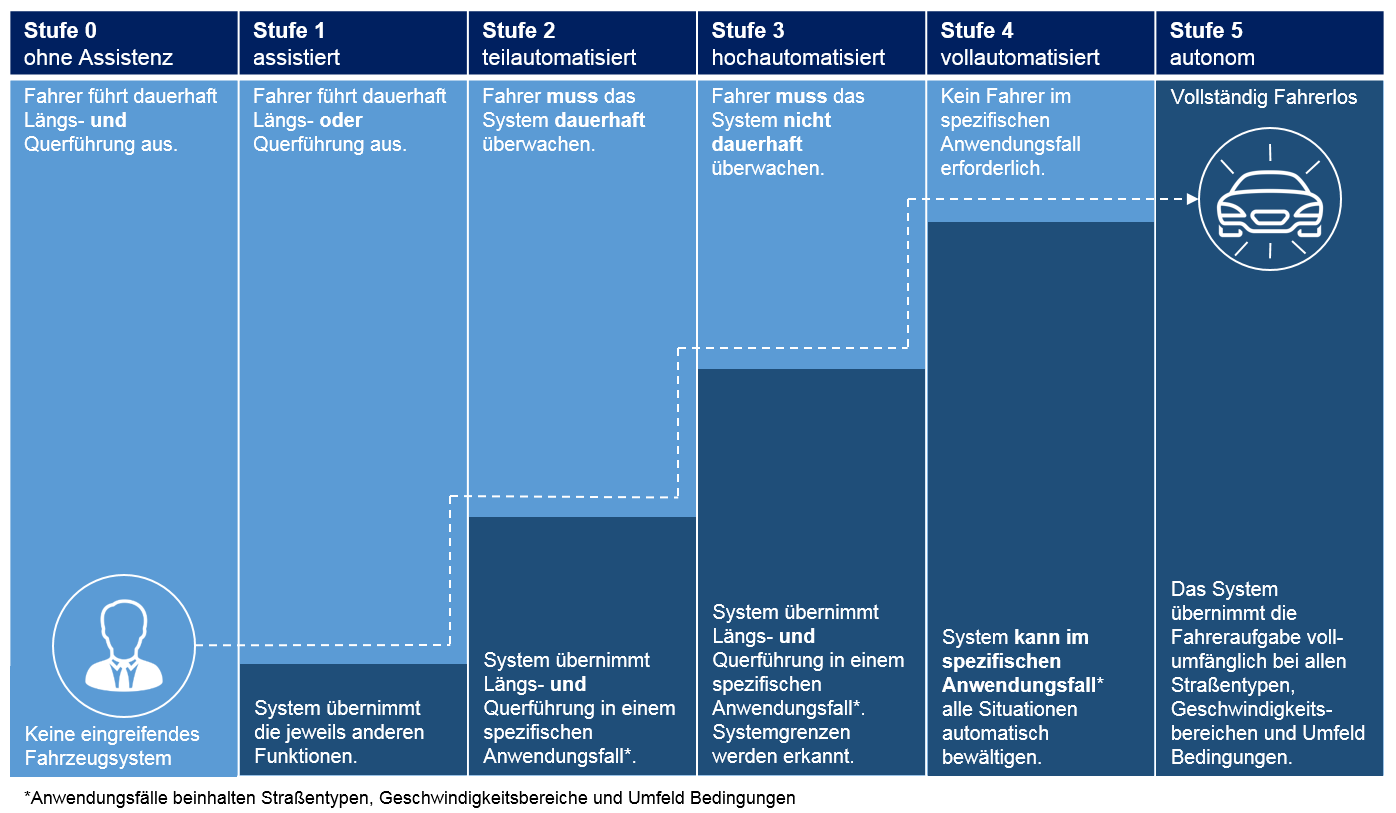
Level 0 - "Driver only":
Vehicles at this level have No integrated automated driving functions. There are therefore no systems that intervene in the longitudinal or lateral guidance (i.e. accelerating, braking or steering).
Level 1 - assisted driving:
Assisting systems such as the anti-lock braking system (ABS), the driving dynamics control system (ESP), the emergency brake assistant, the driving hold assistant or comfort services such as cruise control, are now fully developed and have become a standard feature of the Become standard. Systems of this type can at any time on the longitudinal or Access the transverse function of the vehicle.
Level 2 - semi-automated driving:
Partial automation differs from assisted driving because the system works in a specific use case and under permanent monitoring of the driver both the Take over longitudinal and lateral guidance of the vehicle can. This level is already omnipresent and can be found in parking assistants, overtaking assistants and traffic jam assistants. [1]
Level 3 - highly automated driving:
Highly automated driving is characterized by the fact that the system is used in a specific application, for example on the freeway, no longer permanently monitored by the driver has to be made. If the Ambient conditions (e.g. in construction site situations), however, no longer correspond to the Functional scope of the assistance systemthe driver is informed of this at an early stage and he must take over the driving task again. This stage could become a reality as early as 2021. [4]
Level 4 - fully automated driving:
Full automation is the preliminary stage to autonomous driving and is characterized by the fact that the Transfer the complete driving task to the system in specific use cases can be used. From this level interacts the vehicle with its immediate surroundings and can be used with communicate with other vehicles. The main hurdles in this context are the Car2Car Communicationi.e. the communication between the vehicles, and the Car2X Communicationi.e. the communication between the vehicle and its surroundings. [2]
Level 5 - autonomous driving:
Autonomous driving represents the Final stage of automation and is given when the vehicle Fully comprehensive and system-independent on all road types, in all speed ranges and under all environmental conditions interact can. The steering wheel and pedals are no longer required, so that every vehicle occupant becomes a passenger. [4]
Vision Zero aims to make roads and means of transportation so safe that in the future there will be No more fatalities or serious injuries on the roads gives. [8]
There is currently a Fatal traffic accident on average...
- every 2.8 hours in Germany,
- every 25 minutes in the USA and
- every 26 seconds worldwide.
Figures that reflect how important it is, Making vehicles even safer.
The following diagram shows the figures for the Traffic accidents resulting in death on a time axis. In order to illustrate this development in conjunction with increasing automation, we have also included Assistance system milestones after their temporal introduction.
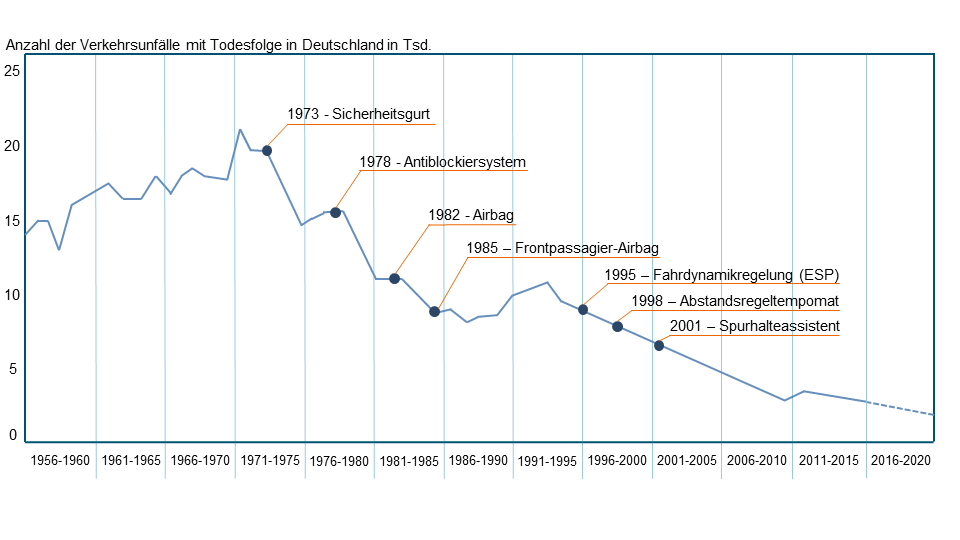
Image source: Own illustration based on https://www.destatis.de/DE/Presse/Pressekonferenzen/2018/Verkehrsunfaelle-2017/pressebroschuere-unfallentwicklung.pdf?__blob=publicationFile&v=3
Despite a steady increase in traffic volumes, the number of road accident fatalities in Germany is still falling. declining since 1970 is. A decline that is sometimes clearly attributable to the Introduction of new automation systems is.
Of course, the causes of every accident are different. However, figures from the Federal Statistical Office show that 88 percent of all traffic accidents can be attributed to driver error are. Just once one percent of the causes of accidents are of a technical nature. [3]
First and foremost, weaknesses are linked to the different characteristics of people. Every person is an individual and has Various properties (age and personality), Skills (physical and mental performance) and skills (experience and driving style).
In addition to the characteristics, there are also disturbance variables that can occur during the journey. These include, for example Communication with the front passenger or operating the smartphone. Already small distractions ensure that the driver's information intake is focused on something else. [9]
In contrast to humans, a Fully automated vehicle its environment by means of Sensors, such as cameras and radar sensors, in interaction with digital maps and other information available in real time. The Vehicle processes the recorded dataregistered by a Predefined programming and develops a automatic scene understanding. [11]
Neither disturbance variables nor human characteristics are included in the information and decision-making process. Furthermore, the built-in Sensors and cameras for enormous potential, as these 360-degree all-round view enable. Dangers can also detected as early as possible using mono, stereo or infrared cameras distances can be analyzed by a radar. In the event of imminent danger, the vehicle thus Early braking or evasive maneuvers on. [10]
Example scenario:
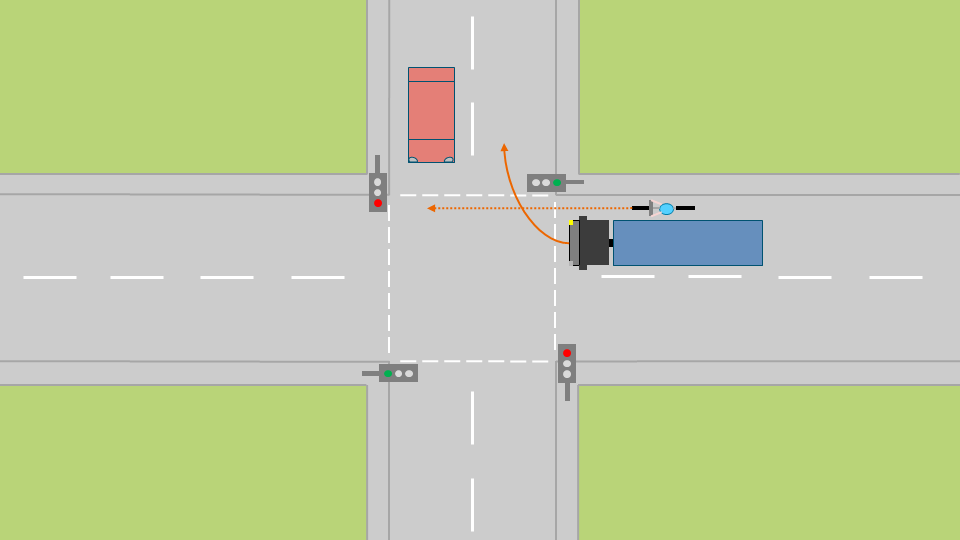
Initial situation:
A cyclist crosses the road when the light is green. A truck turning right in parallel crosses him.
Result - Level 0 ("Driver only"):
Depending on the truck driver's concentration and attentiveness, an accident can be prevented by anticipating the situation. Otherwiseolliding trucks and cyclists.
Result - Level 1 (assisted driving):
An exemplary assisting system in this scenario is the Blind spot assistant. Sensors around the truck recognize the immediate surroundings and send the driver a Early warning signal. However, all subsequent actions must be carried out by the driver. If the warning is ignored, a collision will occur.
Result - Level 2 and 3 (semi-automated and highly automated driving):
The sensors attached to the truck detect the approaching cyclist via a Extended blind spot assistance system and, in addition to a warning signal, also initiate a Evasive maneuvers or a braking maneuver in. A collision is avoided.
Highly automated driving will initially only take place on highways.
Result - Level 4 and 5 (fully automated and autonomous driving):
The fully automated truck is equipped with sensors and recognizes the approaching danger from the cyclist. The truck and the red vehicle are also in Direct Car2Car communication. If the red vehicle detects a danger to other traffic, it transmits a warning signal to the truck. Additional warning signal. The cyclist riding straight ahead is granted right of way - a Collision is avoided.
Conclusion - autonomous driving and Vision Zero remain wishful thinking for now
With regard to the levels of automation, it can be said that today we are just at the Edge of level 3 are. Nevertheless, historically speaking, it is already a great success that increasing automation is having a positive impact on safety potential and accident prevention. As humans are the number one source of accident errors, it is to be expected that accident figures can be further reduced through increasing automation.
Fully automated and autonomous vehicles, on the other hand, are not influenced by characteristics. They interact according to pre-programmed rules and algorithms. In return, however, the associated risks must also be taken into account. Every object in traffic must be correctly recognized and interpreted. Already The smallest programming errors can have catastrophic consequences. In addition, high data security requirements must also be guaranteed in the future in order to protect vehicles from hackers.
The topic autonomous driving remains exciting and it remains to be seen when the first self-driving vehicles will actually appear on public roads. The decisive factor will be how they prove themselves in the transition phase - without automation towards full automation.
You are currently viewing a placeholder content from YouTube. To access the actual content, click the button below. Please note that doing so will share data with third-party providers.
More InformationOne thing is certain "Vision Zero" is and remains a pipe dream for the time being. Increased automation as well as contributing data communications between the vehicle and its immediate surroundings, however, offer enormous security potential and can help to make the "Vision Zero" goal more tangible in the future.
You might also be interested in these blog posts:
The key core technologies on the road to self-driving vehicles - Part 2: Vehicle-to-everything (V2X)
Sources:
[1] https://www.fuw.ch/article/die-revolution-in-der-automobilindustrie-beginnt-jetzt/
[2] https://www.dondahlmann.de/?p=24974
[3] https://www.destatis.de/DE/Presse/Pressekonferenzen/2018/Verkehrsunfaelle-2017/pressebroschuere-unfallentwicklung.pdf?__blob=publicationFile&v=3 [4] https://www.bmw.com/de/automotive-life/autonomes-fahren.html
[5] https://www.adac.de/rund-ums-fahrzeug/autonomes-fahren/autonomes-fahren-5-stufen/
[6] https://fuhrpark.de/teil-1-der-autonome-stufenplan
[7] https://www.adac.de/rund-ums-fahrzeug/autonomes-fahren/car2x-kommunikation/
[8] https://www.dguv.de/de/praevention/visionzero/index.jsp
[9] [Hakuli et al. 2015] Hakuli, Stephan; Lotz, Felix ; Winner, Hermann ; Singer, Christi-na (eds.): Handbuch Fahrerassistenzsysteme. 3rd edition. Wiesbaden : Springer Vieweg, 2015
[10] [VDA 2015] VDA: Automation - From driver assistance systems to automated driving. In: German Association of the Automotive Industry (2015), September
[11] [Dietrich and Minx 2015] Dietrich, Rainer; Minx, Eckard: Autonomes Fahren - Wo wir heute stehen und was noch zu tun ist. Daimler and Benz Foundation, October 2015