
Artificial intelligence has always been an essential component of futuristic visions. In recent years, rapid developments in the field of artificial intelligence have brought us much closer to these visions of the future. Who would have expected self-driving cars at the turn of the millennium? At the same time, the (seemingly infinite) Possibilities of AIThe media, for example, is often overly optimistic or even exaggerated. The so-called Deep learninga special mathematical method based on neural networks, is crucial for the current Hype about AI responsible for this. At the same time, this Method has its limitsto the Gary Marcus in his paper "Deep Learning: A Critical Appraisal" in a structured manner. Inspired by this work, these boundaries will be discussed in more detail below.
The size of the real world and how limited AI sees it
The Reality is incredibly complex and incredibly diverse. We humans navigate this complexity on a daily basis, which often stems from the fact that we do not live in firmly defined, self-contained systems. Many Subtasks artificial intelligence can already do better than us, but at the same time humans are still quite good at it, Information in the respective context to process. If we see a red traffic light in a friend's garden at night, we recognize it as a party light and don't wait for it to turn green.
But how does artificial intelligence see the world? AI algorithms learn about the world through data sets. Let's look at autonomous driving, for example. One subtask for AI here is to correctly recognize signs. To do this, we can present an AI algorithm with sample images. At the same time, we would mark the signs on the sample images and name the correct category ("stop sign"). The AI algorithm now compares an image with the expected output ("stop sign") - it does this with all the sample images and tries to find a mathematical relationship between the image and the traffic sign category.
So for an AI algorithm, the world consists mainly of the data that is presented to it. Of course, the AI algorithm is not fundamentally different from us humans, but there are still some challenges and limitations that set it apart.
Sheer hunger for data
A small child who sees an elephant for the first time in its life very quickly understands what an elephant is and subsequently recognizes such an animal very reliably in other contexts, e.g. in a children's book or on television. This is not the case with deep learning algorithms. This is because they recognize such Do not learn connections explicitly can, but these implicitly on the basis of a large number of examples do. They are therefore extremely data-hungry. If these large amounts of data are not available, these algorithms have a very difficult time and the quality of the models and prediction results decreases.
The processed sample data must also be include as many facets of a problem as possible. A deep learning process that has only ever been trained with white swans is - in contrast to humans - not able to recognize a black swan that suddenly appears if it was not previously stored in the training data sets.

Even today, we cannot (yet?) fully explain the world around us. However, one of the strengths of science is to build on existing knowledge and to create ever better models of our world in an iterative process. The English proverb "Standing on the shoulders of giants" describes this vividly: Every generation builds on the pioneers of past eras.
However, this also means that we can always draw on this prior knowledge in everything we do. If we let go of an apple in our hand, it falls to the floor and does not rise to the ceiling. If we touch a cold wall, the wall gets warmer and our hand gets colder - energy is transferred to the colder body. The opposite does not happen spontaneously. These are all examples of general prior knowledge that we always recognize as Transfer knowledge regardless of which specific problems we are currently solving.
But Deep learning algorithms cannot use this transfer or general knowledge. They cannot build on general prior knowledge, but have to learn every problem they have to solve from scratch. Deep learning algorithms are therefore always very problem-specific.
One example in this context is image recognition. There are already very good deep learning models for object recognition. These recognize very reliably whether a plate of noodles or a dog is shown in an image. A slight modification of this problem - e.g. the algorithm should automatically recognize road markings (crosswalks, arrows, etc.) on satellite photos - means that these models become completely useless for this problem and an entire branch of research is founded that deals solely with solving this topic.
Correlation does not mean causal relationship
The Use of prior knowledge is also necessary to logically meaningful connections from random correlations. For example, the birth rate in Western European countries is falling steadily. At the same time, the number of breeding pairs of storks is declining. So if we wanted to increase the birth rate, would we simply have to protect storks better?
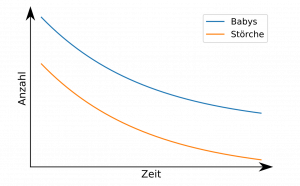
This is, of course, an obvious fallacy. Just because a mathematical correlation exists historically does not mean that the birth rate is logically related to the number of storks.
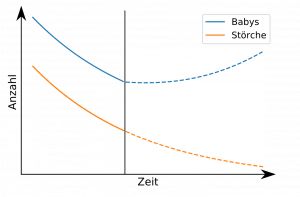
A People can recognize this obvious fallacyas he can draw on his entire life experience and general education - AI generally can't do that. With more complicated problems, even humans can no longer say beyond doubt whether a mathematical relationship is based on a real dependency. Here, scientists have to formulate hypotheses, which they then repeatedly try to disprove with new experiments.
Does memorization really mean understanding concepts?
The term "artificial intelligence" already implies a comparison with human capabilities. These comparisons run through all terms: for example, a machine learning model "learns" relationships and similarities from a given data set. But what exactly does "learning" mean here? A person is able to learn concepts with very little data.
Figure 4 serves as an illustration: in a simple computer game, a ball moves on the screen. The aim is to touch all the blocks placed on the screen with the ball, which disappear when touched. If the ball hits an obstacle, it is repelled from there. Unless it touches the bottom edge of the screen, the game is lost. The ball can be controlled indirectly with the help of a horizontally movable bat.

A person understands the principle of the game after a few seconds, even without an explicit definition of the rules, and has no problems with a slight modification: for example, by slightly changing the vertical position of the racket. A Deep learning model often has major problems with such generalizations and fails due to the slight change in external circumstances. The model has not really learned generalized concepts ("bat", "ball", "wall") but has found a successful solution strategy through endless trial and error - which, however, is not robust against small changes in the system parameters.
The much-feared "black box"
Deep learning models are often said to be difficult to "explain" and act like a "black box". You feed the model with data, get an answer, but don't really know why the model gave this answer. The set of rules that leads to the decision is not immediately apparent - it is downright opaque. To break through this opacity of AI, the "Explainability" of AI models a subject of current research. But why is this important at all? Specifically, opaque AI models limit the applicability of AI in the following two examples:
TrustworthinessEspecially in regulated areas, such as medical technology or transportation, all software is subject to particularly strict legal requirements. The aim is to ensure that the software operates safely under all possible circumstances. This presents deep learning models with major challenges: They mainly learn from the available data. Let's take the example of traffic sign recognition again. It is not clear why exactly the model recognizes a stop sign as such. The research group led by Eykholt et al1. showed, for example, how easily AI models can be tricked here. A slight modification to the traffic signs, which was clearly recognizable as such for humans, meant that the signs were no longer recognized as stop signs. Such effects naturally call into question the trust in deep learning algorithms for these applications. The opacity of Deep learning models make it difficult tosuch notice any undesirable effectsas they are not directly recognizable.
Safety and quality guarantees for modular systemsIn engineering, complex technical systems are often made up of many small individual parts. A car needs an engine, wheels, a clutch - for each of these components, safety guarantees can be given during development that allow the part to be used in a larger overall system. Deep learning models cannot do this easily. They are extremely dependent on their original data set. The opacity of the models makes it very difficult to estimate the impact of changing conditions on the model. As a result, it is difficult to build a modular overall system from many models and to derive binding quality and performance guarantees for the overall system.
What does the future of AI and deep learning look like?
Gary Marcus makes a few suggestions regarding the future development of artificial intelligence and deep learning in particular:
- Resurgence of other AI disciplinesDeep learning is a part of machine learning, which in turn belongs to a very specific discipline of artificial intelligence. A classic discipline of AI is symbolic artificial intelligence. This may enable progress to be made in logical reasoning.
- Back to the human study objectThis will allow us to better understand and learn how we learn and perceive the world. Disciplines such as cognitive psychology and developmental psychology, which attempt to better understand how humans function, could provide new impetus here.
- More ambitious goalsDeep learning is often used to solve narrowly defined problems. Instead, the suggestion is made to set up challenges that go beyond this - e.g. to have an algorithm analyze any video or text and have it answer open questions: Who is the main character? What does she want to achieve? What would be the consequences of their success or failure?
Conclusion: Knowing the challenges and limitations - using deep learning correctly
Sometimes it seems as if artificial intelligence is on the verge of surpassing humanity in every respect. There are indeed individual problems in which AI has already succeeded. Nevertheless, we are still a long way from AI dominating all areas of life. Deep learning methods work particularly well when a lot of data is available and the problem is clearly defined. But there are also still many challenges - including: a real understanding of abstract concepts, transferring knowledge to novel application problems, transparency and security guarantees, distinguishing between random and logically meaningful relationships. It is therefore very important to be aware of these framework conditions when using AI processes such as deep learning. Gary Marcus' suggestions for future development can provide valuable impetus.
Co-author: Danny Claus
1 Robust Physical-World Attacks on Deep Learning Visual Classification
These other blog posts may also be of interest: