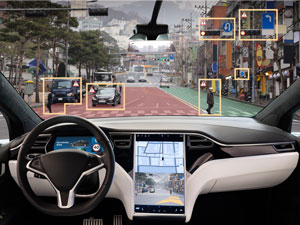
The following is about the Interaction of the vehicle with its environmentthat Testing autonomous driving functions and the associated Challenges. Means V2X communication cars can now "hear" as well as "feel" and "see". Vehicles and traffic infrastructure are networked via radio technology. This allows information to be exchanged between vehicles and between vehicles and the traffic infrastructure (e.g. variable message signs and traffic lights) and integrated into traffic management systems. In the V2X context, the term C-V2X (Cellular-Vehicle-to-Everything) is also used, depending on the manufacturer, as the connection is based on mobile radio (cellular)[1].
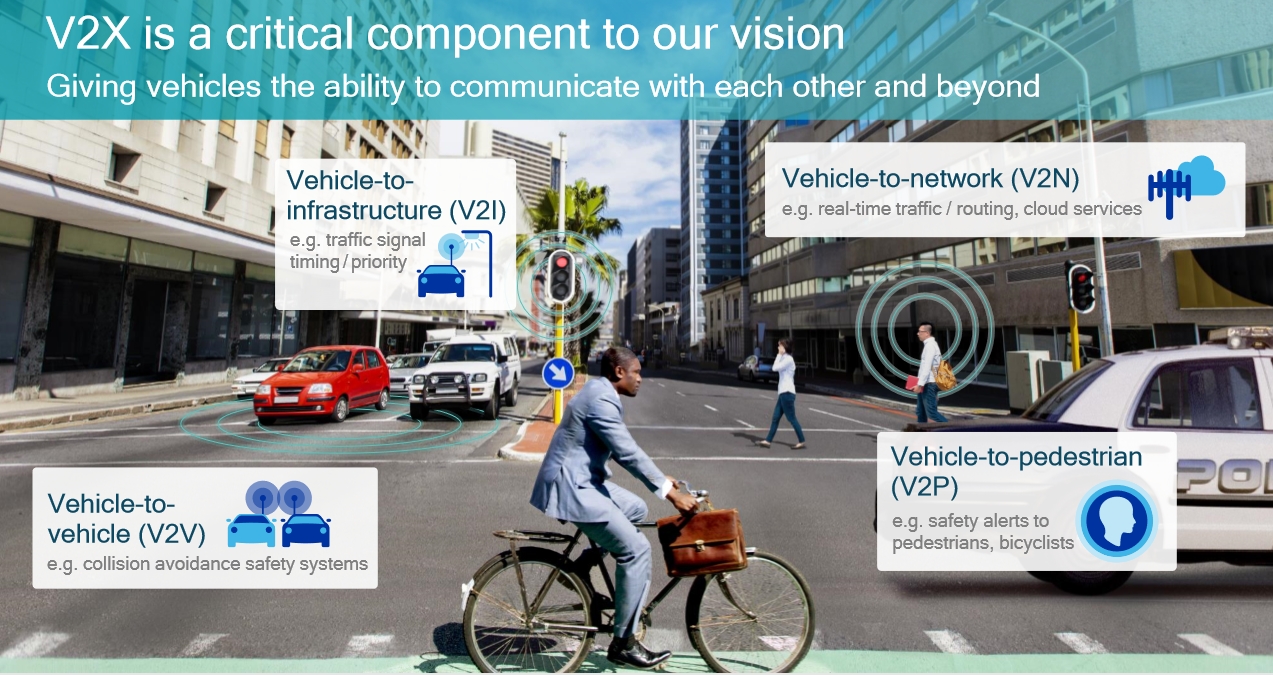
The following graphics from Qualcomm illustrate the individual V2X elements[2].
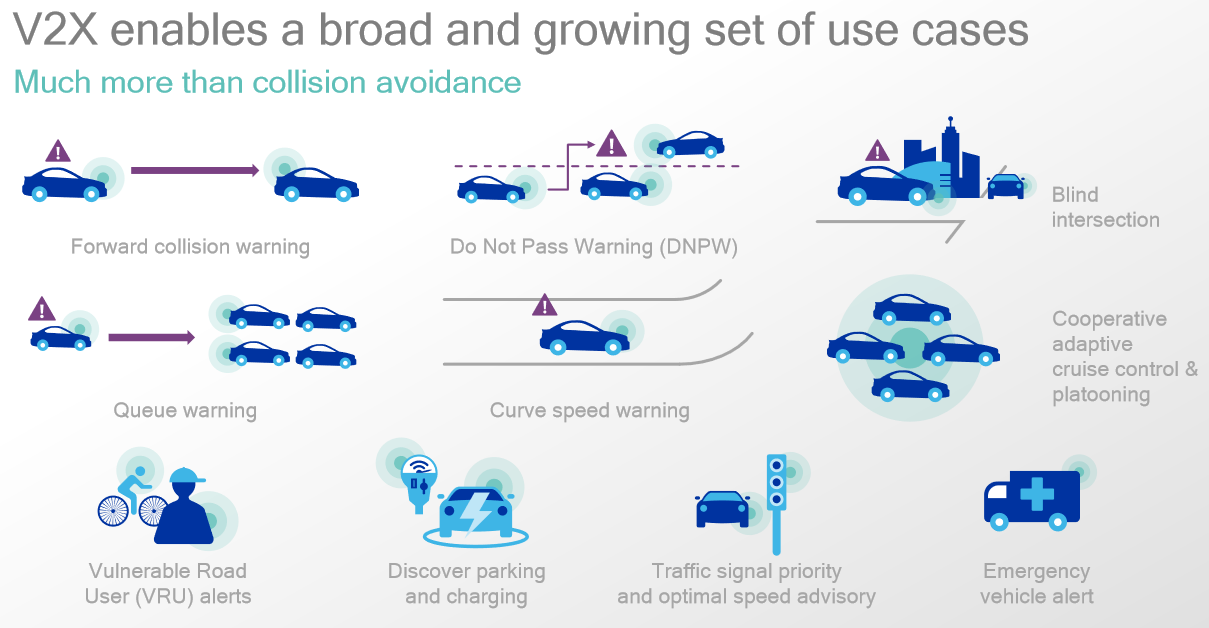
Among other things, the following use cases, also presented by Qualcomm, are to be made possible:
In addition to the safety aspects, V2X also has an ecological aspect. "With full penetration of V2X communication-based functions, an annual economic benefit of up to 6.5 billion euros could be achieved through avoided road accidents and 4.9 billion euros through the avoidance of environmental pollution," writes the German Association of the Automotive Industry (VDA)[3].
V2I - Communication between vehicles and infrastructure
But what does the Status quo at the individual car manufacturers out?
With Volkswagen the technology Car2X and is to be introduced shortly. The initial aim is to inform drivers about "green waves", for example, and thus avoid unnecessary braking and acceleration. To this end, two road junctions in Wolfsburg are to be equipped with appropriate sensors to detect pedestrians and cyclists. At complex junctions and accident blackspots, the aim is to provide information that the vehicles themselves are unable to detect. These "cooperative safety functions" are intended to intervene in situations in which the driver or the vehicle cannot detect the surrounding road users with their own sensors or can only do so at a very late stage[4].
Also at the Stuttgart car manufacturer Daimler enables Car-to-X a completely new type of information exchange. The intention is the same: The networked car looks around corners and through walls. It warns others of dangers and prevents accidents. In short, it ensures greater safety and comfort. The driver assistance systems provide the driver with additional safety and comfort functions, thus achieving a further milestone on the road to autonomous driving[5] [6].
Audi announced in May 2019 that a technology that has already been ensuring relaxed and more efficient driving in the USA for two and a half years is now also to be installed in Germany. The car manufacturer wants to network new models with the traffic lights in Ingolstadt; other European cities are to follow from 2020. Audi drivers will be able to see in the cockpit the speed at which they will reach the next traffic light when it turns green. The system will "Green Light Optimized Speed Advisory" (GLOSA) called. "In the future, the anonymized data from our cars could help to better control traffic lights in cities and optimize traffic flow," explains Andre Hainzlmaier, Head of Development Apps, Connected Services and Smart City at Audi.[7]
V2V - communication between vehicles
V2V (vehicle-to-vehicle) communication and the networking of assistance systems for automation are also already being tested. The companies BoschVodafone and Huawei joined forces just over a year ago to carry out tests for the use of the mobile communications standard for autonomous driving. These tests have already taken place in China, Japan and the USA. They are based on 4G, but 5G, which AT&T is already introducing in the USA and with which the C-V2X standard is compatible, will be introduced in the future. Preparatory tests have already been carried out on the digital test field on the A9 highway in Bavaria.
Previously, the Communication standard Warnings in real time in terms of braking and lane changes. The next step is to ACC (Automatic Cruise Control) in the control system. This system not only warns, but also actively intervenes and brakes the vehicle, for example. In the future, the vehicles will be able to communicate with each other via this system, which will also enable the autonomous driving make it possible. This means that the sensor data can be used not only by one vehicle, but by all vehicles in the respective traffic situation. This information transfer should take place in quasi-real time so that the systems can intervene in good time.
Conclusion
V2X technology is an important step towards the autonomous driving vehicle. Communication with the environment as well as with other road users is an essential part of reducing risks. For example, if a sensor does not detect the traffic situation correctly, V2V can prevent an impending accident. V2X can support the vehicle in tricky situations such as roadworks or a change in traffic routing in real time.
doubleSlash is currently involved in various V2X projects in requirements management and software development. The challenge here is to provide the vehicle with aggregated data from various sources (e.g. various traffic information points) at high speed. The vehicle must receive the correct information at all times and also store and process the data that comes from the vehicle via a return channel. The high non-functional requirements on the Performance and scaling of such backend systems via a cloud infrastructure - for example AWS - are the biggest challenges with such an infrastructure.
In part 1, we look at sensor technology and sensor fusion
In part 3 of our series the topics of maps, 5G, digital twin and data economy will be discussed.
Further services relating to the topic of autonomous driving can be found here.
Are you interested in the field of Future Mobility? Then apply to us now as a consultant or software developer.
[1] https://www.vda.de/de/themen
[2] https://www.qualcomm.com/media/documents/files/cellular-vehicle-to-everything-c-v2x-technologies.pdf
[3] https://www.vda.de/de/themen
[4] https://www.heise.de/newsticker/meldung/Volkswagen-und-Siemens-testen-Funk-fuer-Ampeln-4183853.html
[5] https://www.daimler.com/innovation/case/connectivity/car-to-x.html
[6] https://www.auto-motor-und-sport.de/verkehr/vehicle-2-x-datenuebertragung-globaler-streit/