Our blog series looks at the key core technologies on the road to self-driving vehicles. There are currently many players in autonomous driving: Established car manufacturersthe American car manufacturer Tesla, Industry supplier, Technology groups such as Alphabet and Apple and Mobility service provider like Uber or Dixi. There is a race between these players for the Redesign of the vehicle market (see also: "The future of e-mobility: BMW and Daimler invest more than one billion euros in joint mobility services - a commentary").
From the customer's point of view, the idea of an autonomous vehicle is appealing: getting in in the morning, reading messages, answering emails or taking a quick power nap while being gently driven through the heavy rush hour traffic to the office. If mobility service providers have their way, in the future we will no longer own carsbut rather kilometers as Purchase transportation service. The vision: the car drives ahead and transports us to the desired destination.
Modern vehicles already contain Numerous assistance systemswhich all monitor internal and external processes and thus relieve the driver of many tasks: Brake and lane departure warning, distance meter or cruise control. But despite the technology, the Decision-making authority with the driveri.e. in humans.
This is exactly what is set to change in the near future: "We are already close, as IT and car manufacturers are already carrying out initial tests together with suppliers. And not on special routes, but even on regular highways such as the A9 between Ingolstadt and Nuremberg - and in the middle of rush hour traffic," says Rahman Jamal from National Instruments. Autonomous driving is currently already possible for several minutes with the so-called traffic jam pilot.[1]
This article provides an overview of various core technologies that should make autonomous driving ready for use on our roads - in commuter traffic, but also in much more complex environments such as on country roads or in the city. These include:
- Sensors (Part 1)
- Sensor fusion (part 1)
- Virtual test centers (Part 1)
- Vehicle-to-everything - V2X (Part 2)
- Maps (Part 3)
- Connectivity and 5G (Part 3)
- Digital twin and data economy (part 3)
Sensors - the sensory organs for the autonomous vehicle
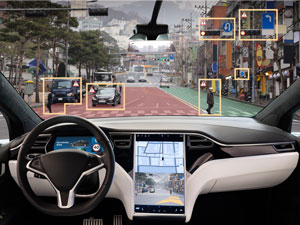
For an autonomously operating vehicle Laser and radar-based sensors and cameras with a 360° panoramic view that analyzes everything in the immediate vicinity, but also at a distance, is absolutely essential. This is because it has to take into account a large number of parameters and influences of all kinds. To put it simply: everything that people know about their Sensory organs perceives. Depending on the configuration for autonomous driving, we are talking about 15 required sensors. Their number increases with the growing complexity of the requirements. A radar, for example, no longer just detects that something is there and moving, but also specifies which object it is. "Only when the sensor technology is very precise can responsibility be reduced and transferred from the driver to the system," emphasizes an expert from Audi."[2]
The majority of car manufacturers currently assume that fully autonomous driving will require an additional independent type of sensor in addition to the camera and radar systems already in use. Lidaris required.
Lidar systems are ready for fully autonomous driving Level 3 an important prerequisite. Multiple redundant Camera or radar systems increase reliability, but objects that the first radar/camera system may not detect due to the system will not be detected by the second. This requires a Further sensor - and that is Lidar. The primary purpose of the system is Measure distances to stationary and moving objectsbut also through special procedures provide three-dimensional images of the recognized objects.[3]
The lidar receives the signals emitted with lasers by means of Multispectral cameraswhich can absorb light in several wavelengths. The reflected light of the laser from the surface of the object allows Conclusions about its speed and position to. This data can be used, for example, to identify a possible collision course and counteract it[4].
Some of the camera systems already in use are systems for medium to long ranges, i.e. in the range between 100 and 250 meters. These cameras use, among other things Machine learning algorithmsto automatically recognize and classify objects and determine their distance. The following, for example, are to be recognized Pedestrians, cyclists, motor vehicles, hard shoulders, bridge piers and roadsides. The algorithms are also used to recognize Traffic signs and signals used.
Cameras with Medium range essentially serve to Warning of cross trafficas Pedestrian protection and for Emergency braking, lane departure warning and signal light recognition. Typical areas of application for cameras with high range are Traffic sign recognition, video-based distance control and road guidance recognition.[5]
Radar systems have been available in vehicles for some time and already perform the following tasks, among others:
- Blindspot detection (blind spot monitoring)
- Lane departure warning and lane change assistant
- Rear-view radar for collision warning or collision avoidance
- Parking assistant
- Cross-traffic monitoring
- Brake assist
- Emergency braking
- Automatic distance control
Sensor fusion - interaction of sensors for autonomous driving
To detect what is happening on the road, data from cameras, radar, ultrasound, lasers, etc. must be synchronized - the keyword here is "sensor fusion". Many sensors have to work together to know where the vehicle is and what is in front of and behind the vehicle in order to make a risk assessment. With the help of sensor fusion, not only can Weaknesses of individual sensor systems but also a Higher reliability (robustness) by means of redundancy. The objectives of sensor fusion are also
- Improve accuracy
- Improve object classification
- Availability
- Enlarging the total detection range
- Detailed property description
In addition, sensors should be able to recognize independently using algorithmswhen they are affected by temperature, sunlight, darkness, rain or snow. incapacitated be taken into account. Market specifics such as different road signs, miles instead of kilometers or sand drifts must also be taken into account.
The following video shows how the vehicle sees the road and why sensor fusion is needed:
Incidentally, it should not be neglected that the Coordination effortin other words, the computing power required to make appropriate decisions, more complex the more sensors are integrated.
Virtual test simulation - the path to millions of test kilometers
The sensor data collected is essential for creating virtual test scenarios. More and more OEMs and automotive suppliers are relying on the possibility of simulations here. The virtual world of simulation is of twofold importance with regard to assistance systems. Firstly, tests can be carried out over days or even weeks in all conceivable situations, independent of test vehicles. This can speed up the development time enormously. Secondly: safety. The self-driving car must be able to assess all traffic situations, however improbable they may be. For example, all weather conditions can be simulated. For safety reasons alone, such scenarios cannot be tested on public roads if, for example, many participants are involved in complex inner-city traffic[6].
With the help of simulations, you can virtually drive 8,000 kilometers per hour instead of 10,000 kilometers per month. This not only saves time and money, but also protects the environment. In addition, situations can be reproduced exactly and, for example, new versions of an algorithm can be tested again under identical conditions. This makes errors reproducible - and solutions can be found more quickly[7].
But how many test kilometers are necessary to enable a car to drive independently? BMW, for example, estimates that 230 million kilometers of testing are required. "Around 95 percent of the test kilometers are completed using simulation," estimates Martin Peller, Head of Driving Simulation at BMW[8].
Conclusion
A wide variety of assistance systems are already available today to support drivers. However, autonomous driving places completely new, much more complex demands on sensor technology. While the driver today recognizes sensor misconduct and acts accordingly, in future this must be detected by sensor fusion. Simulation is a cost-effective way of perfecting this.
For us as an IT service provider, the topic of autonomous driving presents exciting challenges, particularly in the design and development of backend systems in the cloud. The entire sensor system generates terabytes of data that can be stored, classified and reused for training purposes, such as in the simulation environment mentioned above, in a wide variety of scenarios. The high non-functional requirements for the performance and scaling of such backend systems via a cloud infrastructure from AWS, for example, are the biggest challenges with such an infrastructure.
To part 2 with the topic: V2X - Vehicle-to-everything
Further information about autonomous driving can be found here.
Are you interested in the field of Future Mobility? Then apply to us now as a consultant or software developer.
[1] https://www.etz.de/8335-0-Autonomes+Fahren+Anforderungen+an+die+Technologie+dahinter.html
[2] https://www.etz.de/8335-0-Autonomes+Fahren+Anforderungen+an+die+Technologie+dahinter.html
[3] https://www.all-electronics.de/welche-rolle-spielt-lidar-fuer-autonomes-fahren-und-welche-radar-und-kamera-ein-vergleich/
[4] https://www.autonomes-fahren.de/lidar-licht-radar/
[5] https://www.all-electronics.de/welche-rolle-spielt-lidar-fuer-autonomes-fahren-und-welche-radar-und-kamera-ein-vergleich/
[6] https://www.autonomes-fahren.de/vw-simulation-fuer-assistenzsysteme/
[7] https://www.autonomes-fahren.de/continental-kooperiert-mit-aai-fuer-autonomes-fahren/
[8] https://www.automotiveit.eu/virtuelle-kilometerfresser/entwicklung/id-0064486