The end of the year is the perfect time to look back at the topics that have particularly moved you on our blog this year.
In 2025, our blog focused on one key question—one that is highly relevant in many companies right now: How can artificial intelligence be used in a way that works in everyday business life—sustainably, in a controlled manner, and in a practical way?
Two contributions stood out in particular. Not as buzzwords, but as genuine answers to specific challenges in AI projects.
Your own AI instead of API costs: Why the Ollama article had so many readers
Many companies are just starting to work with generative AI and quickly encounter familiar questions:
- rising costs of using external AI APIs
- Dependencies on cloud providers
- Requirements for data protection and data sovereignty
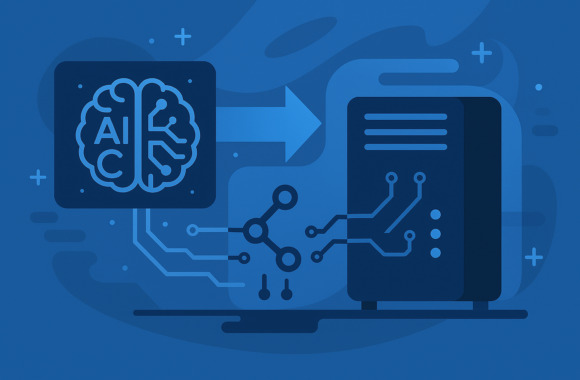
This article shows how large language models can be operated locally and in a controlled manner—specifically, step by step with Ollama in Docker.
In focusArchitecture, setup, and practice instead of product promises.
It is precisely this combination of technical depth and pragmatism that has won over many readers.
- Curious? Now entire blog post read.
Integrating AI instead of isolating it: MCP as an architectural approach
- How can language models be connected to existing IT systems in a secure, flexible, and scalable manner?
- That's exactly what Konrad Krafft and Manuel Bauer's article on the Model Context Protocol (MCP) is about, which is also one of our most popular articles of the year.
- While large language models are readily available today, the real challenge often begins with integration: How can models be reliably connected to existing systems, tools, and data sources?
- This results in proprietary interfaces, a lack of standards, and high maintenance costs.
- MCP wants to change that.
- It is not without reason that Anthropic refers to the open protocol approach as „USB-C port for AI“Described as: uniform, secure, modular—and thus the key to true scalability.
- The article highlights the technical and architectural fundamentals and shows what is important when using MCP—primarily through:
- Standardized interfaces instead of individual connections
- Interchangeability of models and sources
- Secure contexts through sandbox mechanisms
- Scalability for complex AI landscapes
- Click here to go directly to to the article.
A shared vision of 2025 – and beyond
Both articles shed light on different levels of modern AI architectures. Taken together, however, they clearly show the issues that are currently preoccupying companies:
- How can AI be used? economical and controlled operate?
- How can AI be used? Seamlessly integrate into existing IT landscapes?
The next answers are currently being developed – and we are ready to share them with you in 2026.