
TL;DR
Good architecture decisions are not the result of trends, but of a structured, comprehensible process: understanding the context/requirements, prioritizing quality objectives, comparing options based on criteria (incl. trade-offs/ATAM), checking risks via prototyping and documenting the decision with ADRs. The architecture is then regularly reviewed and adapted if the context changes.
How good architecture decisions are made in complex software projects
In dynamic markets, where requirements change quickly, and complex systems, a well-founded architectural decision more important than ever in a software project. But how do you make this decision systematically and thoughtfully?
It is one of the most important strategic decisions in every software project and determined:
- How efficiently teams can work
- How well a system scales
- How easily it can be further developed and adapted in the long term
This article presents a procedure that helps to make architecture decisions consciously, transparently and reliably - regardless of which specific architecture pattern is chosen later.
Why understanding requirements is the first step
Every architectural choice begins with a deep Understanding the project context. These include:
- Purpose and business objectives: What problems should the system solve? What is the key value added?
- Functional requirements: Which use cases and domain areas are essential?
- Load and usage profiles: How many users are expected? How high is the data volume? What are the growth expectations and how will peak loads be handled?
- quality requirements1: How is scalability ensured? What performance targets are to be achieved? What security measures are required? How is availability guaranteed? How flexible is the system in terms of changes? How easy is it to maintain and test the system?
- Strategic framework conditions: What budget is available? How quickly does the system have to be brought to market? What regulatory requirements must be observed? How will the system be integrated into existing systems?
Important: This step ensures that all parties involved, including project managers, architects, developers and other stakeholders, have a common understanding of the requirements.
How to determine the most important quality criteria for your project
Not all requirements are equally important. That is why the survey is followed by a Prioritization: Which quality features are Critical for the success of the project?
Examples (Important: Prioritizations should be quantified, e.g. on a scale of 1-5 or as a percentage, so that the weighting is measurable and comprehensible):
- High availability > Performance
- Low operating costs > maximum flexibility
- Fast delivery > perfect scalability
Such Weightings make decisions more objective. It is important that each weighting is justified: Why is one requirement more important than another? This prevents personal preferences or trends from determining the architecture.
Why your team has a say in the architecture
Technical decisions only work in the context of the organization in which they are implemented. This includes:
- Organizational structure (e.g. team size and structure)
- Experience and skill set of the team (e.g. in dealing with deployment and operational processes)
- Maturity in the DevOps area (e.g. degree of automation, CI/CD pipeline, monitoring)
- Availability of infrastructure and tooling (e.g. performance, security, maintainability)
Principle: Good architecture only exists if the team can build it and maintain it in the long term.
How to make an informed architecture decision in a software project: comparing architecture concepts in a meaningful way
In the next step, different architectural approaches are compared with each other - not because they are modern or are currently being hyped, but because they are measurably better suited to the previously prioritized requirements. The comparison thus becomes a structured and well-founded decision-making process for the architecture instead of a pure gut decision.
An effective comparison is based on two pillars: one criteria-based evaluation and one Analysis of the compromises (trade-offs).
1. Criteria-based assessment
First, you evaluate each architecture concept using the same, clearly defined quality requirements that you collected and prioritized in the previous step. For example:
- Scalability: Does the architecture grow horizontally or vertically with your user numbers?
- Costs: What infrastructure and maintenance costs will arise in the short and long term?
- Development effort: How steep is the learning curve for your team?
- Evolutionary capacity: How easy is it to replace parts later on?
A simple decision matrix often helps here to compare the concepts quantitatively. When selecting the criteria for a decision matrix, the Quality model of the ISO standard support.
2. The professional check: The ATAM method2
To make sure you don't overlook any hidden risks, it's worth taking a look at the ATAM method (Architecture Trade-offs Analysis Method). It was developed by the Software Engineering Institute (SEI) and is considered the gold standard for evaluating software architectures.
The core of ATAM is the realization that there is no such thing as „perfect architecture.“ Every decision is a compromise. ATAM helps you systematically uncover these compromises:
- Scenario-based thinking: Instead of discussing „performance“ in abstract terms, ATAM uses concrete scenarios. Example: „What happens in the system when the number of users doubles within 10 minutes?“ or „How does the architecture behave when the database fails?“
- Identification of trade-offs: ATAM shows you the interactions. An approach that is extremely secure (high encryption) often comes at the cost of performance (latency). A system that is developed extremely quickly is often more difficult to maintain later on.
- Risks and sensitivity points: You find out where your architecture is sensitive. This prevents you from „thinking in terms of patterns“ and protects you from unpleasant surprises in live operation.
Conclusion of the comparison: Instead of rashly selecting patterns, the combination of the evaluation matrix and ATAM way of thinking creates a transparent decision-making chain. You don't simply choose the „best“ pattern, but the one whose compromises are most acceptable for your specific project.
Prototyping: The key to minimizing risk
For central technical risks, we recommend a Prototype, an early, simplified implementation of a system component for testing technical approaches, or a Proof of concept, in other words, focused proof that a certain technology or idea works in principle. Questions such as:
- Does the architecture achieve the required performance?
- How does the system behave under load?
- How well does it integrate into existing systems?
- What operational challenges arise?
One Early validation saves a lot of effort later on and reduces wrong decisions.
ADRs: Document your architectural decisions in a comprehensible manner
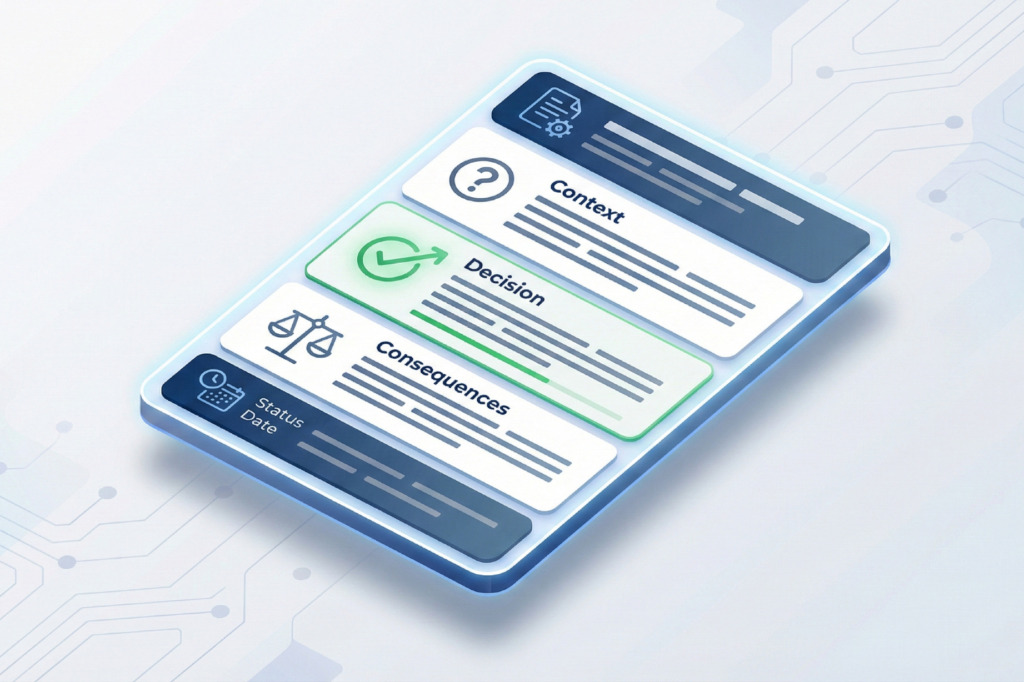
The most important step comes at the end: the decision must be documented in a comprehensible manner. Here come Architecture Decision Records (ADRs)3 into play.
An ADR typically contains:
- Context: What was the initial situation?
- DecisionWhat was decided?
- Reason: Why was this choice made?
- AlternativesWhich options were rejected and why?
- Risks and consequencesWhat does this decision mean in the short and long term?
ADRs ensure that decisions can be made even months or years later. comprehensible stay - for:
- New team members
- auditors
- Stakeholders
- Future developments
They are particularly important because the architecture, like the organization and teams, is constantly evolving: New requirements such as changing user behavior, growing user volumes or changing team situations can make adjustments necessary. ADRs document this path step by step.
Why you should regularly review your architecture
Architecture is not a unique artifact. A good system grows with its functional and qualitative requirements. It should therefore be checked regularly:
- Have loads or user numbers changed?
- Are there any new integration requirements?
- Are the operational realities different than expected?
- Has the team gained new skills or are new skills needed?
Important: If the context changes, the architecture must also be adapted, and the ADRs with it.
Conclusion
The well-founded choice of architecture in a software project is not a guessing game or a question of trends. It is the result of a structured process:
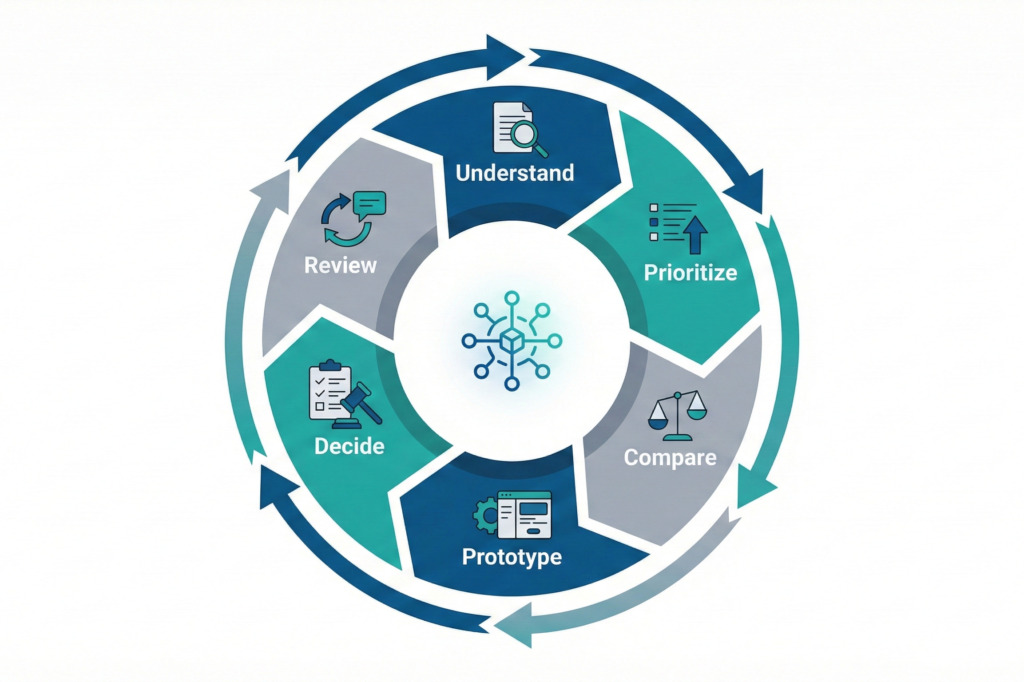
1. Understand - Capture project context and functional and non-functional requirements
2. Prioritize - Weighting quality requirements
3. compare - Criteria-based evaluation of architecture concepts (e.g. using ATAM)
4. Validate - Using prototypes to minimize risk
5. Decide - Make an informed choice and document ADR
6. Review - Regular review and adjustment
A sustainable architecture is one that measurably fits your project, your team and your framework conditions and requirements - and whose reasons, pitfalls and decisions are clearly documented.
With clearly documented architecture, you are well equipped for future challenges. Through the consistent use of Architecture Decision Records, decisions remain understandable, verifiable, and future-proof.
FAQs
How do I make a sensible start to an architectural decision?
With a common understanding of objectives, functional requirements, load profiles, quality requirements and framework conditions (budget, time-to-market, regulation, integration).
How do I prevent gut decisions and trend-driven architecture?
By prioritizing/weighting quality criteria (measurable) and comparing architectural approaches using a decision matrix and trade-off analysis (ATAM, scenario-based).
When do I need prototyping or a proof of concept?
When central risks are open: Performance under load, integrations, operating costs/monitoring or the feasibility of a technology.
How do I make decisions comprehensible and adaptable in the long term?
With ADRs (context, decision, justification, alternatives, risks/consequences) and regular reviews as soon as requirements, load or team/operational reality change.
This article was written jointly by Luca Schwarz and Maximilian Eberle.