

What hexagonal architecture can do
In the world of software architecture, there are various approaches to developing and scaling complex applications efficiently. One of these approaches is the hexagonal architecture, also known as "ports and adapters". This architecture focuses on the business logic of an application and enables a flexible and testable structure. In this blog post, we will take a closer look at the hexagonal architecture, its features, areas of application and advantages and disadvantages.
The basic idea of hexagonal architecture:
At the center of the hexagonal architecture is the business logic of the application. This logic contains the specific functionalities that form the core of the application. The special feature of the hexagonal architecture is the various interfaces, each of which is represented by an edge of the hexagon. These interfaces not only serve to receive requests from other systems, but also make it possible to address other systems via these interfaces. For example, the database adapter can communicate with the database.
Another common name for the hexagonal architecture is "Ports and Adapters". Here, the various facets of the application such as user interaction, administration tasks, data access or event processing are regarded as ports. The adapters, on the other hand, establish the connection between the ports and the technological implementations, for example through REST interfaces or web interfaces.
The hexagonal architecture offers various advantages that make it an attractive option for modern applications. One major advantage is the easy interchangeability of the interfaces. As the business logic is isolated from the specific implementation details of the interfaces, these can be easily exchanged without affecting the logic itself. This improves the flexibility and expandability of the application.
Another advantage is that the hexagonal architecture enables very good testability. As the business logic is separated from the technical details of the adapters, tests can be carried out at the logic level without depending on the specific implementation of the interfaces. This simplifies testing and enables comprehensive coverage of the application functionalities.
The hexagonal architecture also provides a clear separation between logic and the specific protocols and implementations of the adapters. This improves the maintainability and expandability of the application, as changes to the technical details of the adapters have no impact on the business logic.
The hexagonal architecture is particularly suitable for microservices architectures. The clear separation of the business logic from the technical details of the interfaces and adapters means that individual services can be developed and scaled independently. This promotes flexibility and makes it possible to expand and adapt the application efficiently.
The challenges of hexagonal architecture:
Despite the many advantages, the hexagonal architecture also has some challenges. Due to its monolithic structure, it can be difficult to scale the architecture. For rapidly growing applications, the monolithic nature of the architecture can lead to bottlenecks and limit scalability. In such cases, alternative architectural approaches may need to be considered.
Conclusion
The hexagonal architecture, also known as "Ports and Adapters", offers a flexible and testable structure for modern applications. The clear separation of the business logic from the technical details of the interfaces and adapters improves maintainability, expandability and testability. The hexagonal architecture is used in microservices architectures in particular. However, it is important to note that the monolithic structure of the architecture can limit its scalability. The specific requirements and challenges of the application should therefore be taken into account when choosing the right architecture.
Summary
We have briefly summarized the most important features of this style for you as a picture.
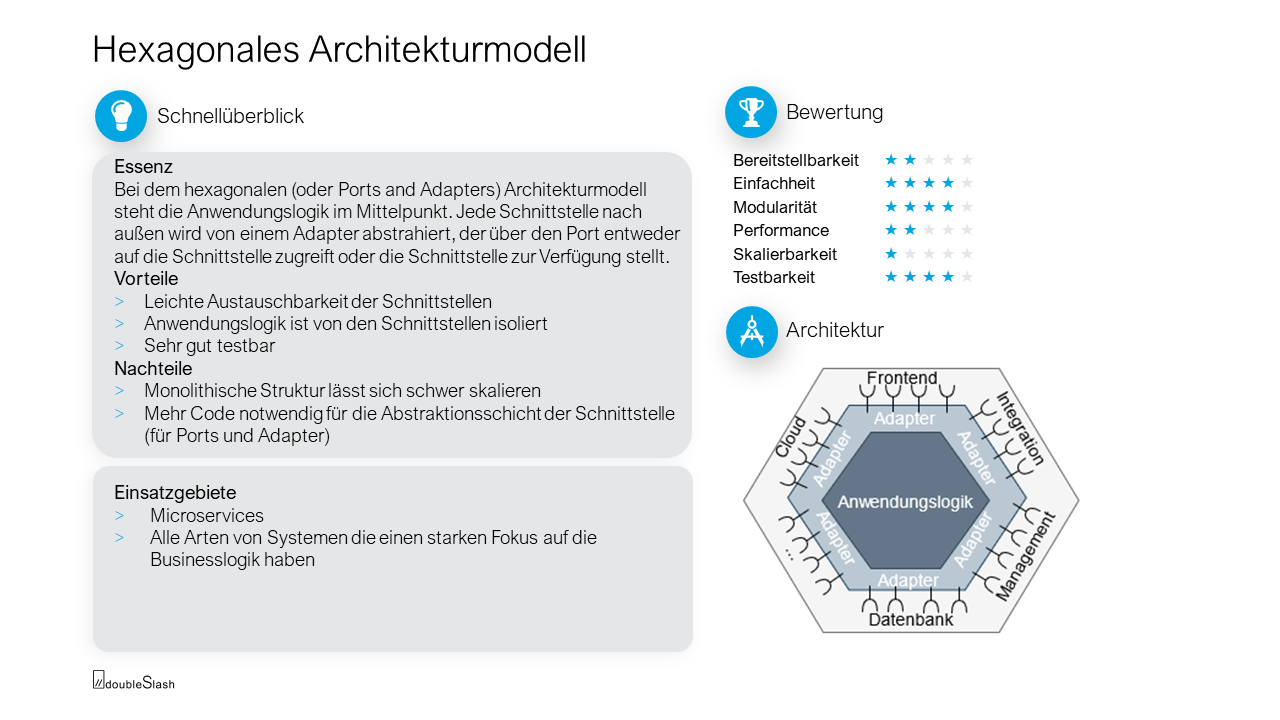
Disclaimer: The Architecture Spicker is largely based on the book Handbook of modern software architecture by O'Reilly. For more in-depth information, we recommend buying this book.