

What microservice architecture can do
In the world of software architecture, there are various approaches to developing and operating complex systems efficiently. One of these approaches is the use of microservices. This distributed architecture is based on the concept of "bounded context" from domain-driven design and aims to create encapsulated and independent services that each handle a specific business requirement. In this blog post, we will take a closer look at microservices, their areas of application and their advantages and disadvantages.
Microservices are independent services that are operated as separate processes and are ideally hosted on different (virtual) machines. Each service is responsible for processing an encapsulated business requirement and communicates as little as possible with other services. This achieves a high level of scalability and interchangeability. The concept is based on the bounded context from domain-driven design, in which the business requirements are divided into clearly delineated areas.
Microservices are particularly suitable for medium-sized to large systems in which loosely coupled use cases exist. By splitting the functionalities into independent services, complex systems can be made more manageable and development and maintenance can be simplified. Microservices also offer a good solution for use cases where scalability and reliability are important.
Embedded systems, i.e. embedded systems with limited resources, are unsuitable areas of application for microservices. Due to the distributed nature of the architecture and the associated network communication, microservices are not efficient in such environments and lead to disproportionate overheads.
Microservices offer a number of advantages that make them an attractive option for modern systems. A high level of reliability of the overall system is achieved if the microservices are well designed and have a clear separation of business requirements. The scalability of the individual services means that the system can be flexibly adapted to increasing requirements. Microservices also enable good interchangeability, as individual services can be developed and exchanged independently of each other.
Splitting business requirements into encapsulated services can be a complex and error-prone task. Poor tailoring of services can lead to high coupling and limit the benefits of scalability and interchangeability. In addition, the performance of the system can be affected by the additional network traffic between the services. Careful planning and design of microservices is therefore essential to overcome these challenges.
Conclusion
Microservices offer a scalable and interchangeable architecture for modern systems. By splitting business requirements into independent services, complex systems can be made more manageable. The advantages of microservices lie in their reliability, scalability and interchangeability. Nevertheless, the design of microservices requires careful planning in order to manage complexity and avoid potential challenges such as high coupling or performance losses. However, with a well thought-out architecture, microservices can help to develop and operate modern systems efficiently.
Summary
We have briefly summarized the most important features of this style for you as a picture.
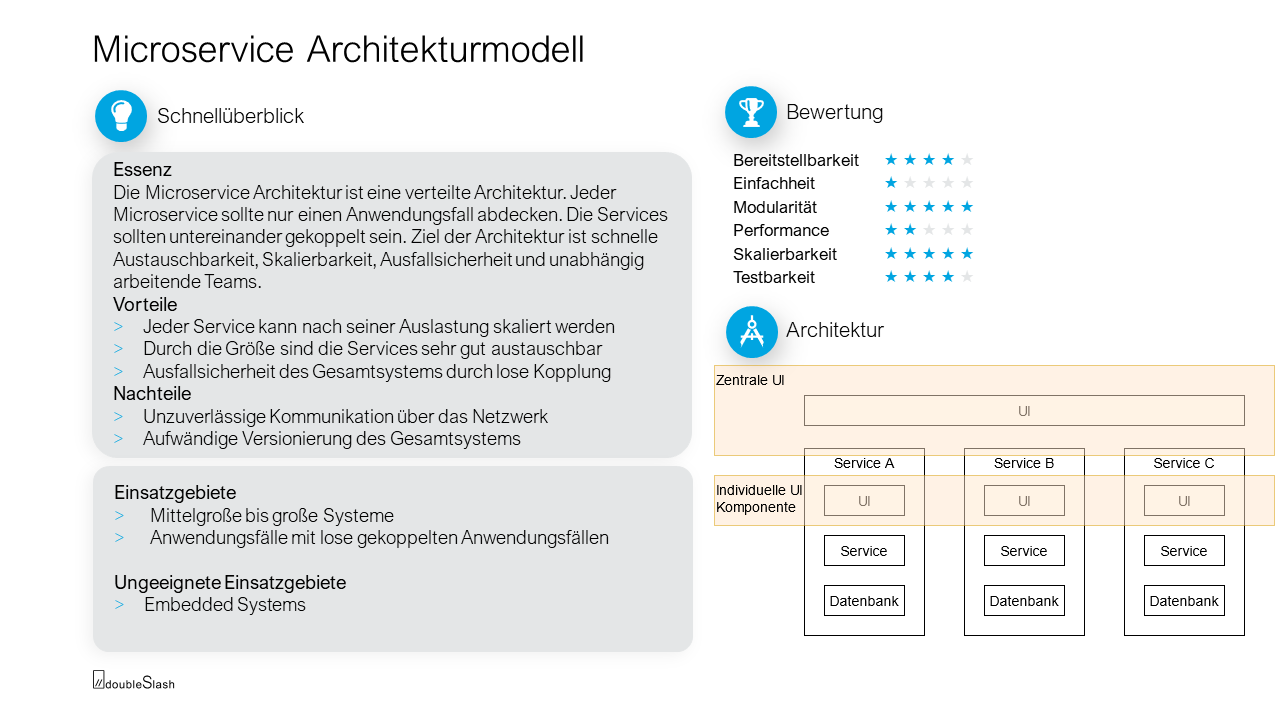
Disclaimer: The Architecture Spicker is largely based on the book Handbook of modern software architecture by O'Reilly. For more in-depth information, we recommend buying this book.