

What layer-based architecture can do
In the world of software architecture, there are various approaches to designing the structure and organization of systems. One of these approaches is layer-based architecture, which offers a simple and obvious solution. In this blog post, we will take a closer look at layer-based architecture, its areas of application and its advantages and disadvantages.
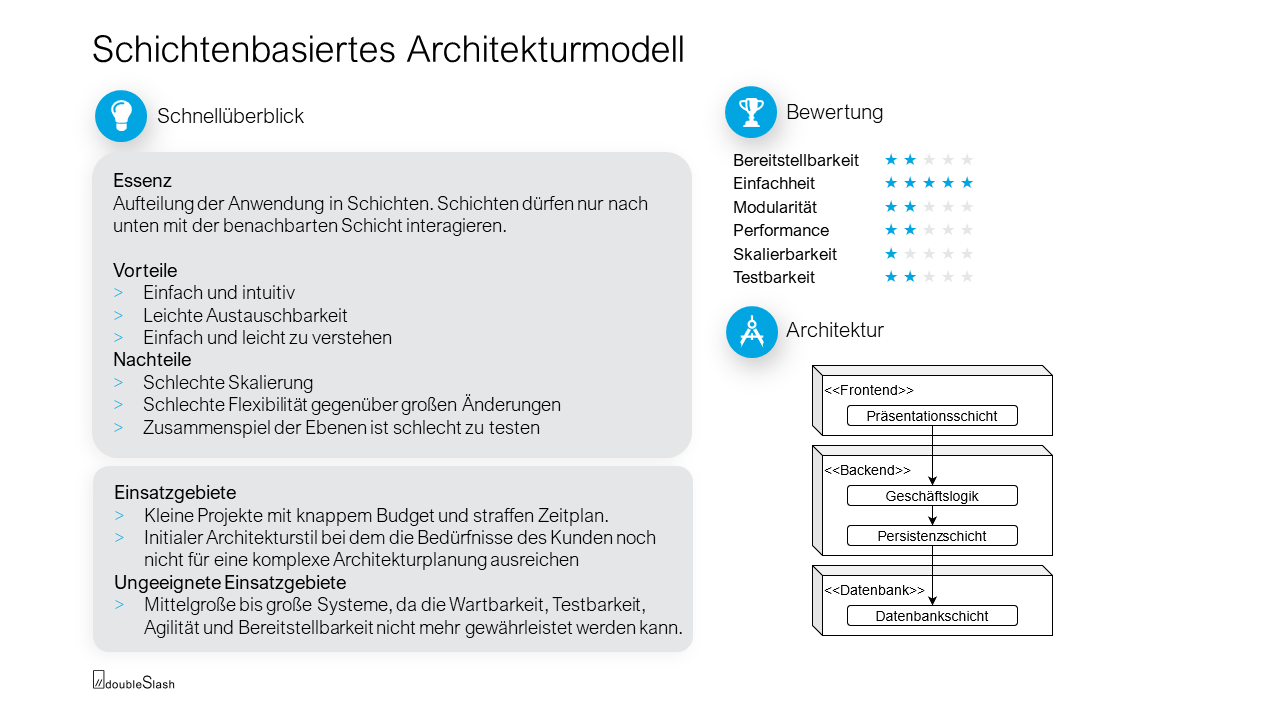
The layer-based architecture consists of different layers, each of which has specific responsibilities. In principle, there are no restrictions on the number or type of layers, but most architectures of this type consist of the three standard layers: Presentation, Business Logic and Persistence or Database. These layers can be implemented either in a monolith or in different physical components.
The basic principle of the layer-based architecture is the "separation of concerns" (separation of responsibilities). Each layer has its own tasks and can only access the next layer down. The presentation layer does not need to know how business data is stored and the business logic layer does not need to know how the data is represented. Direct access to a higher-level layer is not permitted.
It is important that the layers only interact with the layer immediately below. Otherwise, strong couplings occur, which can impair the development speed and lead to unexpected problems.
The layer-based architecture is particularly suitable for small projects with a limited budget and tight schedule. In such cases, a simple architecture that can be implemented quickly can be advantageous. Even if the customer requirements are not yet sufficient to carry out complex architecture planning, the layer-based architecture can serve as a starting point.
However, the layer-based architecture is not suitable for medium-sized to large systems. With increasing complexity, maintainability, testability, agility and deployability can no longer be guaranteed.
The layer-based architecture offers several advantages. The loose coupling of the layers makes it very easy to exchange them. The simplicity and widespread use of the style also has a positive effect on the development process. Development costs tend to be lower as the architecture is well known and understood. Each layer can be tested separately, which improves quality assurance.
However, there are also disadvantages to the layer-based architecture. In the event of changes or new features, adjustments usually have to be made in all layers, which involves a high level of coordination. With monolithic implementation, the entire system must be completely redelivered with every change. Changes can lead to unexpected boundary conditions, and changes in one layer often result in changes in other layers. The interaction of all layers is difficult to test and the scaling of individual layers in terms of load is challenging. Due to the monolithic structure, all layers share resources, which can lead to an overall failure. Restarting the system takes longer due to the monolithic structure, and the system cannot grow indefinitely as scaling can only be done vertically. Assuming that no load balancer is used.
Conclusion
Overall, the layer-based architecture is a simple and easy-to-understand solution that is suitable for certain use cases. For small projects with limited budgets and tight schedules, it can be an efficient choice. However, the potential drawbacks must be considered, especially when it comes to scalability, flexibility and maintainability of medium to large systems. Careful consideration of requirements and proper planning are critical to choosing the right architecture for the project at hand.
Disclaimer: The Architecture Spicker is largely based on the book Handbook of modern software architecture by O'Reilly. For more in-depth information, we recommend buying this book.