
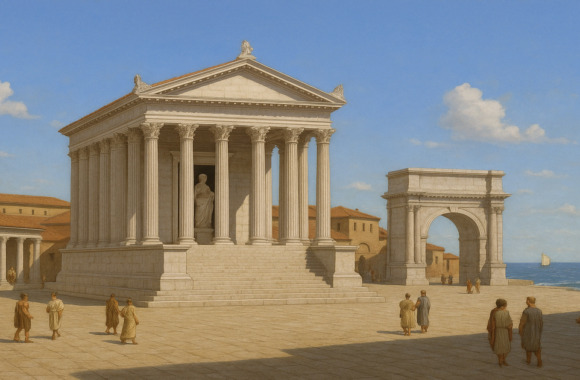
Even in ancient Rome, the architect Vitruvius (Marcus Vitruvius Pollio) principles that are still valid today - not only in building construction, but also in software architecture. His famous trinity - Firmitas, Utilitas and Venustas - describes what makes good architecture: stability, functionality and attractiveness.
Vitruvius' architectural principles in the building industry
Vitruvius formulated his work between 33 and 22 BC around 15 BC De architecturain which he postulated that a building can only be considered successful if it fulfills three requirements1:
Firmitas - Stability:
A building must be durable and solid, resistant to weathering and loads.
Example: The Roman aqueducts have survived for centuries thanks to their massive stone arches and ingenious statics.
Utilitas - practicality:
A building must serve its intended purpose - be it residential buildings, temples or baths.
Example: The Colosseum, with its 80 entrances, was designed so that over 50,000 people could flow in and out in a very short time.
Venustas - Beauty:
Architecture should also be aesthetically pleasing and appeal to the senses.
Example: The proportions of the Pantheon are based on mathematical harmony, which is still considered beautiful today.
Transfer to software architecture
Just as buildings follow these three principles, digital systems should also Firmitas, Utilitas and Venustas unite. Software must also run stably, offer value-adding functionality and be perceived - by users as well as developers.
Firmitas - stability and durability
In terms of software architecture, this means that your system remains stable - even under load or in the event of an error. Or it can be restored quickly in the event of a failure.
You can achieve this, for example, by:
- Redundancy & failover
≥ 2 pods + anti-affinity via zones, shared storage; PostgreSQL cluster with Patroni - Fault tolerance
Timeouts, retries, bulkheads; monitoring via Prometheus - Backup & Recovery
Snapshots with Velero/pgBackRest, infrastructure via Terraform,pg_restore+ DR tests - Monitoring & Self-Healing
Grafana/ELK combination, Kubernetes restarts, Argo rollouts, KEDA for autoscaling - Robust APIs
Backwards-compatible REST/gRPC interfaces with OpenAPI/Protobuf
Utilitas - benefit and function
Architecture must serve its purpose.
A well thought-out software architecture ensures that the requirements placed on it are met. In contrast to buildings, software is frequently adapted or expanded. This means that the architecture must ensure that this can be done economically.
You can achieve this, for example, by:
- Purpose-oriented architecture
Patterns that support development & maintenance in the long term - Modularity
Hexagonal architecture or Clean Architecture separates domain and technology - Domain-Driven Design (DDD)
Bounded contexts, clear service responsibility - Scalability
Event-driven microservices with Kafka or RabbitMQ - Configurability
Feature toggles (e.g. openfeature.dev), plug-in systems - API-First
Stable interfaces, independently deployable front & back ends
Venustas - Attractiveness and experience
Good architecture appeals to our senses.
In the digital space, this is reflected in a high developer experience (DX), clear interfaces and comprehensible code.
You can achieve this, for example, by:
- Developer Experience (DX)
Structured code, good documentation, consistent dev environments - Consistent APIs
REST/GraphQL, speaking endpoints, suitable granularity - Readable code
Linter, formatter, style guides, peer reviews - Modularity in the front end
Micro front ends, component libraries, monorepos - UX-optimized backends
Backend-for-Frontend (BFF), GraphQL for client-specific payloads - DX-Tools
Fast CI/CD pipelines, Docker-based dev environments
Conclusion: Good architecture is interdisciplinary
Even if buildings and Software are completely different things - good architecture remains interdisciplinary. It unites Function, stability and aesthetics.
Ask yourself with every architectural design:
Does your system live Firmitas, Utilitas and Venustas?