 More and more products are networked. Cisco, for example, estimates that the number of connected things will rise to 50 billion by 2020. This would mean that, on average, each person will have around seven connected products in use (based on an estimated global population of 7.7 billion people by 2020). More smart products are already being added every day: in addition to smartphones, tablets and PCs, these include more and more cars, coffee machines, traffic lights, parking meters and even cows have already been networked [1]. In this three-part blog series "The Internet of Things - optional extra or mandatory for your business success", we show how the newcomer IoT is becoming a basic technology.
At the CES in Las Vegas, Samsung recently announced that 90 percent of products bearing the Samsung label will be connected by 2017. Over the next five years, every Samsung product will be connected - from smartphones and TVs to refrigerators [2]. The Disproportionate increase in networked devices and machines also means that the global data traffic on the Internet (IP data traffic) will increase dramatically will grow. According to Cisco, this is expected to amount to an estimated 1.8 zetabytes in 2018, which represents an increase of around 300 percent compared to 2013 [3].
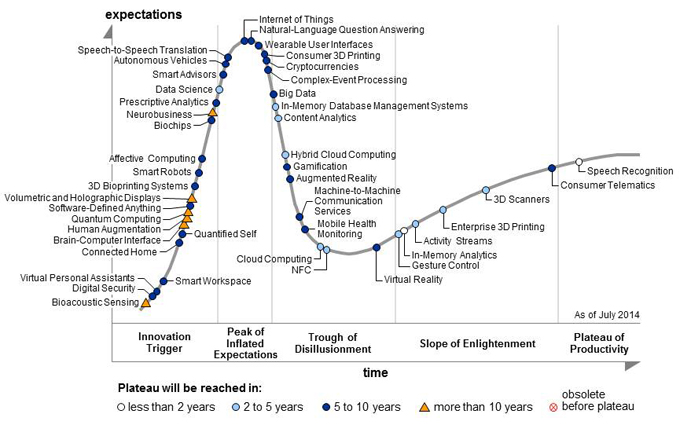
In its most recent update of the Hype cycle for emerging technologies - Gartner Hype Cycle for Emerging Technologies 2014 [4] - places the Internet of Things at the highest point in the "peak of inflated expectations" phase. Gartner predicts that the Internet of Things will reach the "plateau of productivity" phase in the next five to ten years.
IoT - from optional to mandatory
What can companies learn from this?
- Companies that have already jumped on the bandwagon and are now Optimizing business processes with the help of new technology or even completely redesign them, are Benefit in the long term.
The benefit: Companies that utilize the new technology quickly and sensibly can secure a sustainable competitive advantage.
The risk: The use of new technologies also entails certain risks, e.g. a lack of acceptance among employees, a lack of expertise in the area of agile software development or data security. - Companies that take a slightly wait-and-see approach to the current situation but plan to use the new technological possibilities within the next twelve months can hardly expect to gain a competitive advantage. However, clear advantages can also be identified for these companies.
The benefit: The so-called "fast followers" are likely to benefit from further falling prices, an increase in industry standards and more experience.
The risk: It is quite possible that the competitive advantage gained by the competitor is so great that it cannot be made up in the medium term. - Companies that do not consciously and actively respond to the trend of increasing digitalization and therefore do not plan to actively use the new technologies will very likely be at a significant competitive disadvantage.
There is no clear, strategic benefit here in the long term. In the short and medium term, however, this type of company saves on the necessary capital expenditure for hardware, connectivity, software (consulting and integration) and for the necessary knowledge development within their own organization.
These and other well-founded forecasts show that the expectations for the new technology are just as enormous as the speed at which IoT is developing.
The necessary Building blocks for successful market penetration are already available:
- The Hardware (embedded system)which ensures that the relevant data is collected, aggregated and subsequently communicated in the product, has been around for years. Performance is increasing rapidly, while prices are falling.
- The Connectivitywhich ensures that the collected data is sent from the product to a service, e.g. to a suitable IoT platform. Here, too, it can be seen over the last few years that the performance and number of providers has increased and the services are becoming ever cheaper.
- Another fundamental building block for a reliable and scalable IoT solution is a so-called IoT or M2M platform. This solution module has the task of decoding and storing the machine data so that it can be further processed and used in the next step.
- The final building block in an IoT solution is the Integration into the corporate system landscape. The data must be integrated into the company's system landscape so that it can be used sensibly for internal processes (e.g. monitoring and reporting of product quality) as well as External processes (e.g. actively contacting the customer when the next service is due) can be used.
The The Internet of Things is the technological basisto optimize business processes or even implement completely new business models.
Read part 2 here: IoT is completely reshaping the value chain
Read part 3 here: IoT decision in your company: Weighing up opportunities and risks sensibly
Sources:
[1] http://blogs.cisco.com/diversity/the-internet-of-things-infographic
[2] http://www.cnet.com/news/samsung-co-ceo-in-5-years-all-our-products-will-be-internet-connected/
[3] http://www.techradar.com/news/internet/broadband/the-internet-of-things-will-cause-ip-traffic-to-skyrocket-300-by-2018-1252812
[4] http://www.gartner.com/newsroom/id/2819918
[5] Image source: Fotolia © bakhtiarzein