

After we had first part of our blog series have reported on the development of IoT, the second part the benefits of IoT for companies and customers. The Internet of Things is the technological basis for new solutions and business models. Ultimately, every successful business model also addresses a real customer need. For example, the solution must support the customer in becoming more efficient (this saves the customer time and therefore money) and enables the customer to do completely new things (this can give them a strategic market advantage).
So that IoT is the right decision
From a business perspective, it is important that the IoT-based solution has a quantifiable added value in the company offers. The all-important question before the GO or NO GO decision is therefore often: when will our Investment and how high is the subsequent profitability, i.e. the return on investment? ROI (return on investment)?
There is no generic answer to this question, as every project and every business process is unique. The following questions will help you make a basic decision for a new, IoT-based solution:
- Which process steps slow down my standard process times?
- Example: If the service technician does not know exactly what damage exists on the device or machine and what spare parts he needs before leaving for the customer, this can increase the process time and drive up costs unnecessarily.
- How much does it cost me to have this information available in real time?
- Example: The one-off implementation of the solution costs €200,000, with operating costs of €1,500 per month.
- How much time is assumed to be saved in the core service processes over the next 12 months?
- Example: The new, IoT-based solution can significantly increase the "first resolution rate".
These questions alone help to provide an initial indication of how high the savings potential in the company can be. It is also important to consider the added value generated for the end customer, which is usually not clearly quantifiable, such as increased customer satisfaction or improved customer loyalty.
In consultations and workshops with our customers, we use a simple maturity model, to achieve a common basic understanding of both the Status Quo as well as the Overall strategic orientation of the customer. The model is divided into four phases and shows how mature the company already is in terms of product networking and where the journey could take it.
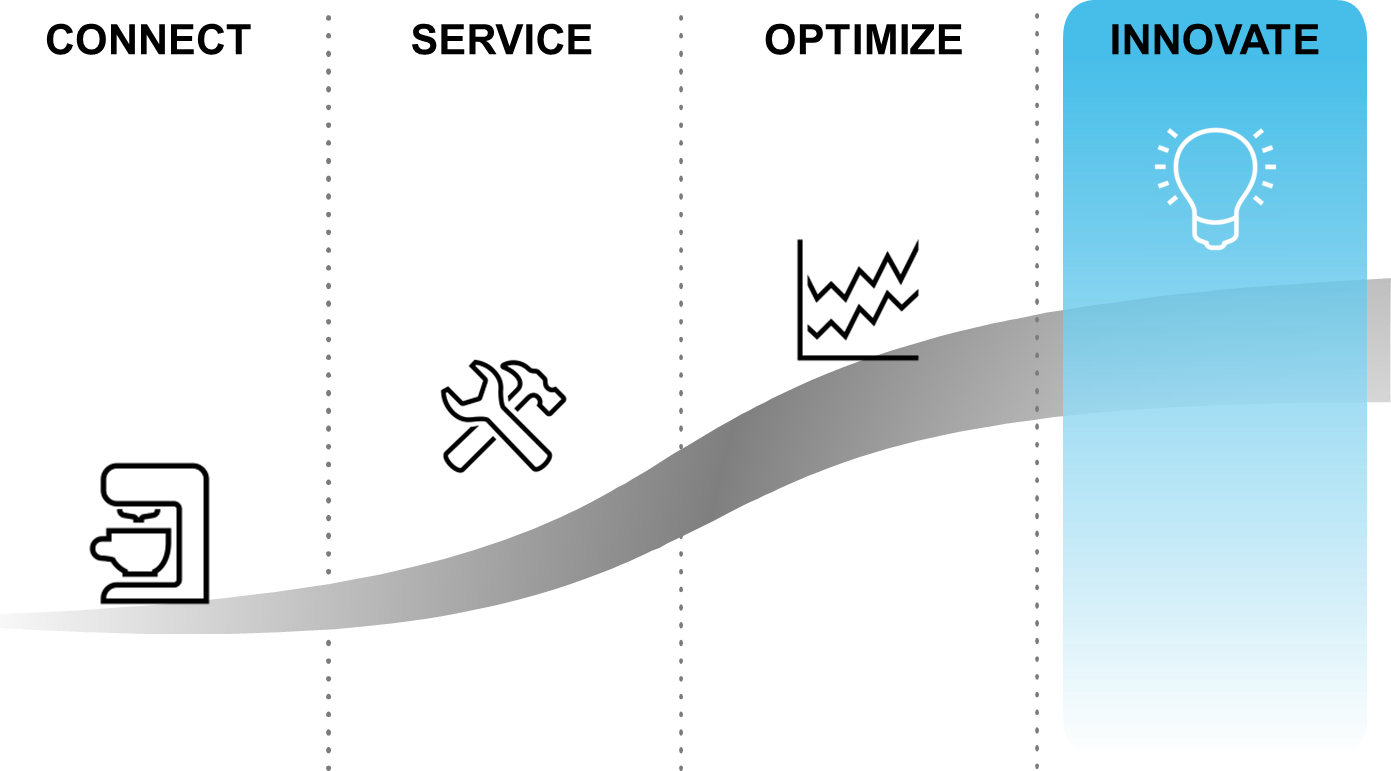
Phase 1 - connect
Companies whose products are not yet networked are in this phase. Questions relating to sensor technology, connectivity and data need to be answered here.
Phase 2 - service
In development stage two are companies whose products are already networked and can be used for certain services. At this point, questions relating to M2M or IoT platforms, data visualization and service processes are relevant.
Phase 3 - optimize
This is where companies whose products and IT applications already support certain service processes in digitalized form stand. At this point, it is important to address issues such as business integration and value-added services for the customer,
Phase 4 - innovate
Phase four includes companies whose products and IT applications are already fully vertically integrated into existing business processes. Strategic issues in the "new business models" domain are the main focus here.
This three-part blog series has primarily shown that IoT has outgrown its infancy. Various analyses and studies show that the Market continues to grow rapidly and in the coming years with more efficient, more favorable solution modules can be expected. Companies that want to make use of the new technology in the short term have a good chance of finding a sustainable competitive advantage to achieve. Some exciting examples of what this can look like come from the automotive and consumer goods industries, such as Tesla and Philips. Before this can be achieved, however, various questions about the "IoT maturity level" of the company to answer.
Have we sparked your interest in IoT? On Thursday, 23.04.2015, we will be hosting a themed evening at our Munich branch focusing on aftersales services and the opportunities they offer companies.
Read part 1 here: IoT - from newcomer to market breakthrough
Read part 2 here: IoT is completely reshaping the value chain
Sources:
[1] Image source: iStock © prawny