The focus is now less on the short-term sale of products and more on the Customer himselfThe benefits and long-term value (Customer Lifetime Value) for the company in the Focus. This change in perspective is also changing what companies offer. Apple, for example, has long since ceased to be a product company. The company's strategy has long since ceased to be based solely on the sale of end devices. customized services using the Apple ID. Many other companies now offer subscription-based business models.
1Not only to benefit from this trend, but also to stay in the market. Thus, according to Zuora's CEO Tien Tzuo, the Digitalization leads to a renaissance of the subscription model following the example of Netflix and Spotify, which will disrupt all sectors - from the automotive industry to retail and manufacturing. It is the "beginning of the subscription age" and the "end of ownership". However, the transformation of one's own, usually product-centric business model to a subscription-based business model can be difficult.
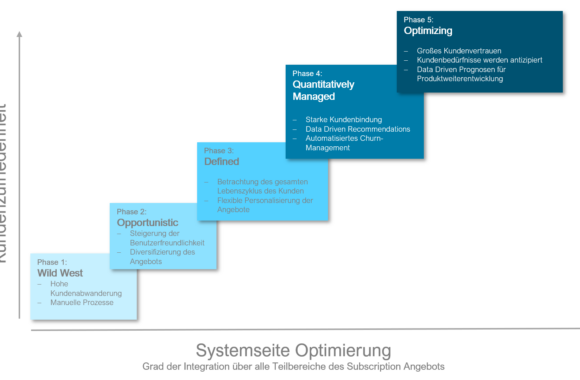
The Subscription Maturity Model is to be used for the Corporate transformation as a guidepost and support them successfully. It provides a basis for identifying and prioritizing the necessary steps for five different phases that companies may find themselves in. Our experience has shown that companies can reach phase 4 or even phase 5 as quickly as possible if early into the Processes and systems invested is implemented. The processes should be fully automated across the entire lifecycle of a customer, i.e. from offer browsing to lifecycle management and invoicing.
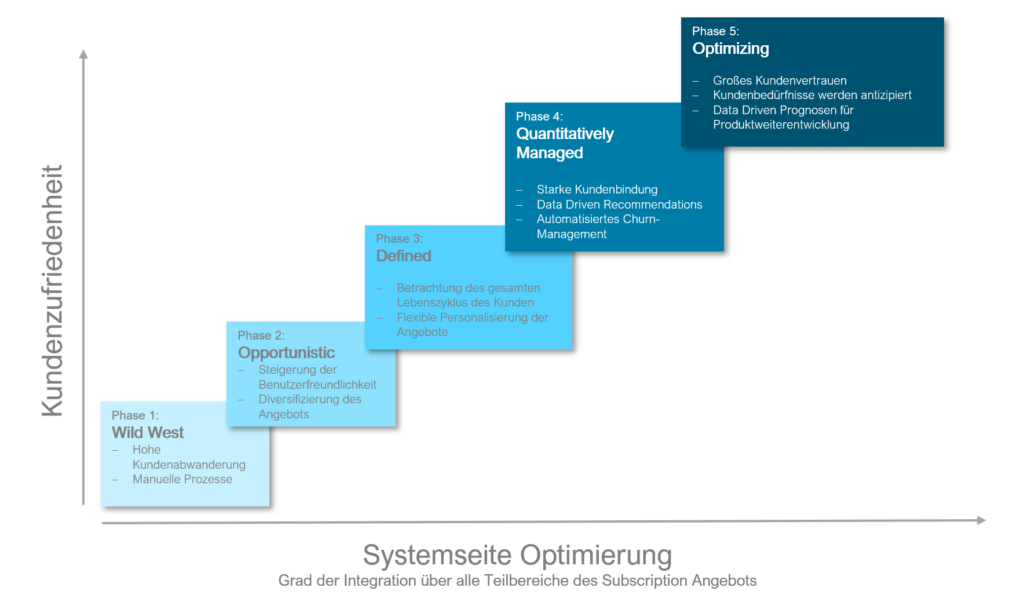
Phase 1: Wild West - anything that brings customers is allowed
As the name of the first phase suggests, anything goes as long as it increases the number of subscribers. The focus here is undoubtedly on the Customer acquisition. In order to reach as many customers as possible as easily as possible, a "One-size-fits-all" pricing strategy resorted to. The company must invest resources in order to move out of this phase, even though no profit or even losses are being made at this time.
Other things, such as expanding the range or differentiating the price model, are not taken care of at first. Customer loyalty is also neglected in the first phase. This leads to the Customer migrationis quite high, regardless of price or performance. The customer experience is also inconsistent and the Costs for customer acquisition are quite high.
It is difficult for companies to move out of this phase. In order to develop further, they must Resources and time invested without the profitability being directly apparent. Many companies with traditional business models find themselves in this phase for a long time. This may be because, for example, the company treats the acquisition of a customer merely like the sale of another product. As a result, both the IT landscape and the portfolio of products and services are usually focused purely on Short-term, product-oriented Transactions aligned. In some cases, customers' unwillingness to pay also poses a challenge when switching from the initial free offer to a paid subscription.
Phase 2: Opportunistic - refine the subscription offer and reduce costs
In the second phase, the main focus is on refining the offering and reducing customer acquisition costs. The focus here is on the User-friendliness of the offer and the ability to easily register as a user, for example through self-service portals. However, the provider lacks the ability and infrastructure to scale the number of users and generate data-based insights into user behavior. Attempts are being made to Segment demand and differentiate supply. Customer satisfaction is increasing thanks to the refinement of the offering and increased user-friendliness. Nevertheless, customer churn is still very high, while customer value remains low.
The view of a complete customer life cycle has also not yet become established and is therefore not reflected in the system landscape. The segmentation of the offering and customers is limited purely to the front end, and does not interfere more deeply with the processes and systems in the back end. For example, when running through an entire Process manually supported interventions and procedures, such as manual steps in invoicing, still plays a major role.
Although the costs for customer acquisition can be reduced in this phase, the customer value remains at a low level. This is due to the fact that subscription providers in this phase still fundamentally lack the ability to create high customer value after acquisition.
When a company finds itself in this phase, the focus should be on moving away from customer acquisition, which has dominated up to now, towards a more sales-oriented view to develop the Corporate transformation to move forward.
Phase 3: Defined - the entire customer life cycle is considered and suitable subscription offers are formulated
In this phase, the focus is no longer on pure customer acquisition, but on the Development of a holistic monetization strategy. Structures are formed that simplify the renewal of the subscription and prevent the emergence of a real, defined customer life cycle support. A subscriber-focused platform is being developed that offers a Flexible personalization makes this possible. The focus is on the customer. This is also reflected in the establishment of a central customer ID which the entire platform and the use of the services are geared towards.
This is supported by a so-called Customer success team is formed. It takes care of customer support (reactive communication with the customer) and customer success management (proactive action towards the customer). Customer lifecycles are created that go beyond the registration of a subscription and are viewed from a holistic perspective. Strategies are developed that contribute to this, Identify customer groups and the Assign the correct levels of the subscription offer.
Customer growth is generally still very high in this phase, which is why the costs of customer acquisition can still exceed the value of the customer life cycle. However, the first positive trends can be derived from the general development of customer value, the level of recurring revenue and the customer retention rate.
Phase 4: Quantitatively managed - strong customer loyalty and long customer lifecycles with suitable subscription offers
The subscription providers that are in this phase have not only created the conditions for strong customer loyalty and long customer lifecycles, but are also taking advantage of the collected data for the further development of all aspects of the businessin particular the development of even deeper relationships with customers.
In concrete terms, this means system and process-supported capability, Accompany and support customers in their personal development. For the customer, this includes switching between offers, combining offers and receiving personalized recommendations.
An active reporting system is established for all sub-areas of the subscription offering, whereby the company's financial situation is monitored using a wide range of key figures. This provides a more detailed view of the most important key figures and the company is increasingly building a Quantitative basis for decision-making on. This allows the influence of central decisions on revenue generation to be predicted to a certain extent. By improving the subscription offer and the relationship with the customer, the revenue generated by existing customers increases. The focus is on both profit and growth.
In this phase Trust has developed into a core valuewhich is a prerequisite for the next phase. This trust can be built through a high level of transparency, where customers have control over their subscription through user-friendly pausing, resuming, renewing or canceling.
Phase 5: Optimizing - Tailor-made solutions for the customer - the subscription offer of the future
The focus in this phase is on efficient growth and the Creation of customer benefits. Ideally, the company is strongly focused on its customers in order to generate value and benefits together with them. This puts the customer in the central role of "service beneficiary", whereby the company helps them to experience individual value when using the product or service. To make this possible, the company has learned to reach this stage, Anticipate customer needsThe aim is to align the product or service with this and at the same time give customers control over their subscription.
The processes are supported by systems that enable an optimized customer life cycle and thus a seamless transition between the order, revenue recognition and back to the order. Up to this point, the system landscape of the subscription provider has Highest degree of integration across all areas of the subscription offering achieved. Customers can shop via any channel and experience the same quality of service everywhere.
The company has a certain Price flexibility. This enables it to conduct technology-supported price experiments, the effects of which can be observed in real time. The subscription provider has implemented the capability, collect, integrate and evaluate important key figures across all subscription offers. This includes, for example, the number of postings and invoicing, realized sales, sales backlog and deferred income. By subsequently analyzing the collected data, companies can forecastwhen a customer wants to adjust their subscription in order to achieve their desired benefit. The provider can respond to this and develop measures that Support customers in customizing their offer. Customer care teams are responsible for evaluating customer usage data and finding out whether customers are actually achieving their expected benefits. Although the company is constantly acquiring new customers, it generates the majority of its revenue from Recurring income from both up-sells and cross-sells, as well as contract renewals.
The four dimensions for a future-proof subscription model
We have been advising customers in this environment for over ten years - regardless of which of the five different phases they are in. In addition, we always consider four different dimensions, which we believe are essential for a solid and sustainable subscription model:
Strategy: The introduction of subscriptions fundamentally changes the business model.
Culture: The new business models around subscriptions have an impact on all business areas in the company.
Process: From CPQ (Configure Price Quote) in the sales area to customer support and invoicing, new processes need to be introduced and existing ones further developed.
Systems: Existing systems in the company quickly reach their limits.
Conclusion
From practical experience, we can say that although trends are short-lived, the global development of customer behavior and the increasing oversaturation of the markets mean that it is foreseeable that the trend will continue. Subscription-based business models will continue to spread in the future. The incoming Transformation of companies represents a complex and long-term process is presented. The Subscription Maturity Model describes the five phases that a subscription provider can go through in order to optimize its offering. In our experience, the Maturity Model has shown that the Basis for roadmap development and creates a Reference model for the sustainable further development of the subscription offering represents. It provides companies with guidance on how to position themselves in this longer-term process and, depending on the phase, identifies specific fields of action and the associated optimization potential.
But not without a vision. The Matrurity Model Framework therefore serves as a bridge between the vision of transforming an entire company into a subscription provider and the activities to turn this vision into reality. With countless possible activities to choose from, it provides clues as to which specific activities can have the greatest impact on the implementation of a successful subscription model.