
What is New Work?
New Work describes a profound cultural and structural change in companies. It is more than just a trend: it is a comprehensive transformation that goes far beyond flexible working hours and working from home. The focus is on overcoming rigid hierarchies and traditional working models in order to offer employees more autonomy, flexibility and opportunities for self-realization. This is achieved through fluid teams, self-organized working methods and greater involvement of employees in decision-making processes.
From an employer's perspective, this holds enormous potential for attracting and retaining top performers in specialist and management positions and thus promoting sustainable, successful corporate development.
Definition of New Work
New Work focuses on employees and their needs and skills and promotes a work culture based on flexibility, personal responsibility and a sense of purpose.
What are modern remuneration models?
Modern remuneration models are not only based on market comparisons, but also focus on aspects such as fairness, transparency and participation. The aim is to create a salary structure that reflects the values and goals of the organization and at the same time takes into account the needs of the employees.
Modern remuneration models
Innovative remuneration models that are based on fairness, transparency, personal responsibility and participation and thus support a modern, future-oriented corporate culture.
Why is a participative salary formation process so important?
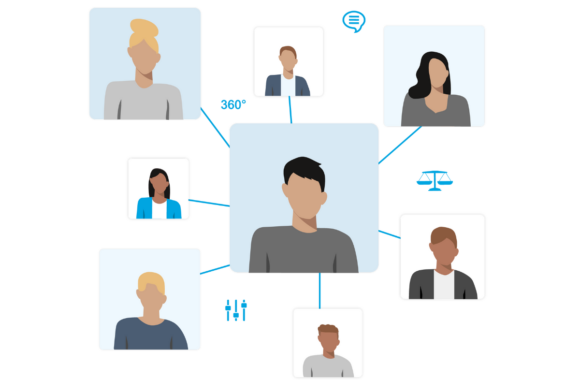
Participation is a fundamental principle of New Work and innovative remuneration models. A participative approach to skills assessment as part of the salary formation process strengthens employees' trust and motivation. If they are actively involved in these processes, a feeling of appreciation is created, which has a positive effect on their loyalty and satisfaction. Young managers or representatives of a modern management style can also be found in this approach. This also increases the chances for employers to attract and retain good managers. Participation can be promoted through the use of a 360° feedback tools This can be promoted considerably by incorporating feedback from different perspectives into the salary determination process.
How does a company become New Work Ready?
To become New Work Ready, companies need to consider the following aspects:
- Cultural changeCompanies must create an open, transparent and participative corporate culture in which employees are actively involved in decision-making.
- Technological supportThe use of modern tools, such as a 360° feedback tool, supports the necessary transparency and participation in the salary formation process.
- Agile structuresAway from rigid hierarchies towards agile, self-organized teams that can react flexibly to changes.
- Continuous learningPromoting a learning culture in which employees continuously develop their skills is crucial.
Four phases on the way to becoming a New Work Ready Company
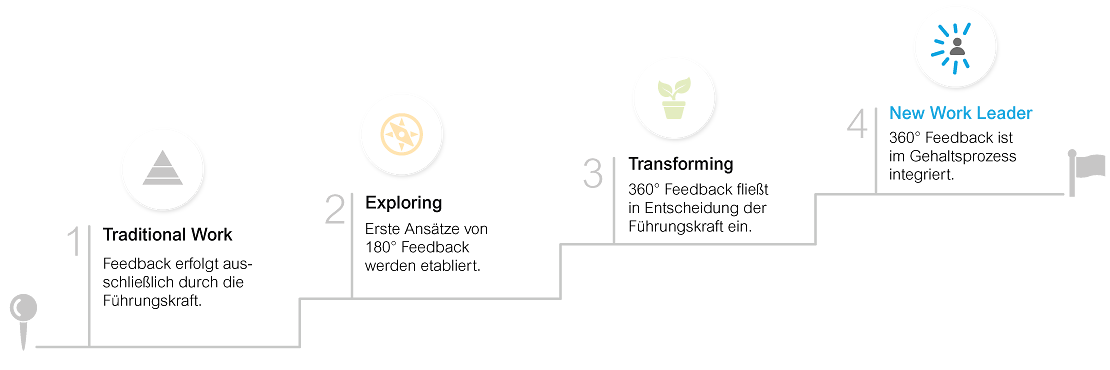
Change takes time and usually happens in phases. For example, companies can go through the following stages on their way to becoming a New Work Ready Company. Each phase brings with it specific challenges and opportunities and encompasses different aspects of New Work:
- Phase 1: Traditional Work
Highly hierarchical structures without employee participation. Flexible working models and modern salary formation processes are not established. - Phase 2: Exploring
The first steps towards New Work are being taken. Employee opinions are included in decision-making processes and there are approaches to flexible working models, while the salary formation process remains traditional. - Phase 3: Transforming
360° feedback is being introduced, participation is increasing. There are flexible working models and self-organized teams that are driving change forward. - Phase 4: New Work Leader
New Work principles are fully integrated, with extensive employee participation in decision-making processes, flexible working models and a transparent salary formation process supported by 360° feedback.
These phases provide an insight into the possible development process towards a modern, employee-centered corporate culture. For detailed insights into each phase and specific recommendations for action, download our free eBook down.
How does a 360° feedback tool support change?
A 360° feedback tool plays a central role in the transformation process towards a New Work Company. It enables the comprehensive collection of feedback from different perspectives, which forms the basis for transparent decision-making processes. Particularly in the salary formation process, such a tool promotes employee participation and supports an open, appreciative corporate culture.
But how can a 360° feedback tool be used specifically in a company? Our doubleSlash evaluation tool offers a range of functions that are specifically designed to establish a participatory and fair evaluation process. It integrates feedback from various stakeholders and enables a holistic and differentiated evaluation of employees. In addition to the secure management of employee data, the software ensures a continuous and up-to-date performance assessment through evaluations throughout the year and the aggregation of individual evaluations into an overall result. The special feature of our tool is that it can be used in different dimensions. Whether as a pure feedback tool for a small group of people, e.g. management appointments, or as a central component of company-wide salary formation - the customer decides on its use. And can move step by step towards New Work or modern remuneration models without having to change the tool or invest in others.
Of course, it takes courage to relinquish responsibility in the skills assessment and salary process, because change brings uncertainty. But this courage is crucial in order to move with the times and remain attractive as an employer for applicants and employees. The doubleSlash 360° feedback tool can support this process step by step and individually/modularly, for example through flexible adjustments such as the definition of roles and rights, the weighting of feedback groups and their influence on salary formation.
Conclusion
Although the path to becoming a New Work Company is a challenge, it offers enormous opportunities. A participative salary formation process, supported by a 360° feedback tool, represents a central building block on this path.