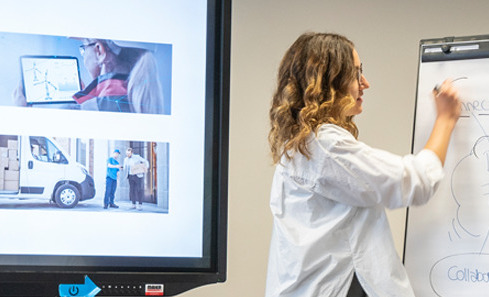
In this interview, HR Manager Leonie Hlawatsch and Team Leader Michael Goldschmidt provide insights into the doubleSlash "LEARN" training model.
Why is further training such an important topic at doubleSlash?
Leonie: Further training not only means accompanying and promoting talented individuals on their path, but also providing the right framework for individual further training.
Michael: Developing and sharing know-how is an integral part of our corporate DNA. Everyone wants to learn and grow with others, even at work. doubleSlash offers many opportunities for this, such as our annual TechDays, internal workshops run by colleagues for all employees and participation in external training courses and conferences.
How is further training organized at doubleSlash?
Michael: There used to be a time quota for "self-study" and all employees could also take part in internal workshops or give presentations themselves during working hours. In addition, individual training courses were held after consultation with the employee's own manager. Decisions on this and the budget were managed by the management team.
Leonie: Today, the process is more open, transparent and individual. Employees can continue their education according to their own needs or those of the team. It doesn't matter whether this is through self-study, participation in training courses or conferences. Another important change: the teams are responsible for their own training budget. Participation instead of top-down decisions - that was important to us. This allows the teams to decide, based on their team vision, which training courses suit them best and who from the team should take part.
Individual training on sensitive topics can still be discussed individually and confidentially with the manager and initiated. In these cases, the budget is provided directly by HR.
How did the LEARN model come about and what is special about it?
Leonie: Our training activities have always been very diverse, but not yet fully transparent within the doubleSlash team. For example, employees could not see who was actively working on which training courses or planning them for the future. As a result, we were unable to fully exploit our potential for synergies or promote the exchange of information on further training.
The new model offers more freedom and thrives on exchange within the team and beyond, communication with each other and common goals. It makes dialog an integral part of the process and promotes aspects of our culture that are particularly important to us: Responsibility and participation.
Michael, you and your team were part of the doubleSlash LEARN model for a year. How did you go about it?
Michael: We defined the framework parameters in advance and continuously fine-tuned them together with HR. More transparency and flexibility for the teams, with as many advantages of the current model as possible and no disadvantages for colleagues - these were the target criteria we set ourselves.
It quickly became clear that trust and courage from all sides would play a decisive role. Transparency and flexibility bring freedom and opportunities, but also responsibility and obligations. Today, the entire team decides on further training and also demands active knowledge transfer from the participants.
During the trial year, this dialog with each other was important. Not only was a new model tested, but trust in this model was also strengthened.
The feedback from the team, both at the beginning and during the trial phase, was ultimately decisive for the introduction and acceptance of LEARN, both among employees and managers.
How does LEARN work in practice?
Leonie: We use our agile working tools Jira and Confluence for this. A ticket including costs and benefits is recorded for each training course and then jointly evaluated by the team. Each team then decides on the implementation and results of the respective training courses. Team management and the HR department provide the annual budget for this and provide organizational support as required, both in terms of preparation and implementation. With each training course, our platform for sharing further training projects and experiences grows.
And how is that accepted?
Leonie: One trial year turned into two, and 1.5 years ago it became the company-wide LEARN rollout. We experience the positive effects every day and how our LEARN model itself encourages learning: Taking responsibility in the team, maintaining and promoting open exchange, reflecting on, planning and also implementing our own further training.
Today, 210 training courses and 464 LEARN tickets later, we are constantly developing the model further with feedback from colleagues. A rollback to the previous approach has not yet been proposed.
Authors: Leonie Hlawatsch & Michael Goldschmidt