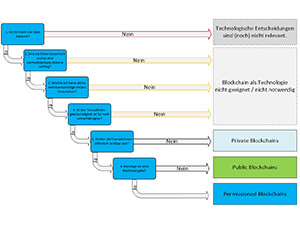
To make it easier to assess whether the current trend is also suitable for your own problem, there are various Decision models. These models use a set of questions to try to clarify whether blockchain should be used.
A large selection of models can be found in Sebastien Meunier's blog post on Medium.com, among others, and we would like to take a closer look at some of the models in this blog post [1].
Blockchain decision model of the World Economic Forum
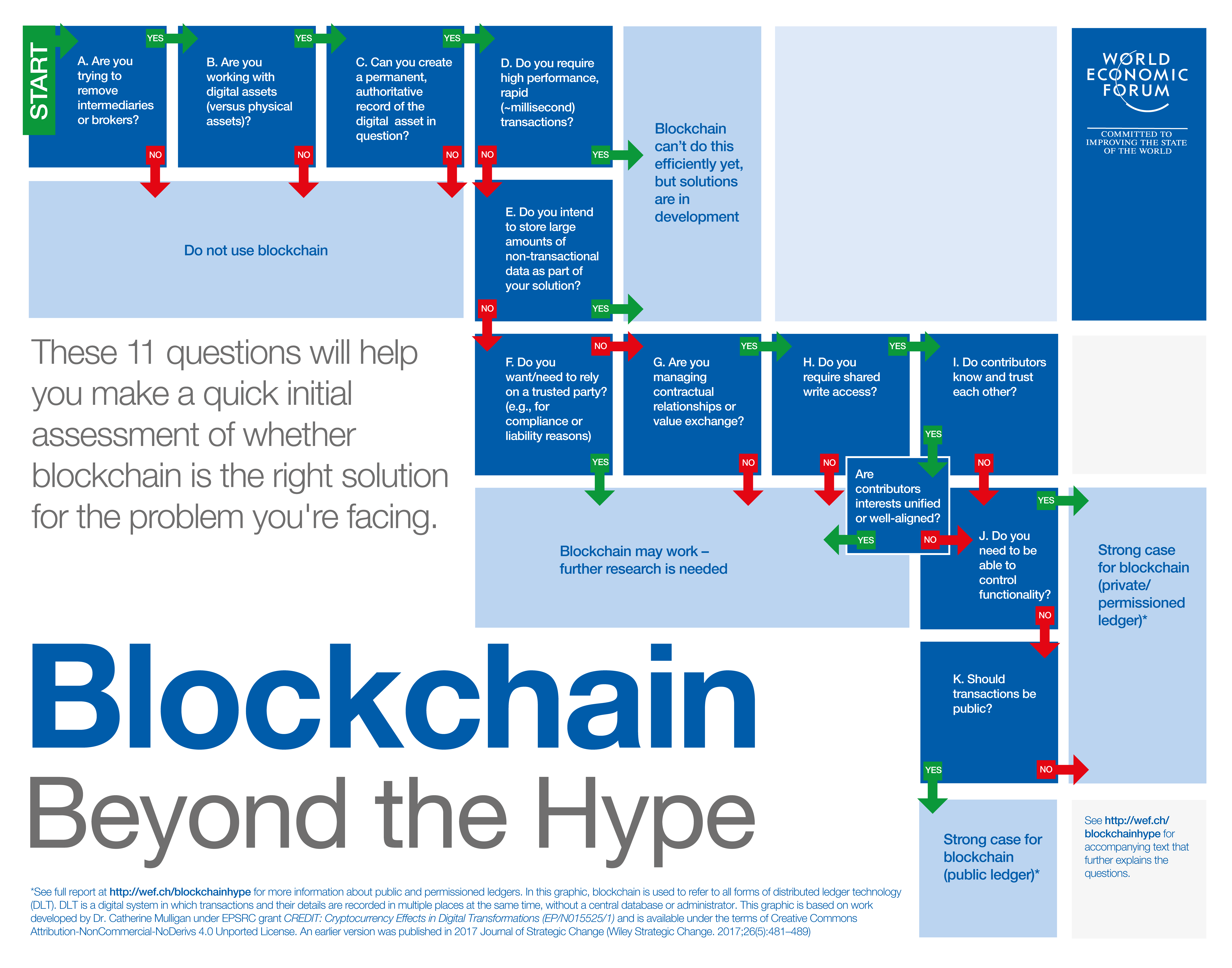
Founded in 1971, the World Economic Forum (WEF), is home to a large number of international members from all sectors who can draw on a wealth of expertise. The decision model shown below was created and developed by Dr. Catherine Mulligan. It offers many detailed questions that follow a clear structure. The first two questions in particular set this model apart from others (see chart).
With question A, the WEF experts refer to whether you want to outsource intermediaries, such as banks, from your processes. With the help of the blockchain, transactions would only be carried out directly between companies and individuals and no extra intermediary would be necessary.
Question B considers whether the Goods (assets) of a company in are suitable in relation to blockchain. In order to be able to use blockchain as a technology, it should be digital goods trade. This means that the assets must be able to be represented in a digital format. Storing physical assets that can change their form on a blockchain is an extremely difficult and complex undertaking that cannot be implemented in a meaningful way at the moment.
Source: https://www.weforum.org/agenda/2018/04/questions-blockchain-toolkit-right-for-business [2]
Blockchain decision model according to Tommy Koens and Erik Poll
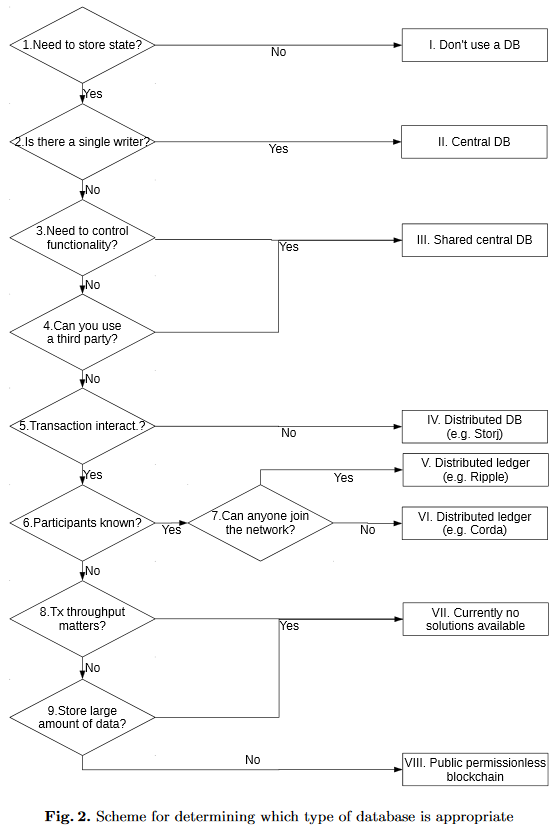
The decision-making model developed by Tommy Koens and Erik Poll is based on a Analysis of many different decision models. They have classified and evaluated the various models and developed the model shown below on this basis. Instead of simply pointing out whether blockchain should be used or not used, here Alternatives are shown which could be used instead of data storage in a blockchain (distributed ledger).
The key question in this model is the fourth question: "Can you use a third party?". It is also the question which Trust in the decision-making process is incorporated. The Blockchain technology makes trustworthy third parties superfluous, as the blockchain itself is sufficient as a trustworthy authority. However, if there is the option of using a trustworthy third party to handle transactions for you, you should rely on them. According to Poll & Koens, the Investments for smart contracts, connection to the blockchain and the risk of error are disproportionate. The trusted third party alternative should therefore be preferred.
You can find the complete work of Tommy Koens and Erik Poll at [3].
Source: http://tommykoens.com/wp-content/uploads/2018/09/blockchain-alternative.pdf [3]
Birch-Brown-Parulava decision model
The Decision model according to D. Birch, R. Brown and S. Parulava was created when the three colleagues worked together on a white paper. The focus of the model is less on the technological aspect of blockchain and more on the Distributed ledger concept itself. So if it has already been decided that blockchain will be the technology used, the model supports you in finding the appropriate ledger type. Decisions are made on the basis of the user groups and how data integrity is to be guaranteed.
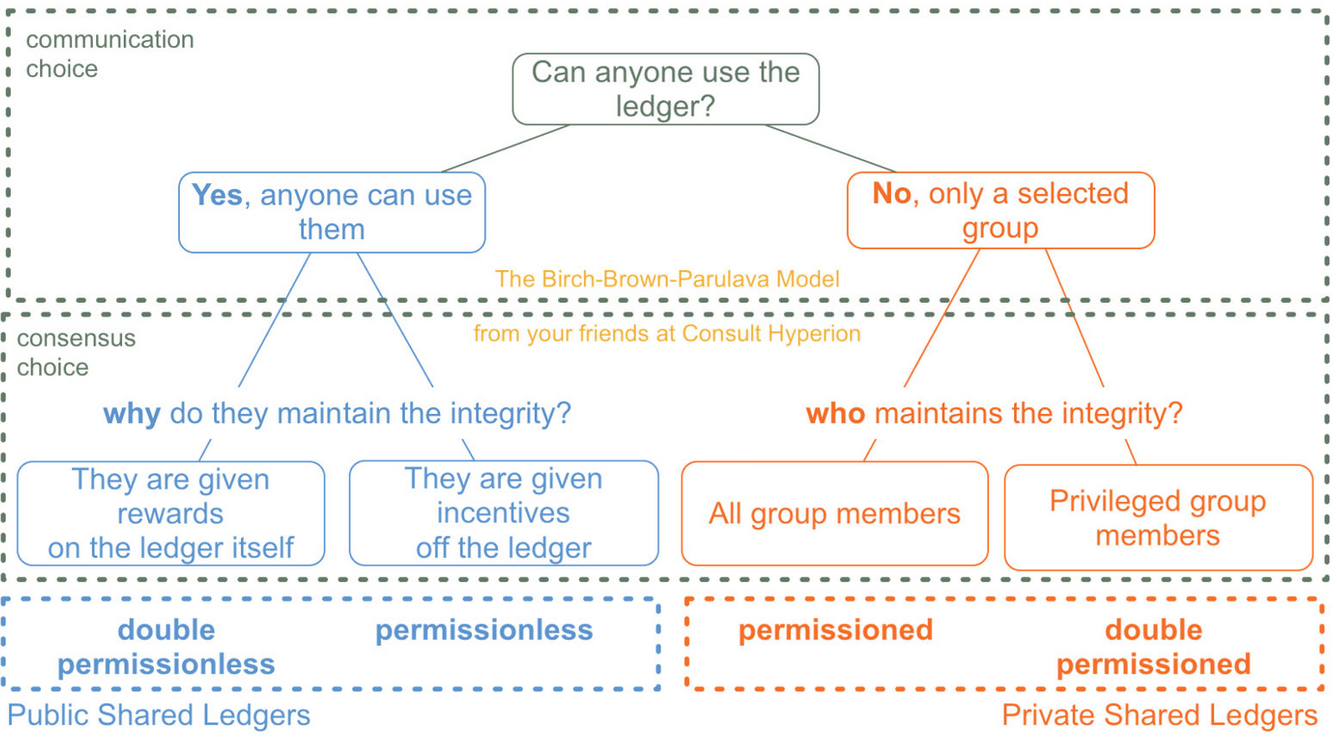
Source: https://www.chyp.com/a-legacy-of-transparency/ [4]
Model similarities & the doubleSlash consulting approach to blockchain
The individual decision models pursue different objectives, evaluate details at different levels and sometimes contain a great deal of information. Therefore, a variety of models tends to confuse rather than clarify the question of whether blockchain could be relevant.
In our view, all decision models have commonalities that can be used to determine whether blockchain is the right technology for a problem. We have compiled these commonalities in a new model and added questions relating to blockchain types.
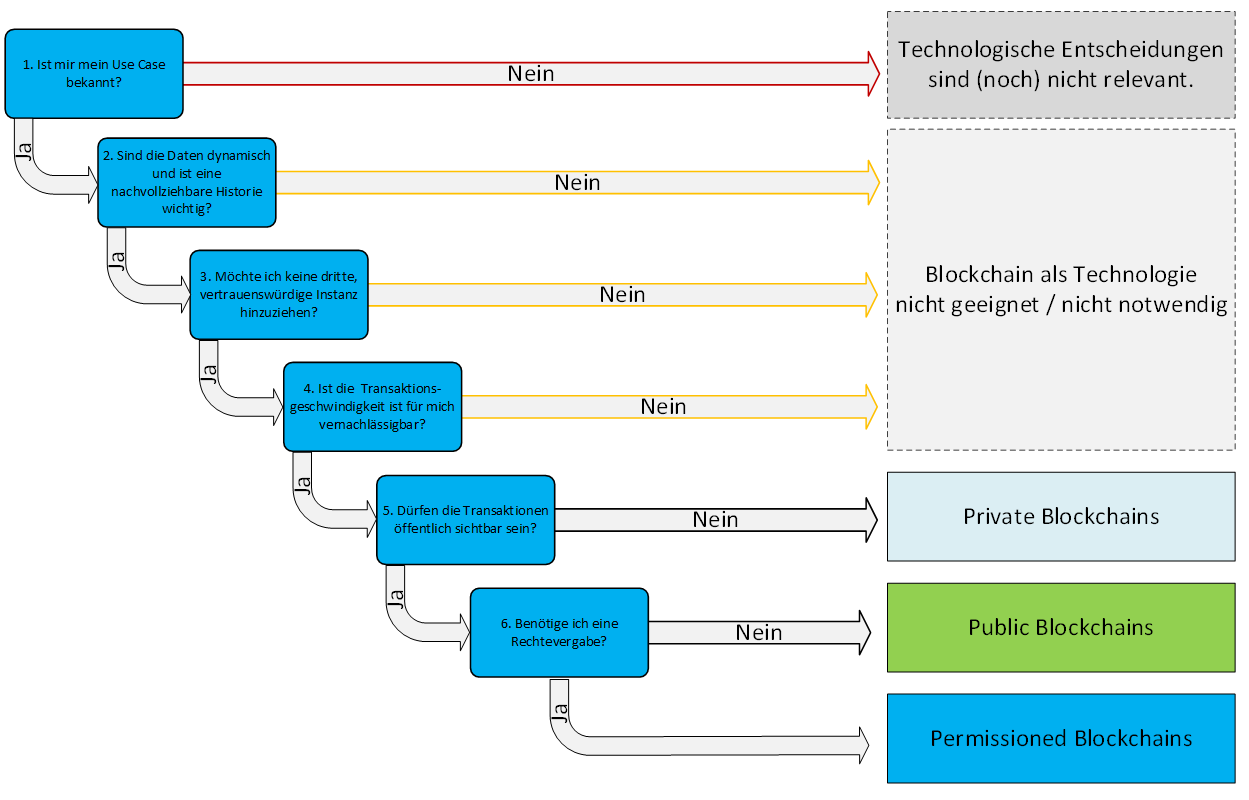
As can be seen from all models, blockchain is not suitable for all types of data storage. It must be carefully weighed up whether it makes sense to use blockchain or to fall back on more suitable alternatives. However, if blockchain is suitable for the given use case, you should definitely bet on the trend.
We will be happy to advise you on any questions you may have about blockchain.
Co-author: Patrick Kratzer
Get more information about blockchain here
You might also be interested in these blog posts:
One blockchain to have your say, please!
Blockchain and cryptocurrency: why haven't any lucrative business models been found yet?
Sources
[1] https://medium.com/@sbmeunier/when-do-you-need-blockchain-decision-models-a5c40e7c9ba1
[2] https://www.weforum.org/agenda/2018/04/questions-blockchain-toolkit-right-for-business
[3] http://tommykoens.com/wp-content/uploads/2018/09/blockchain-alternative.pdf