In Part 1 of our blog post focused primarily on the sensors in the vehicle, in Part 2 dealt with the topic of V2X presented. In the following, the topic of autonomous driving is examined from the perspective of maps, connectivity and vehicle networking.
Over-the-air map material: orientation for the autonomous vehicle
2016 bought Audi, BMW and Daimler use the "Here" map service from the Finnish Nokia Group. This is shown by the Relevance of map material. The three car manufacturers have joined forces to prevent the Key technology for navigation, assistance systems and autonomous driving falls into the hands of Google or another Internet company.
But why is map material so important? Not only for navigation, but also to validate environmental information recorded by other sensors. The software in the vehicle then takes maps generated by sensors, combines them with the existing high-resolution maps and derives important conclusions from this.
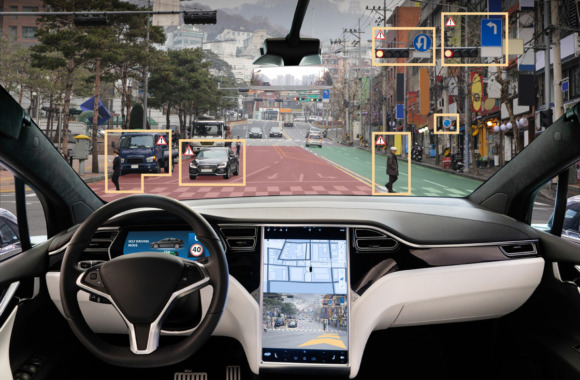
Autonomous vehicles have gained in importance Combination of 3D maps, radar sensors and live camera images an exact picture of their surroundings. If, for example, lane markings are no longer available in snowy conditions, the Orient the vehicle to the surroundings. Tesla uses its own fleet of vehicles sold and a clever "swarm function" in its software: for example, all Tesla Model S vehicles currently on the road are constantly collecting data and making it available in the cloud. This information is uploaded in real time and made available to all other vehicles that are also traveling on this route or in this area. For example, information is provided about sudden rain or snowfall, roadworks, breakdowns or accidents.[1] This is where the topic of data economy becomes relevant, which is discussed in the conclusion.
5G: connectivity and software update over-the-air
Die Zeit writes"The self-driving car needs 5G". And Vodafone spokesperson Markus Teubner describes the performance of the next generation of mobile communications as follows: "5G enables the Real-time data transmission with a delay time of just one millisecond. That's shorter than the blink of a human eye." Tomorrow's transmission technology must be geared towards the Orientation to the requirements of the human eye and the senses of touchThe experts explained with regard to the self-driving car, which has to react just as reflexively as a human driver in critical situations[2].
That Vehicle functions can already be improved "over-the-air" (OTA)The influential US consumer magazine "Consumer Reports" initially refused to award the Tesla Model 3 its "Recommended Buy" seal of quality because the brakes were too weak. After the manufacturer made improvements with a software update, the coveted seal has now been awarded after all. According to the magazine, the braking distance Update carried out online can be significantly shortened[3].
The acceleration values could also be improved without a visit to the workshop. Accordingly, the Model S 100D accelerated from 0 to 100 km/h in 3.3 instead of 4.3 seconds. For the Model X 100D, 4.5 instead of 4.9 seconds were specified for the sprint to 100 km/h.[4]
When you consider that the Focus on autonomous driving increasingly shifting towards software OTA updates are a key technology for the vehicle fleet - especially when responsibility shifts from the driver to the vehicle. Here, a faulty software version could have fatal consequences and it must be possible to rectify errors as quickly as possible.
Digital twin and data economy
For the analysts at Gartner, the topic of digital twin is one of the most Ten top technology trends (as of 2017). All German car manufacturers are currently pressing ahead with the topic. The digital image can be checked quickly and easily, whether and how a part can be retrofitted and whether it is compatible with the rest of the vehicle. The benefits start in product development, continue through production and end in aftersales, for example in the planning of recall campaigns[5].
With Digital Twin, real objects and processes are given a virtual software mirror image in the digital world. Digital Twins can help to manage real vehicles during their life cycle. Especially in the transition of responsibility from human to vehicle, the possibility of a important to provide complete proofto prevent potential errors and identify safety-relevant trends across the entire fleet.
In the context of autonomous driving, the data collected by the Digital Twin is naturally also of interest for third-party applications. To this end, BMW launched the telematics data platform BMW CarData was launched with the aim of Provide telematics data recorded by the vehicle. As required by the EU GDPR, customers therefore have full transparency when it comes to their own data. And Partner companies can use this to develop additional beneficial services for customers. Of course, data should only be passed on to the partner companies if the Customer has explicitly agreed to this has.
While it was previously common for vehicle manufacturers such as BMW and others to sell material goods, they are increasingly investing in Digital business models. The IT systems required for this must be developed and seamlessly integrated into the existing infrastructure. The Topic "Subscription Management" or "Billing and Payment" for billing the services are frequently discussed in this context.
When it comes to autonomous driving, it is crucial that third parties such as insurers or service partners can access vehicle data and that the provision of data enables lean processes in order to provide an optimal customer experience. This makes it possible, for example, to integrate service partners who take care of the Maintenance of autonomous vehicles take care of it, Design simply.
Conclusion
Vehicle connectivity and the ability to quickly update map material or control unit software in the vehicle via 5G is a crucial building block towards autonomous driving. Weak points in assistance systems, for example, can be rectified quickly and without costly recalls. The Digital mirror image of the vehicle enables a Real-time assessment of the vehicle's condition. However, this data will not only be used by OEMs, it will also enable third parties to offer new services.
It will be exciting to see how the technologies develop and how quickly autonomous driving will become established. However, there are still many Mastering challenges and gain experience.
For us as an IT service provider, the field of autonomous driving offers many exciting challenges. This applies to the projects in which we are active in requirements management and software development. But it also applies to the high non-functional requirements for the Performance and scaling of the required backend systems and the required infrastructure.
to Part 1 Core technologies for automated driving: Sensors and sensor fusion
to Part 2 Core technologies for automated driving: V2X
Further information on the topic of autonomous driving can be found here.
Are you interested in the field of Future Mobility? Then apply to us now as a consultant or software developer.
[1] http://www.auto-nomous.com/meinung/kartendienste-als-schluesseltechnologie-fuer-das-autonome-fahren/
[2] https://www.zeit.de/mobilitaet/2016-04/autonomes-fahren-mobilfunk-5g-echtzeitdaten/seite-2
[3] https://www.kfz-betrieb.vogel.de/bremsprobleme-des-tesla-3-mit-update-over-the-air-behoben-a-720627/
[4] https://teslamag.de/news/sekunden-update-beschleunigungswerte-model-s100d-16834
[5] https://www.computerwoche.de/a/wie-unternehmen-von-einem-digitalen-zwilling-profitieren,3544454