
A standard contract is a written agreement/service between two parties. The benefits or services from the contract are due under certain conditions. But how do standard contracts become Smart contracts?
What are smart contracts?
Put simply, smart contracts are programs that are based on the Blockchain run.
The stored program code checks and processes the requests automatically and triggers the benefits/services without the involvement of an intermediary, i.e. a mediator between creditor and debtor.
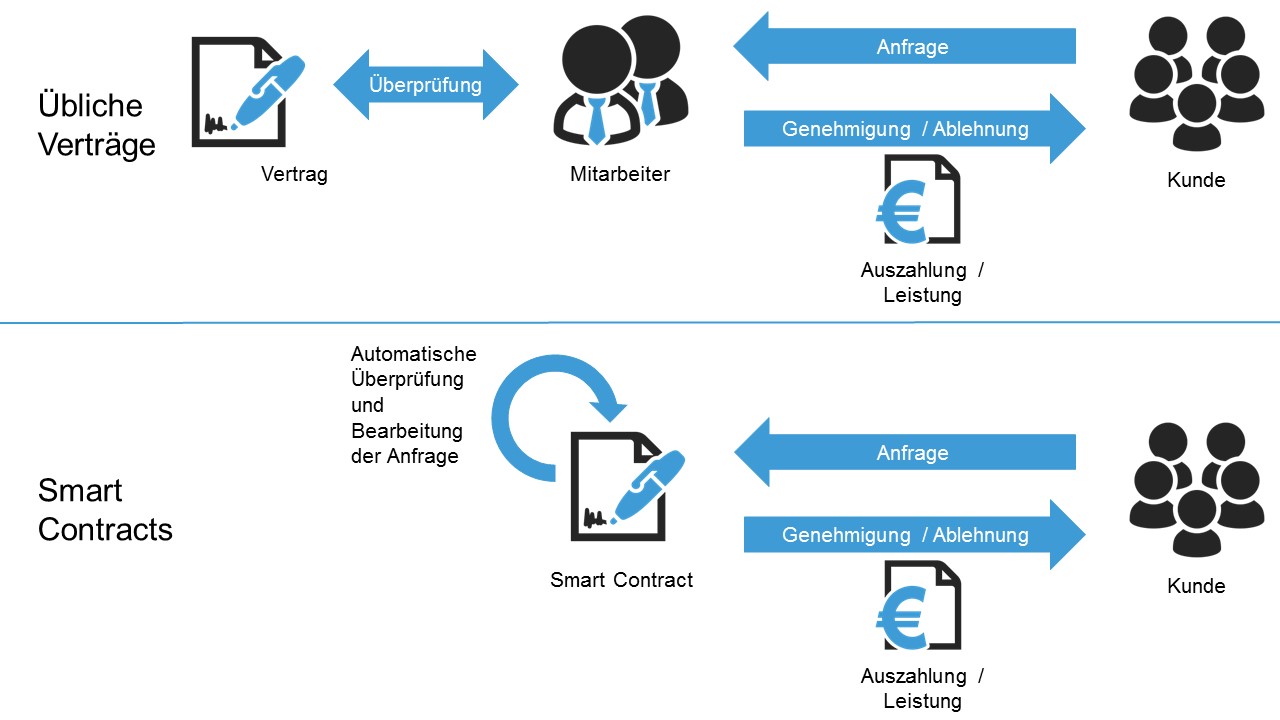
Solving smart contracts Actions such as payouts or digital services independently and automatically based on stored rules from. There is no need for an intermediary to check the request and initiate the actions. The concluded smart contracts contain a Logic (program code). This is executed when the corresponding event occurs. The smart contract processes requests strictly according to the defined and identical rules. Therefore, the same result is always achieved for the same requests. Smart contracts only work with Cryptocurrencies such as Bitcoins or Ether and not with real currencies.
To make the functionality a little clearer, here is an example of parking. Smart contracts can take over the calculation and payment of parking fees.
In this scenario, the driver of the vehicle concludes a smart contract with the parking lot operator, which allows them to use the parking lot for a fixed fee.
The driver drives his vehicle to a parking space that can be used with a smart contract. He then concludes the smart contract with defined rules.
These could be the following rules, for example:
- One hour's parking costs €5.
- You must park / pay for at least 15 minutes, maximum 20 hours.
- A maximum of €100 can be transferred, with a minimum of €2.
- When the driver finishes parking, the remaining amount is refunded to the exact minute.
Based on this set of rules, the user can use the service in the way that suits him best.
The advantages of smart contracts
A key advantage of smart contracts is that they are always accessible. Smart contracts can process requests around the clock (24/7). The fact that an employee's tasks, such as processing inquiries or making payments, are taken over by a smart contract means that personnel costs can be saved and the speed of processing increased.
Furthermore, smart contracts several guarantees. On the one hand, there is the guarantee of Equal treatmentbecause every request is treated according to the same rules in the contract.
Secondly, in order to use smart contracts, you usually need No additional devices or powerful end devices. Normally, smart contracts can be concluded and used via a browser or an app. The computing power is then provided by the blockchain or the service provider.
The next point can be seen as both an advantage and a disadvantage. An actually fair characteristic of smart contracts is that all requests are always interpreted according to the same rules. As a result, smart contracts have no leeway and therefore the same or similar requests always produce the same result. Humans, on the other hand, can interpret rules or contracts in a different way depending on the case. This Interpretation of the contract with human judgment is necessary, justified and also advantageous in some situations. Smart contracts are unsuitable for such scenarios.
With the help of smart contracts, new business models can be enabled or supported in the future. One of these, for example, is the autonomous drivingas for this also autonomous transactions are required for charging, parking, tolls or similar. Smart contracts allow users to authorize their vehicle to use and pay for certain services independently.
Conventional contracts such as sales contracts or employment contracts are not so much replaced by smart contracts, but rather extended by additional functions, as there are certain requirements for the use of smart contracts. For example, the smart contract must all relevant data digitally available stand. In the case of parking, the relevant data includes an ID to identify the user, the tariff used and the parking duration. Based on this data, a smart contract can calculate the use of the parking space and make the payment immediately.
One possible application for the implementation of smart contracts is demonstrated by the cooperation between Slock.it, a company specializing in blockchain and IoT and the energy supplier RWE. They are planning to Payment process for the charged electricity with smart contracts. The smart contract takes over the tasks of the Activation of the service (charging station is activated for charging the car) and the Billing (calculate costs and make the payment). Billing is carried out using the cryptocurrency Ethereum. The driver only concludes the smart contract and can then use the Use and pay for cashless services quickly.
In addition to the positive aspects of smart contracts, there are also features that can be viewed negatively or are still subject to a question mark. These include, for example legal aspects of smart contracts. One major disadvantage is the "online constraint".
Some negative points are closely linked to the fundamental Blockchain technology on which the smart contracts are based. For example all data public (public) is stored in the blockchain. Via the Public Key of a user, the transactions made can be tracked by third parties via the blockchain. However, no further information about the user can be found via the public key.
One danger that can occur with all technologies is Manipulations or hacks. In the case of smart contracts, this concerns the technology behind them - the blockchain. However, it has been shown that the blockchain is very difficult to hack (see article: One blogchain to have your say). With smart contracts, there is more of a risk that a Gap in the program code is discovered and exploited. An example of an error that can be caused in a smart contract is shown in the DAO hack. A hacker exploited a bug in the smart contract code and was able to steal around 50 million dollars. The hack shows how important the Logic of a smart contract is. There is also another risk in the program code: If, for example, a price is incorrectly stored in the program code higher than specified (e.g. 10 euros instead of 10 cents), the wrong price is calculated in the program code and payments are also made. With smart contracts, there are No human plausibility check to detect such errors, all requests are processed strictly according to the logic of the smart contract.
Do smart contracts have the potential to become established in the future? Or do the problems and uncertainties outweigh the legal aspects? The direction in which smart contracts are heading will also depend heavily on dependent on the development of the blockchain as smart contracts are based on this technology.
Smart contracts could Basis for new business models or have an impact on existing ones and expand them. The greatest potential here most likely lies in Insurance companies and banks. Here, some central tasks such as concluding contracts, processing inquiries, transfers or payment verification could be taken over by smart contracts or the blockchain. There are already First pilot projectsthat work with blockchain databases and smart contracts. The probability that we will come into contact with smart contracts on a daily basis in the future is therefore relatively high, as in the parking process example above.
However, for smart contracts to be successful, the legal framework must be clarified so that users and providers have certainty. The open questions, such as: "Is it a criminal offense to exploit the programming error or is the hacker entitled to the money, as in the case of a legal loophole?", need to be clarified before smart contracts can become socially acceptable.
The fact is that there is a lot of potential in blockchain and smart contracts. It therefore makes sense to intensify our understanding of these technologies and invest in them.
Read more about blockchain and smart contracts in our Computerwoche article
Does blockchain suit my business? Learn more here