
It becomes problematic when contracts are "written" in a programming language. This applies in particular to smart contracts, which have enormous potential but can hardly be classified as a legally valid contract due to the lack of a legal framework and the incomprehensibility of the content. We would like to present the Ricardian Contract as a solution to this problem and some other useful applications.
What are Ricardian Contracts?
The concept of Ricardian Contracts was developed in 1995 as part of the Ricardo payment system by Ian Grigg and Gary Howland. They used it to implement a system for trading bonds and are now regarded as pioneers of financial cryptography. During their work, they realized that bonds and all other financial instruments are essentially nothing more than contracts. Their structure consists of a Combination of parameters (i.e. name, coupon, date, etc.) and legal texts together. As a result, they designed a document that could be read by both humans and machines, defined and digitally signed by the issuer of the instrument. They called this document the Ricardian Contract. Ian Grigg defines the Ricardian Contract as follows:
- A contract issued by a debtor to a creditor.
- The creditor thus acquires a right to a value that is determined and managed by the issuer.
- The contract is easy for people to read - just like a normal contract on paper.
- The contract can be read by machines.
- The contract is signed digitally.
- The contract contains a key and server information.
- The contract is linked to a unique and secure identifier.
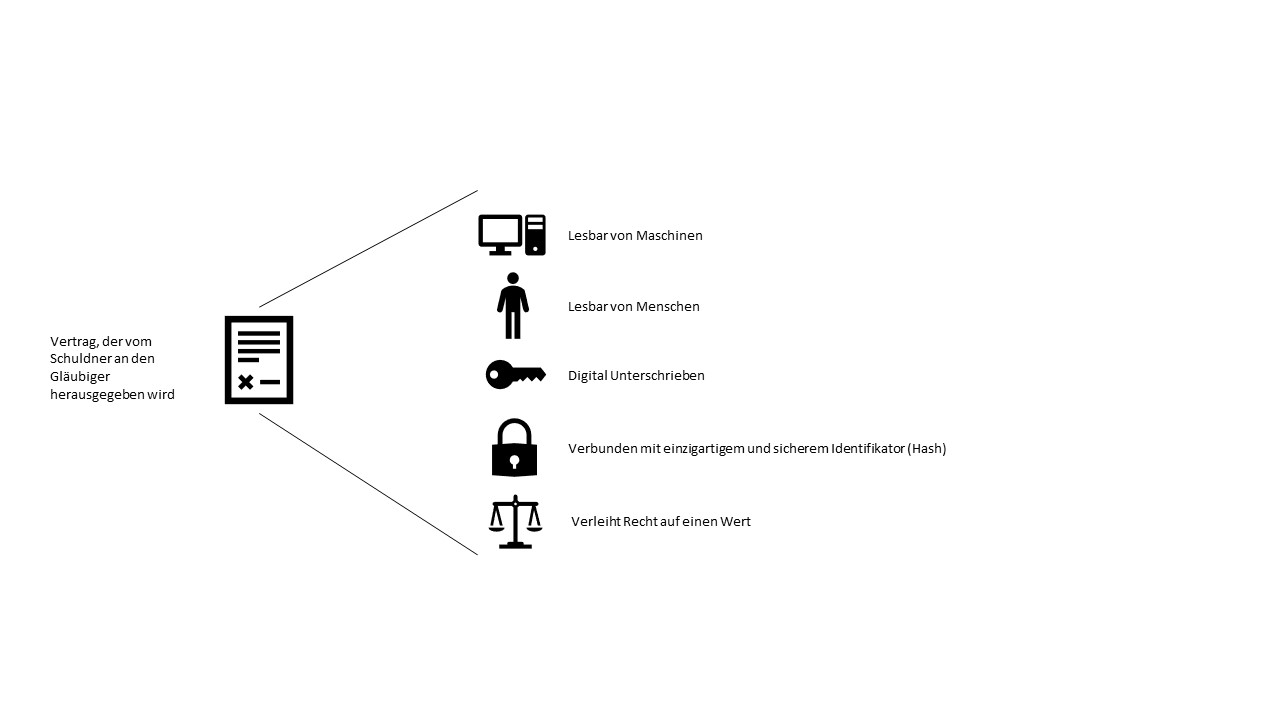
The Contract is in a simple Text file and can be written down with the insertion of a Markup language can be read by programs. As digital Signature the publisher signs the contract in the OpenPGP Klartext Form with its Private Key. This confirms the content of the contract and makes it a binding offer. With the help of the private key, the Contract participant traced and be held accountable. It also links the entire chain of OpenPGP keys so that programs can immediately authenticate and verify the document. To uniquely identify the contract, each user can calculate a summary of the plain text, in the form of a Hash value (public key). This hash represents the content of the entire document in a relatively short number. The hash is stored in each transaction and forms a secure and unforgettable link to the management system. Each document has its own unique hash value.
Advantages of Ricardian Contracts
- In many contracts, a phenomenon can be observed that goes by the name of Frog boiling has become known. Here the stronger contractual partner (issuer) usually changes the terms of the contract over timeas soon as it can gain an advantage. The hash identifier of the Ricardian contract opposes this. This is because the hash is linked to the content of the contract and would also change if the contract were changed. The hash of the corresponding contract is also integrated in the records (such as invoices, payments, balance sheets, etc.) and this cannot be changed without losing the ability to pass a signature verification test. In addition, the contract would lose its relationship to all previous signed and issued records.
- Further advantages result from the Integration of the public key infrastructure into the contract itself. This ensures that:
- client software can automatically verify the entire digital signature chain at once.
- No third-party provider is required to organize the PKI, which is reflected in the security aspects and costs.
- The issuer cannot dispute the content or its signature once the contract has been consolidated through frequent use by users.
- The use of a Hash value as identifier ensures the assumption that only people who can interpret the hash really have a contract.
- For smart contracts to be used as legally effective contracts, there needs to be a way of putting the content into a form that people can understand. This is because it must be ensured that all contracting parties as well as lawyers, judges and other stakeholders understand what the contract says. It is also necessary to regulate what should happen if unforeseen circumstances arise that have not been taken into account in the smart contract or are too complex to be fully mapped. The solution is the Merging smart contracts with Ricardian contracts. Combined into a single object, the programmed code on the Ethereum blockchain can refer back to an external document that describes the contents of the contract and records the legal clauses. The result is a contract consisting of a code for automation, a legal text and parameters - also known as a Ricardian Tripple.
Challenges with Ricardian Contracts
- To sign the contracts Private Keys is used. Although this is a very secure way to sign documents electronically, it violates the legal regulations and requirements for an electronic signature. Outsiders would have no way of judging who used the private key and whether this person knew that using it was tantamount to signing a document electronically. Legally binding signature.
- Even if it were theoretically possible to conclude Ricardian Contracts completely anonymously, it would not be possible to assert this in court. The situation is different with Pseudo-anonymityFor example, an identity that can cryptographically prove its existence and authority, but otherwise does not disclose any information about itself. This principle is widespread in the blockchain environment and is not necessarily an obstacle to a legally valid contract.
- Another point is that Ricardian Contracts have only been used by companies in isolated cases to date and are therefore still little practical experience exist. In particular, there is a lack of court rulings to demonstrate the actual effectiveness of Ricardian contracts.
Application examples
| Projects / Industry | Description |
| OpenBazaar / E-Commerce | The project stands for a digital marketplace that is completely decentralized. Transactions are carried out peer to peer and with the help of Ricardian Contracts regarding invoicing, acceptance, payment, etc. Only cryptocurrencies are used as a means of payment. |
| Open-Transactions | At the heart of the project is the question of how transactions can be carried out without having to trust a third-party provider. Blockchain has made this possible, but transactions via it are slow and comparatively expensive. With Open Transactions, it is possible to obtain the advantages of server-side implementation without having to trust a third-party provider. Various financial instruments are supported, which are implemented with Ricardian Contracts, among others. |
| CommonAccord | The aim of the project is to create a way to combine smart contracts with Ricardian contracts and ultimately obtain a legally binding contract. This works by providing users with a database of legal texts that are linked to small snippets of code. |
Conclusion
Even if the Ricardian contract concept already around 25 years old it possesses through the increasing desire for Automation and digitalization more relevant than ever. With the help of smart contracts, it has been possible for the first time to allow complex contract processing to be carried out completely autonomously by machines. This saves a lot of time and effort in many areas and can form the basis for new business models. Nevertheless, people without an understanding of code must be able to understand exactly what has been decided in the contracts. Therefore, on the way to the widespread implementation of Smart contracts There is still one major obstacle to overcome: Bringing together executable computer code and human-readable prose. These must be closely and immutably linked, with the prose text forming the basis for the contract. The Ricardian Contract is a promising way of doing just that. Through the cryptographic approach However, there are both advantages and challenges. The future will show whether the weaknesses of the concept can be remedied and whether the strengths can also be implemented well in practice.
You might also be interested in these blog posts:
Smart contracts - what's behind the smart contracts
Blockchain and cryptocurrency: why haven't any lucrative business models been found yet?
Using blockchain applications to create added value
Sources:
- https://iang.org/papers/fc7.html
- https://iang.org/papers/intersection_ricardian_smart.html#ref_wip
- https://www.youtube.com/watch?v=wokvO1ptE1k&feature=emb_title
- https://bitsonblocks.net/2016/11/22/in-a-nutshell-ian-griggs-ricardian-contracts-and-digital-assets-prehistory/