
What exactly is behind the two terms and what role they play in the salary formation process for modern companies can be in this blog post can be read here.
Why is a participative approach to the employee feedback process so important?
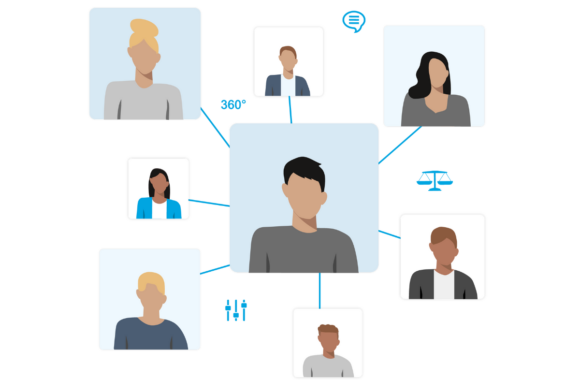
A participative approach to the feedback process actively involves employees in the evaluation and development process. This leads to greater motivation and satisfaction. A 360-degree feedback approach extends this by integrating assessments from different perspectives - from colleagues and managers. This not only promotes a more comprehensive and objective assessment, but also strengthens the feeling of appreciation and participation among employees. Greater participation promotes trust and transparency within the company, which ultimately contributes to greater employee loyalty and a more sustainable corporate culture.
The background: Why feedback and participation are important to us at doubleSlash
The idea for the doubleSlash employee assessment tool originated from an internal working group. As an IT service provider, our core business is advising customers and supporting them in their digital transformation. We have used this experience and expertise from the consulting business to develop software that corresponds to our own values and internal guiding principles. Our aim was to create a tool that supports companies in establishing a transparent, comprehensible and participatory evaluation process that meets the requirements of the modern job market.

The feedback tool: An overview of the software
The doubleSlash assessment tool supports companies in implementing a participative assessment process. It offers a variety of functions that are specifically designed to enable a holistic and differentiated assessment of employees - regardless of whether it is a skills assessment for salary formation or the filling of key positions.
The 360-degree feedback tool integrates feedback from various stakeholders and thus ensures a comprehensive assessment of employees. Assessments are carried out by the manager and by additionally defined peer groups. Peers can be selected by the manager and employee. Self-assessments can also be included. The possibilities here are many and varied. The tool ensures efficient and secure management of employee data in compliance with data protection regulations. By supporting evaluations during the year and aggregating individual evaluations into an overall result, it enables continuous and up-to-date performance evaluation. Standardized evaluation mechanisms and the option of attaching comments ensure transparency and traceability. Thanks to AD integration, the tool offers secure and user-friendly login. It is web-based and mobile, which ensures flexible use.
Functionality and evaluation mechanism: the transformation to New Work and modern remuneration models
Imagine that the evaluation process in the doubleSlash feedback tool is a journey through various stages. Each stage plays an important role in creating a clear and comprehensive picture of an employee's performance. Each stage helps to form a balanced and transparent overall assessment. This takes into account both individual development and contribution to the team.
There are four central evaluation elements in the tool's standard model. The weighting of each evaluation element can be set individually - we currently use the following:
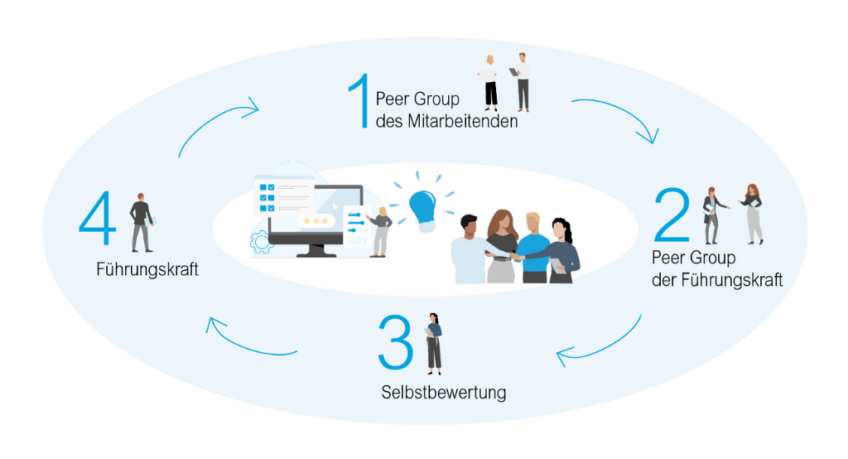
- Manager evaluation (60 % of the overall assessment): The manager contributes their perspective on the employee's performance and potential, thereby laying the foundation for the assessment.
- Evaluation of the peer group selected by the employee (15 % of the overall assessment): Employees have the opportunity to select colleagues themselves to evaluate their work and skills from a different perspective. This creates a diverse picture.
- Self-assessment (10 % of the overall rating): Your own assessment should not be missing. Employees reflect on their own performance and give this partial assessment a personal touch.
- Evaluation of the peer group selected by the manager (15 % of the overall assessment): Finally, the manager selects additional peers to gather further insight and input. This assessment adds additional valuable perspectives to the overall picture. Peers can of course also belong to both peer groups.
This process is flexibly customizable. Companies can change the weighting of the individual evaluation groups or add new evaluation groups in order to adapt the evaluation process to their individual needs. This flexibility guarantees that the evaluations are comprehensible and reflect precisely the aspects that are most important for the respective company.
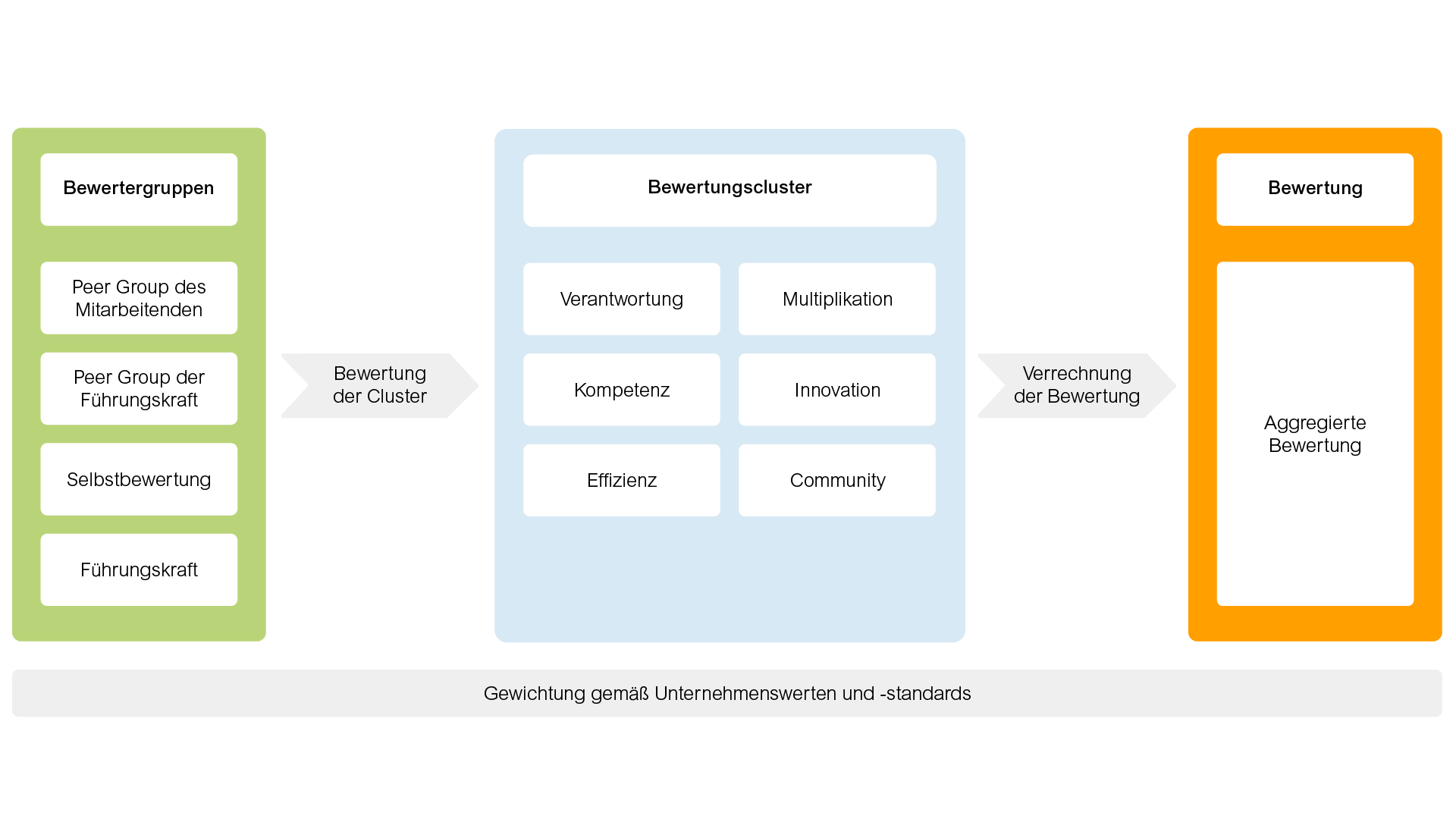
The doubleSlash feedback tool is designed so flexibly that companies can adapt the weighting and composition of the evaluation groups to their specific requirements. Each evaluation group provides valuable information, which we summarize in the form of "evaluation clusters". These clusters represent different aspects of an employee's performance and form the basis for a holistic assessment.
In the standard model, these clusters are composed as follows:
- Responsibility and reliability: This is the largest and most important component that shows how reliably and responsibly employees act.
- Competence, knowledge and quality: This is where the skills and specialist knowledge of employees are assessed, which are decisive for their work and its quality.
- Economic success and efficiency: This cluster evaluates the contribution of employees to the company's success and their efficiency in their daily work.
- Knowledge transfer: How well employees pass on their knowledge to others and contribute to the further development of the team is recorded here.
- Community, team spirit and innovation: These clusters cover important factors such as the ability to work in a team, the contribution to the corporate image and the willingness to drive innovative ideas forward.
Companies can flexibly weight and combine evaluation groups (who is evaluated?) and evaluation clusters (what is evaluated?). In this way, an evaluation is created that corresponds exactly to your expectations. Whether the aim is to activate only certain evaluation groups or to introduce the evaluation step by step - the tool offers the possibility to individually design the degree of participation and the focal points in the evaluation process.
This adaptability means that companies can use the tool in a variety of ways: for example, to develop managers in a targeted manner, to assess employees in certain project phases or to coordinate new role assignments. The flexibility ensures that each assessment is transparent and tailored precisely to the respective needs - and thus supports a sustainable, modern corporate culture.
Conclusion: if you want satisfied employees, you should focus on participation
The doubleSlash employee assessment tool offers companies a comprehensive solution for establishing a transparent salary and assessment process. The comprehensive integration of different appraiser groups and the flexible adaptability of the weightings ensure a holistic assessment of employees. This contributes significantly to a modern and transparent corporate culture that meets the needs of employees.